Best HELOC Lenders: What the Rate Tables Don't Tell You
By Douglas Wilkerson, Mortgage Broker | Branch Manager, NMLS #1680719 — November 22, 2026
The Short Answer
The best HELOC lender is not the one with the lowest number at the top of a rate table. It is the one with the lowest total cost on the same line over the same ten years — and on that test, the lender ranked first usually loses. As of November 22, 2026, the national average HELOC rate is 8.25% variable, the best advertised rate is 7.49%, and the prime rate every HELOC is built on is 7.00% (Federal Reserve H.15, November 20, 2026). A rate table shows one number per lender — not the margin, the fees, the expiring intro rate, or the payment shock at the end of the draw period. This post prices the same $50,000 draw three ways, with real numbers.
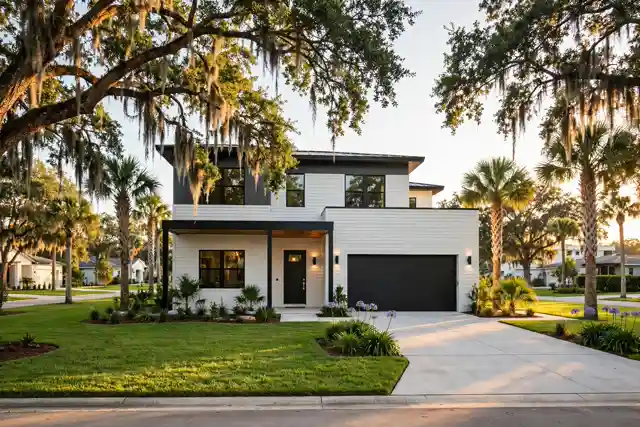
A Jacksonville home with real equity — the lender you pick decides what it costs to use.
Going to check with your bank after this? Don't. Your bank has one HELOC on one shelf, priced with its overhead baked in. A broker shops 200+ lenders and prices your file against all of them.
What one borrower told us: "Doug was thorough, knowledgeable and always set me up to succeed. His experience shined with how fast he was able to close on my VA loan. Highly recommend using his services to purchase your new home!" — Chris C., Google review, July 28, 2026
How a HELOC Rate Is Actually Built
Every HELOC rate is an index plus a margin. The index is the prime rate — 7.00% as of November 20, 2026, per the Federal Reserve's H.15. Every lender uses the same prime rate; the margin is where they differ — and where they make their money. A lender at 7.49% is charging prime plus 0.49%; at 8.25%, prime plus 1.25%; a credit union at prime plus zero charges 7.00% flat. Prime moves when the Fed moves, and your rate moves with it.
The Same $50,000 Draw, Priced Three Ways
Take one Jacksonville homeowner: a $400,000 home, a $200,000 first mortgage, a 720 credit score, and a $75,000 line — 68.75% combined loan-to-value, inside the 80–85% cap most lenders use. She draws $50,000 for a renovation and holds it steady through the ten-year draw period, paying interest only:
| A: Big-bank average | B: Best online headline | C: Credit-union style | |
|---|---|---|---|
| Rate (variable) | 8.25% | 7.49% | 7.00% (prime + 0) |
| Source | National average, Nov 22, 2026 | Bankrate survey, week of Nov 11, 2026 | Prime rate, Fed H.15, Nov 20, 2026 |
| Interest-only payment | $343.75 / month | $312.08 / month | $291.67 / month |
| Interest per year | $4,125 | $3,745 | $3,500 |
| Closing costs | $2,000 | $0 | $500 |
| Annual fee | $75 / year | $0 | $50 / year |
| 10-year total cost | $44,000 | $37,450 | $36,000 |
The 7.49% headline lender costs $1,450 more over ten years than the credit-union structure that never tops a table, because tables rank the headline and ignore the margin and the fees. The big-bank average costs $8,000 more on the exact same draw. Same house, same borrower, same $50,000.

Prime plus margin — and the margin is the only part a lender controls.
The Intro-Rate Trap
Some of the lowest numbers in any rate table are introductory rates — discounted for the first 6 or 12 months, then resetting to prime plus the lender's full margin. On the same draw, a 5.99% intro costs $249.58 a month interest-only. When it resets to prime plus 1.50% — 8.50% at today's prime — the same balance costs $354.17 a month: $104.59 more, on money you already borrowed. Before you sign, get three answers in writing: the margin after the intro period, the rate floor, and the rate cap.
The Fees the Tables Hide
A HELOC's rate is not its cost. The standard fee stack is closing costs of 2% to 5% of the line amount — $1,500 to $3,750 on a $75,000 line — plus an annual fee of $50 to $250 a year, charged even if you never draw. Some lenders advertise no closing costs and recover it with a higher margin; others charge early-closure or inactivity fees. That is why the table above prices total cost, not rate: a "no-fee" HELOC at 8.25% costs more over ten years than a $500-closing-cost HELOC at 7.00%.
The Payment Shock Nobody Budgets
A HELOC has two phases. During the draw period — typically ten years — you can borrow, repay, and re-borrow, paying interest only on what you owe. During the repayment period — typically ten to twenty years — the line closes to new draws and the balance converts to a fully amortizing loan. On our $50,000 draw at the 8.25% big-bank average, the interest-only payment is $343.75 a month; when the draw period ends and that $50,000 amortizes over twenty years at 8.25%, the payment becomes $426.03 — an $82.28 jump, about 24%, with no new borrowing. The table shows the draw-period number, never the repayment-period one.

Two Loan Estimates for the same line can differ by thousands over ten years. Compare the whole document, not the headline.
What the Tables Cannot See: Your Score Tier and Your CLTV
Rate tables are built on a model borrower — a 700 score at 80% combined loan-to-value, the basis of the Bankrate survey. Move off that model and the price moves. November 2026 rate-by-score data on a $50,000 draw: 760+ around 7.75% ($322.92 a month); 720–759 around 8.00% ($333.33); 680–719 around 8.25% ($343.75); 640–679 around 8.75% ($364.58). That is $41.66 a month between the top tier and the 640 tier.
The tables also cannot see the gatekeeper number: combined loan-to-value, or CLTV — your first mortgage plus your full line limit, divided by home value. Most big banks want a 680 score or better and save their best pricing for scores above 720. Below that, the bank's answer is often no — but that is the bank's rule, not the market's. Specialty and non-bank HELOC programs go down to about a 600 score, with tighter CLTV caps of 80–85% instead of 90%, no appraisal required on lines up to $400,000, and funding in about five days. At that tier, a $60,000 draw at an illustrative 9.75% costs $487.50 a month interest-only. Full math: How to Get a HELOC With Bad Credit.
The Jacksonville Angle
Northeast Florida is a strong HELOC market for a mechanical reason: homeowners here have equity, and equity is what a HELOC underwrites. Our example homeowner — a $400,000 Jacksonville-area home with a $200,000 first mortgage — holds $200,000 of equity and a 68.75% CLTV on a $75,000 line, the profile lenders compete for. One Florida caution: under Regulation Z, a lender may suspend draws or reduce your limit if your home's value declines significantly, your finances change materially, or you default. And HELOC interest is tax-deductible only when the funds buy, build, or substantially improve the home securing the line (2017 Tax Cuts and Jobs Act, IRS Publication 936) — talk to your tax adviser.
How to Actually Pick the Best HELOC Lender
Forget the sorted list. Run this five-step check:
- Price the same structure everywhere. Same line amount, same draw, same day.
- Get the margin, the floor, and the cap in writing. Prime plus margin is the rate you will live with — the intro rate is a postcard; the margin is the mortgage.
- Add up ten years of total cost: interest at the ongoing rate, plus closing costs, plus every annual fee. In our example, the cheapest headline loses by $1,450.
- Ask what happens at the end of the draw period. Get the repayment-period payment on your balance in dollars — if the lender cannot show you the $343.75-to-$426.03 jump, they are selling you a rate, not a plan.
- Ask whether you are being underwritten to the real guidelines or to one lender's overlay. A broker with 200+ lenders can place a 600-score file or a file a bank just declined — one lender's floor is never the market's floor.

The leverage belongs to the borrower who shops the whole market.
Frequently Asked Questions
What is the average HELOC rate right now?
Bankrate's national survey for the week of November 11, 2026 put the average HELOC at 7.49% variable, on a $30,000 loan, 700 FICO, 80% combined loan-to-value. Broader averages run higher — about 8.25% as of November 22, 2026 — both built on the prime rate of 7.00% (Federal Reserve H.15, November 20, 2026), plus each lender's margin.
Why is the best HELOC rate in the tables not the cheapest HELOC?
Tables rank headline APR and ignore the margin, intro rates that reset, closing costs, annual fees, and the rate floor and cap. Here, the 7.49% headline lender costs $37,450 over ten years while a prime-plus-zero structure costs $36,000.
What credit score do you need for the best HELOC rates?
The best pricing goes to scores above 720; most big banks want 680 or better. Specialty and non-bank programs go down to about a 600 score with tighter CLTV caps and higher rates. There is no federal minimum — each lender sets its own floor.
What happens when my HELOC draw period ends?
The line closes to new draws and the balance converts to principal-and-interest payments over ten to twenty years. On $50,000 at 8.25%, the payment rises from $343.75 interest-only to about $426.03 amortized over twenty years.
Is HELOC interest tax deductible?
Only when the funds buy, build, or substantially improve the home securing the line, under the 2017 Tax Cuts and Jobs Act (IRS Publication 936). Interest on a line used for other purposes is generally not deductible. Consult your tax adviser.
Sources
Bankrate national survey, week of November 11, 2026 — HELOC average 7.49% variable; 15-year home equity loan average 8.76% fixed; basis $30,000 loan, 700 FICO, 80% CLTV. Federal Reserve H.15, November 20, 2026 — bank prime loan rate 7.00%; FRED WPRIME, 7.00%. NerdWallet, "What Is a HELOC?" (September 14, 2026) — draw and repayment terms, closing costs 2% to 5%, annual fees around $50. CFPB guidance and Regulation Z, 12 CFR 1026.40. IRS Publication 936. Freddie Mac PMMS, week ended November 19, 2026 — 30-year fixed 7.28%, 15-year 6.66%. All payment figures are illustrative.
Our Take
A rate table is not a market — it is a leaderboard for one number, built by companies paid when you click the lender at the top. The lenders at the top optimize that one number — the headline APR — with intro rates, margins that reset, and fees the table never shows. As an independent broker, I shop 200+ wholesale lenders, including the credit-union and specialty shelves where prime-plus-zero margins and 600-score programs live. My verdict: the best HELOC lender is the one whose ten-year total cost is lowest on your file, with the margin, floor, cap, and fees in writing. Anything less is a headline, not a price.
If your bank quoted you a HELOC rate this month, did they show you the margin, the floor, the cap, and the ten-year total cost — or just the one number that looks good in a table?
Your Next Step
Check Your Rate — Free — a Personalized Rate Quote: see what rate you qualify for across 200+ lenders, free, with no credit check.
Run the numbers with our mortgage calculators, and read How to Get a HELOC With Bad Credit if your score is below 680. Ready to move? Start your application.
Prefer to talk it through? Call Douglas direct: (904) 517-4049.
Douglas Wilkerson — NMLS #1680719
Direct: (904) 517-4049
[email protected] | [email protected]
1548 the Greens Way, Ste. 4, Jacksonville Beach, FL 32250
Freeman Douglas Corporation is a DBA of Edge Home Finance. This is not a promise to lend — all credit decisions are subject to approval. Douglas Wilkerson, NMLS #1680719 | Edge Home Finance, NMLS #891464. Verify licensing at nmlsconsumeraccess.org. Equal Housing Opportunity.
