The FHA 203(k) Loan: Buy the Fixer and Finance the Repairs in One Mortgage
The FHA 203(k) Loan: Buy the Fixer and Finance the Repairs in One Mortgage
By Douglas Wilkerson, Mortgage Broker, NMLS #1680719 | November 18, 2026
The Short Answer
Yes — the FHA 203(k) lets you buy a fixer-upper and finance the repairs in a single mortgage, with 3.5% down if your credit score is 580 or higher. One loan covers the purchase price plus the renovation budget, the repair money sits in escrow, and your contractor gets paid in draws as the work is inspected and finished. The Limited version covers up to $75,000 of non-structural work with no consultant required; the Standard version handles structural jobs of any size, with a HUD-approved consultant running the project.
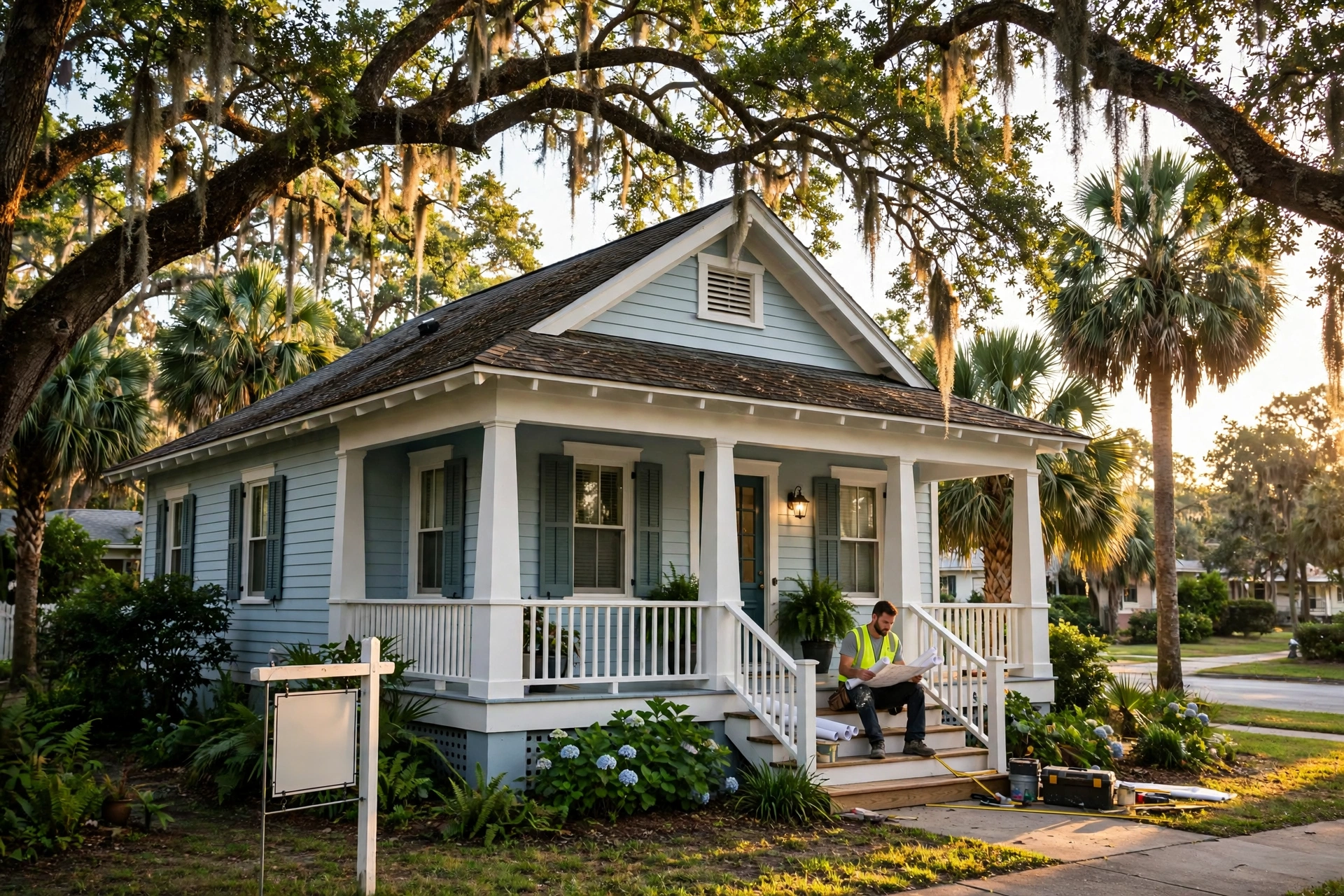
That matters in Jacksonville, where the median listing is $294,750 and whole neighborhoods of solid older homes — Riverside, Avondale, Springfield, Murray Hill, San Marco — sell at a discount precisely because they need work. The buyers who walk past those houses are usually not short on income. They are short on the cash to fix the house after they buy it. The 203(k) is the product built for exactly that gap.
What a 203(k) Actually Is
Most mortgages finance a house as it stands on closing day. A 203(k) finances the house as it will stand when the work is done. HUD, which insures the loan through the FHA, describes it plainly: part of the loan pays the seller, and the remaining funds are placed in an escrow account and released as the rehabilitation is completed. That escrow account is called the Rehabilitation Escrow Account, and it is the mechanism that makes the whole product work.
Here is the chain, in order:
1. You find the fixer and price the work before you offer. A licensed contractor walks the house with you and writes a bid — line by line, with costs. On a Standard 203(k), a HUD-approved 203(k) consultant writes the formal work plan, called a Specification of Repairs, and oversees the job. On a Limited 203(k), the contractor's bid is usually enough.
2. The appraiser values the house twice. Once as it stands today, and once as-completed — what it will be worth after the renovation. The loan is sized off the as-completed value, which is the whole point: the lender is underwriting the finished house, not the broken one.
3. You close on one loan. The purchase money goes to the seller. The repair money goes into escrow. You make one mortgage payment, at one rate, from day one — including during the renovation.
4. The contractor is paid in draws. As each phase of work is finished and inspected, money is released from escrow. The lender holds back 10% of each draw until the work is complete, which keeps the contractor finishing the job instead of moving on to the next one.
5. The work has a deadline. Work must begin within 30 days of closing. A Limited 203(k) must finish within nine months; a Standard 203(k) within twelve. Miss the deadline and the escrow stops paying — so the schedule is part of the underwriting, not an afterthought.
Limited vs. Standard: Which One Fits Your Project?
There are two versions, and the job decides which one you use — not your preference. The dividing line is structural work.
| Limited 203(k) | Standard 203(k) | |
|---|---|---|
| Repair budget | Up to $75,000 in total rehabilitation costs | $5,000 minimum; no fixed ceiling beyond the county FHA loan limit |
| Structural work | Not allowed — non-structural only | Allowed — foundations, load-bearing walls, room additions, full gut jobs |
| HUD consultant | Not required (optional) | Required — from HUD's roster |
| Completion deadline | 9 months | 12 months |
| Mortgage payment reserve | Not available | Up to 12 months of payments can be financed while you cannot live in the home |
| Contractor draws | Up to 4 per contractor | Up to 5 |
| Typical projects | Kitchen and bath remodels, roofing, HVAC, windows, flooring, painting, appliances | Foundation repair, additions, moving walls, major structural rehabilitation |
The $75,000 Limited cap is new, and it is the single most important change in this product in a decade. HUD Mortgagee Letter 2024-13, issued July 9, 2024 and effective for FHA case numbers assigned on or after November 4, 2024, more than doubled the cap from the old $35,000 — and stretched the Limited completion window from six months to nine. A kitchen-and-bath renovation that used to force borrowers into the Standard program, with its consultant and its paperwork, now fits the simpler version. Any lender page or article that still says $35,000 is quoting a rule that expired in November 2024.
HUD also updated the program again in June 2026: Mortgagee Letter 2026-06 raised the number of draws allowed on a Limited 203(k) from two to four per contractor, so the contractor is not waiting on one giant payment at the end of a long job.
The Jacksonville Math: A $250,000 Fixer, $50,000 of Repairs, One Loan
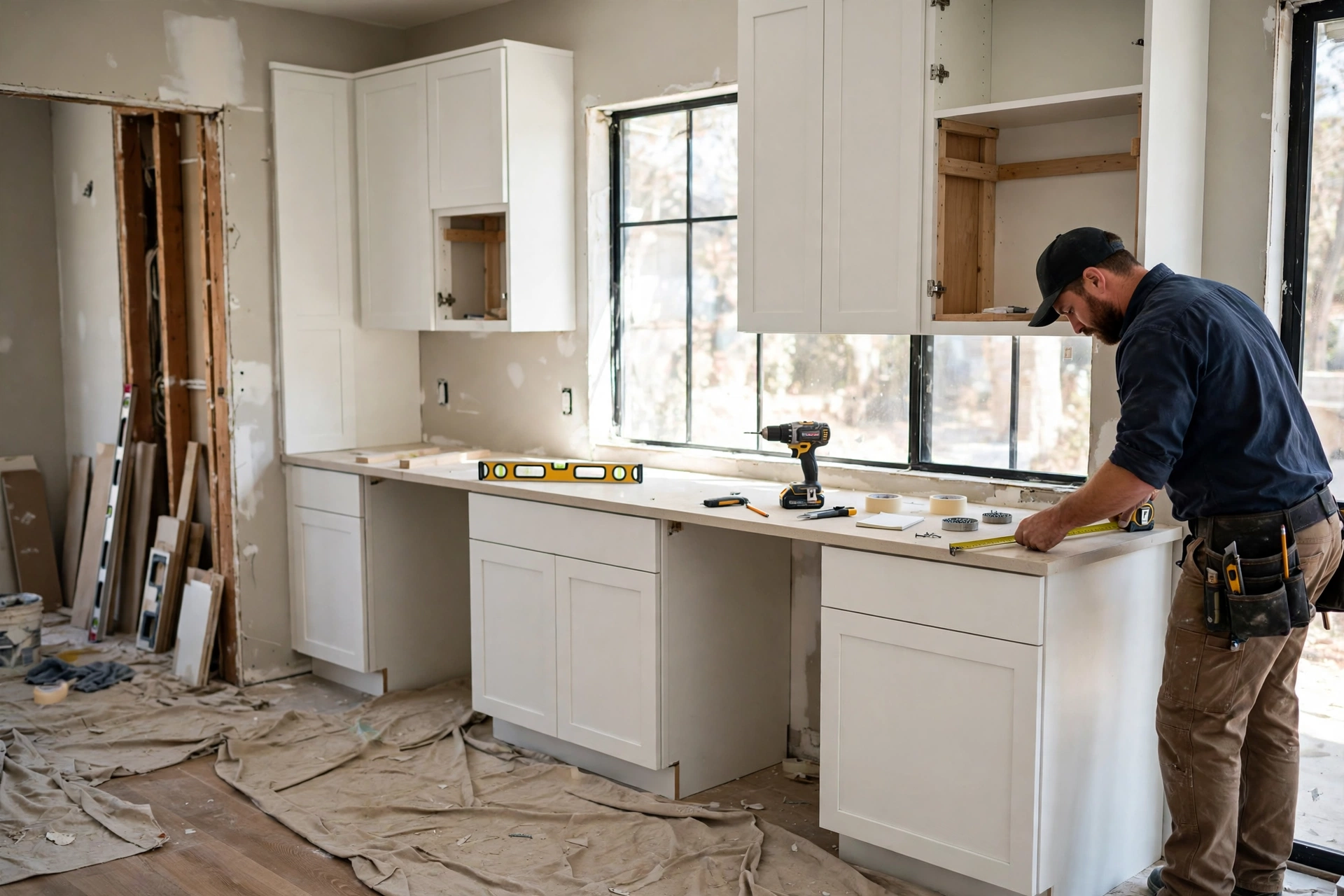
Take a real Jacksonville shape of deal: a 1960s bungalow in Murray Hill listed at $250,000, needing a $50,000 kitchen-and-bath renovation — new cabinets and counters, a bathroom gut, flooring throughout, paint. That is a Limited 203(k): non-structural, under the $75,000 cap, nine months to finish, no consultant required.
| The deal | Amount |
|---|---|
| Purchase price | $250,000 |
| Renovation budget | $50,000 |
| Total project cost | $300,000 |
| Down payment — 3.5% of $300,000 | $10,500 |
| Base loan amount (96.5%) | $289,500 |
| Upfront mortgage insurance premium — 1.75% | $5,066.25 |
| Total loan amount | $294,566.25 |
| Principal & interest at 7.11% (30-year fixed, Freddie Mac PMMS week ended Nov. 12, 2026) | $1,981.57 / month |
| Annual mortgage insurance premium — 0.55% | $132.69 / month |
| Total P&I + MIP | $2,114.25 / month |
That $2,114.25 a month buys the house and the renovation. Now compare the three ways a buyer could actually get this done:
Option 1 — the 203(k): $10,500 down, $2,114.25 a month, repairs financed at mortgage rates and paid out of escrow as the work is inspected. One loan, one payment, one closing.
Option 2 — a standard FHA loan plus a personal loan for the repairs: buy the fixer with a regular FHA loan — $8,750 down, $1,761.87 a month in principal, interest and MIP — then borrow the $50,000 for repairs separately. A $50,000 personal loan at 12% over five years costs $1,112.22 a month and $16,733.34 in interest, and it has to be repaid in five years, not thirty. Total monthly outlay: $2,874.09 — $759.84 a month more than the 203(k) — for the same house and the same kitchen.
Option 3 — a standard FHA loan and pay cash for the repairs: $1,761.87 a month, but $50,000 in cash out of pocket before the first contractor shows up. Most first-time buyers choosing between a fixer and a turnkey home do not have $50,000 sitting in savings after closing costs. That is why the fixer stays on the market and the turnkey home sells.
The rule of thumb to carry into any 203(k) conversation: every $10,000 of repairs you finance adds about $73 a month to the payment — principal, interest and mortgage insurance together at today's rates. That is the number that turns a contractor's bid into a monthly payment you can actually judge.
How the Loan Amount Is Figured — and the Two Numbers That Can Shrink It
The down payment is 3.5% of the total project cost — purchase price plus repairs — for borrowers with a 580 credit score or higher. Below 580, down to 500, the down payment is 10%. That is standard FHA. What is different on a 203(k) is how the ceiling is set.
FHA sizes the loan off the as-completed value — the appraiser's opinion of what the house will be worth after the work. The loan cannot exceed the lesser of the purchase price plus financeable repair costs, or 110% of the as-completed value — and it cannot exceed the county FHA loan limit. In Duval County, the 2026 one-unit FHA limit is $580,750, so a $300,000 project is nowhere near the ceiling. The limit only bites on big Standard jobs.
Two things can shrink the loan below what you planned:
The as-completed appraisal comes in low. If our $250,000 fixer appraises at $285,000 after the $50,000 renovation instead of $300,000, the maximum base loan is 96.5% of $285,000 — $275,025 — and the buyer covers the $14,475 gap in cash or renegotiates the price. The appraisal is the guardrail: FHA will not lend more than the finished house is worth.
The contingency reserve. Old houses hide surprises, and HUD knows it. On a Standard 203(k), the lender must hold a contingency reserve of 10% to 20% of the repair costs — at least 10% when the house is 30 years or older, at least 15% if the utilities do not work. On a Limited 203(k) the reserve is discretionary, up to 20%. The reserve sits inside the repair budget, not on top of it — and if it is not used, it is applied to pay down the loan principal. It is not money lost. It is money that only gets spent if the walls hide something the bid did not.
The Process and the Clocks

A 203(k) takes longer to close than a standard FHA loan — typically 45 to 60 days for a Limited, 60 to 90 for a Standard — because the renovation has to be fully priced and the as-completed appraisal completed before closing. The steps:
1. Get preapproved first, with the renovation in the conversation. The preapproval has to cover the purchase price plus the repairs, because that is the loan amount. A preapproval for $250,000 does not buy a $250,000 house that needs $50,000 of work.
2. Find the house and get contractor bids. One licensed contractor, line-item bid, permits identified. On a Standard job, the HUD consultant writes the Specification of Repairs and will inspect at each draw. Consultant fees typically run $400 to $1,000 for most projects and can be financed into the loan.
3. The as-completed appraisal. The appraiser values the house after the planned work, using the contractor's bid and the consultant's write-up. This is the number the loan is sized from.
4. Close, and the escrow opens. Purchase money to the seller, repair money into the Rehabilitation Escrow Account. Work must start within 30 days.
5. Draws, inspections, completion. The contractor requests a draw, the work is inspected, the lender releases the money minus the 10% holdback. On a Limited 203(k), up to four draws per contractor. When the final inspection passes, the holdback is released and any unused contingency goes to principal.
One clock deserves emphasis: on a Limited 203(k), if the repairs would keep you out of the house for more than 30 days total during the renovation, the job does not fit the Limited program — it belongs in Standard, where the mortgage payment reserve can carry up to 12 months of payments while the home is uninhabitable. That is the rule that decides more Limited-versus-Standard calls than the dollar cap does.
What a 203(k) Does NOT Pay For
The program is generous about repairs and strict about everything else. It does not finance investment properties — the home must be your primary residence, and you must move in within 60 days of closing. It does not pay for luxury additions: a new swimming pool, a tennis court, an outdoor kitchen. It does not pay for your own labor — all work must be done by licensed contractors, and you cannot act as your own general contractor. And on a Limited 203(k), anything structural — moving a load-bearing wall, fixing a foundation, adding a room — pushes the job into Standard, consultant and all.
It also does not erase the FHA mortgage insurance. The upfront premium is 1.75% of the base loan, financed into the loan, and the annual premium is 0.55% — the same as a standard FHA loan. With less than 10% down, that annual premium stays for the life of the loan; the exit is the same as any FHA loan — refinance into a conventional loan once you have the equity. That is a real cost, and it belongs in the math before you fall in love with the fixer.
The Jacksonville Angle

Jacksonville is a 203(k) town and does not know it. The median listing in October 2026 was $294,750, and the city's oldest neighborhoods are full of houses built in the 1940s, 50s and 60s — solid block and frame construction, good bones, kitchens and baths that have not been touched in thirty years. Those houses list below the turnkey competition for exactly one reason: they need work. A buyer who can finance the work buys the discount. A buyer who cannot, pays full price for someone else's renovation.
The math favors the fixer most when the renovation is the kind the Limited program covers — a kitchen, a bath, a roof, HVAC, flooring, paint — and the house is in a neighborhood where the as-completed value supports the loan. That is the check that matters: the finished house has to appraise. In a neighborhood of $300,000 renovated bungalows, a $250,000 fixer with a $50,000 renovation appraises cleanly. In a neighborhood where nothing has sold above $240,000, it does not — and the 203(k) will tell you that before you close, which is the point of the as-completed appraisal.
One more Jacksonville note: FHA's property rules still apply to the finished house. The appraisal checks the same minimum property requirements as any FHA loan — safe, sound, secure — and the September 2026 draft that would drop the appliance and crawl-space inspection requirements is still only a draft, with the comment window closed November 6 and no final rule yet. The renovation has to leave the house meeting FHA's bar, not just looking better.
203(k) vs. the Alternatives
The 203(k) is not the only way to finance a renovation. It is the only one that finances the purchase and the repairs in a single loan at mortgage rates with 3.5% down — but the alternatives are real, and the honest comparison is part of the decision:
Buy now, HELOC later: buy the fixer with a standard loan, then open a home equity line once you have equity. The problem is timing — a HELOC is sized off the equity you have today, and a $250,000 fixer with a $241,250 loan has almost none. You would be waiting a year or more for the equity to build, and paying the higher HELOC rate when it does.
Fannie Mae HomeStyle or Freddie Mac CHOICERenovation: the conventional renovation loans. No mortgage insurance if you put 20% down, no consultant required, longer completion windows — up to 15 months on HomeStyle. But they are conventional loans: higher credit score expectations, and the down payment and pricing reflect it. For a buyer at 580 to 660 with 3.5% down, the 203(k) is usually the only renovation loan that fits.
Cash or a personal loan: the fastest route and the most expensive one. A personal loan at 12% over five years turns $50,000 of repairs into $1,112.22 a month — and the payment is due in full whether the renovation is finished or not.
The 203(k) wins when the buyer has good income, a 580-plus score, and a contractor's bid — but not $50,000 in cash. That is most first-time buyers looking at a fixer. It loses when the renovation is cosmetic enough to pay cash for, or when the buyer has 20% down and the credit score for a conventional renovation loan. The product is a tool, not a verdict — and the right answer is the one the file supports.
Sources
HUD Mortgagee Letter 2024-13 (July 9, 2024; effective for FHA case numbers assigned on or after November 4, 2024) — Limited 203(k) total rehabilitation cost cap raised from $35,000 to $75,000; Limited completion window extended to nine months; Standard completion window twelve months; mortgage payment reserve up to twelve months on Standard. HUD Mortgagee Letter 2026-06 (June 23, 2026) — Limited 203(k) draw requests raised from two to four per contractor. HUD Handbook 4000.1, Section II.A.8.a — 203(k) program rules, including the $5,000 Standard minimum, the consultant requirement, the 10% draw holdback, the 30-day start requirement, the 110%-of-after-improved-value test, and the 10%–20% contingency reserve. HUD FHA mortgage limits, 2026 — one-unit floor $541,287, high-cost ceiling $1,249,125; Duval County one-unit limit $580,750. Freddie Mac Primary Mortgage Market Survey, week ended November 12, 2026 — 30-year fixed 7.11%, 15-year fixed 6.45%. Realtor.com Economic Research, October 2026 — Jacksonville median listing price $294,750. FHA mortgage insurance premiums — upfront 1.75%, annual 0.55% — per HUD Handbook 4000.1. Payment figures in this post were calculated from those rates and verified by hand.
Our Take
The 203(k) is the most underused loan in the FHA toolbox, and the reason is not the guidelines — it is the overlays. Plenty of lenders will tell a buyer the fixer "doesn't qualify" when what they mean is they don't do 203(k) loans, or they only do the Limited version, or their overlay demands a 640 score on a program the agency writes at 580. The agency rule is the rule: 3.5% down at 580, up to $75,000 of non-structural work on the Limited, structural work allowed on the Standard with a consultant. A broker who works from the actual guidelines, across 200 lenders, finds the lender whose overlay fits the file instead of telling the borrower the file doesn't fit. If a lender told you the fixer can't be financed, that lender told you about their business — not about your loan. Bring the contractor's bid and the address, and let the file be priced for real.
Would you buy the fixer if the repairs were already financed — or is a move-in-ready home worth the higher price tag to you?
Your Next Step
Check Your Rate — Free — see what rate you actually qualify for across 200+ lenders, free, no credit check, no pressure.
Run the numbers on your own fixer: Mortgage Calculators — freemandouglas.com
Prefer to talk it through? Call Douglas direct: (904) 517-4049.
Douglas Wilkerson — NMLS #1680719
Direct: (904) 517-4049
[email protected] | [email protected]
1548 the Greens Way, Ste. 4, Jacksonville Beach, FL 32250
Freeman Douglas Corporation is a DBA of Edge Home Finance. This is not a promise to lend — all credit decisions are subject to approval. Douglas Wilkerson, NMLS #1680719 | Edge Home Finance, NMLS #891464. Verify licensing at nmlsconsumeraccess.org. Equal Housing Opportunity.
