Florida Home Insurance Is Changing: The 2026 Homebuyer Advantage | Freeman Douglas
Florida Real Estate, Homeowners Insurance, Mortgage Education
The Insurability Advantage™: How Smart Florida Homebuyers Should Shop for Houses in a Changing Insurance Market
Florida’s insurance market is shifting fast. For homebuyers, that shift isn’t just a headline—it’s a practical opportunity to rethink how you evaluate houses, compare costs, and structure your next purchase. The Insurability Advantage™ is about using insurance information as a strategic tool, not an afterthought.
1. Florida’s Insurance Market Is Changing—Why That Matters in 2026
For several years, Florida homeowners heard the same message: insurance was expensive, unstable, and hard to get. Premiums spiked, carriers failed or left the state, and Citizens Property Insurance Corporation—the state’s insurer of last resort—ballooned to roughly 1.41 million policies in October 2023. For many families, insurance genuinely wrecked mortgage payments.
But the numbers in 2025–2026 tell a different story. Citizens’ policy count has fallen dramatically as risks move back into the private market. Public data shows policies in force dropping from about 395,000 at the end of 2025 to roughly 278,000 by mid‑June 2026—a decline of more than 30% in just a few months, and down more than 75% from the 2023 peak. That’s a powerful signal that private insurers are returning and absorbing risk again.
At the same time, Citizens’ 2026 homeowners multiperil rates are decreasing an average of about 8.8% statewide, with wind‑only policies down around 5.5%, effective July 1, 2026. The Florida Office of Insurance Regulation reports that rates are falling in most counties, and more than 20 new property insurers have entered or re‑entered the market since recent legislative reforms (Florida Office of Insurance Regulation).
None of this means Florida suddenly has cheap insurance. Multiple national surveys still rank Florida as the most expensive homeowners‑insurance state in the country, with average annual premiums for a typical home often ranging from about $5,800 to more than $10,000, depending on the data source and coverage assumptions. But it does mean the market is stabilizing, competition is returning, and consumers have more room to make strategic decisions instead of simply taking whatever coverage they can get.
📌 Key Takeaway: Florida’s market is no longer defined only by crisis. It’s entering a stage where informed buyers can use insurance information as leverage—if they know how to read it.
2. Why Insurance Now Belongs at the Center of the Home Search
Most homebuyers still shop the old way. They scroll listings, fall in love with a kitchen, check the price and the payment estimate, write an offer—and only after going under contract does someone say, “We should get an insurance quote.” In Florida, that sequence is backwards. The question should be asked much earlier: “What does the insurance market think about this house?”
A listing highlights bedrooms, bathrooms, square footage, and schools. An insurer looks at a completely different set of variables:
Roof age, condition, and material
Construction type and building code compliance
Wind mitigation features and opening protection (doors, windows, shutters)
Electrical and plumbing systems and any known hazards or updates
Prior claims history and loss experience on the property (and sometimes the buyer)
Location‑specific flood and wind exposure, including proximity to coastlines and flood zones
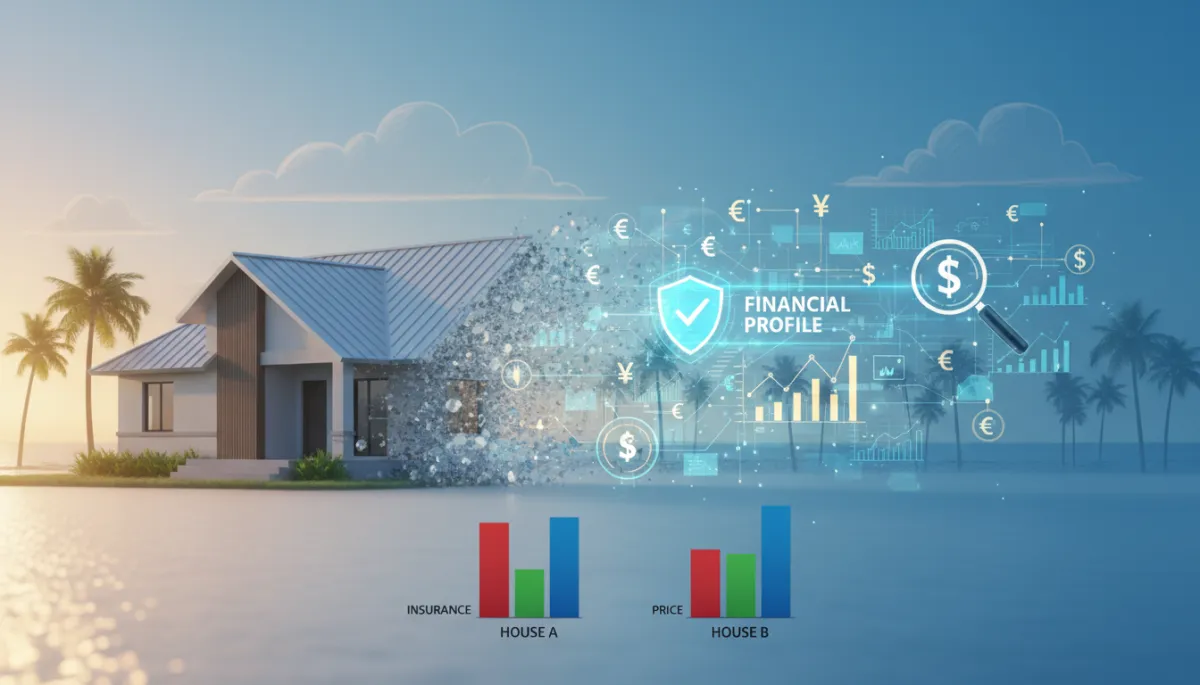
These details can dramatically change the cost of insuring the property. Two houses with the same list price can have very different monthly ownership costs once insurance is included. That is the heart of the Insurability Advantage™: recognizing that you’re not just shopping for a house—you’re shopping for a financial profile, and insurance is one of its most important components in Florida.
3. How Insurance Can Change the Mortgage You Qualify For
Many buyers understand that homeowners insurance is required by their lender, but they don’t always realize how directly it can impact mortgage qualification. When your lender calculates your housing expense, they typically consider:
Principal and interest on the loan
Property taxes
Homeowners insurance (and flood insurance, where required)
HOA or CDD fees and certain other mandatory housing expenses
In other words, if insurance is escrowed, the premium is literally built into the monthly payment used to approve your loan. That means a property with a significantly higher premium can push your total monthly housing cost above the threshold your lender is willing to approve—even if the sale price itself is within your budget.
💡 Educational Insight: You can qualify for “the price of the house” but not for the total monthly cost of that specific house once insurance and other obligations are included.
That’s why focusing only on the mortgage rate—6.75% vs. 6.625%, for example—can miss the bigger picture. Saving $40 per month by shaving an eighth of a percent off your interest rate doesn’t make much sense if you ignore a property characteristic that quietly adds $200 per month in insurance costs. In Florida, a home’s insurability is part of the mortgage conversation, not just a form you sign before closing.
4. Two “Identical” Houses, Two Very Different Insurance Costs
To see how this plays out, imagine two homes in similar neighborhoods:
Both are listed at $450,000
Both have similar square footage and layouts
Both would produce a similar principal and interest payment
On paper, they look interchangeable. But the insurance quotes tell a different story:
Property | List Price | Estimated Annual Insurance | Approx. Monthly Impact |
|---|---|---|---|
House A | $450,000 | $3,000 | About $250/month |
House B | $450,000 | $6,000 | About $500/month |
The difference is $3,000 per year, or roughly $250 per month. Over just five years—before considering any future rate changes—that’s $15,000 in additional cost for House B. Financially, these are no longer “two $450,000 houses.” One has a built‑in recurring expense that directly affects your budget and potentially your ability to qualify for the loan.

-toned graphic on a desk showing two similar houses side by side with different insurance cost...
Two similar list prices can hide thousands of dollars in long‑term insurance differences.
5. Why the “Cheapest” House Can End Up Costing More
Consider another scenario. You’re comparing two homes:
House A – Purchase price: $425,000; Insurance: $6,000/year
House B – Purchase price: $435,000; Insurance: $3,500/year
On the contract, House A looks $10,000 cheaper. But House A also costs $2,500 more per year to insure. Over four years, that’s another $10,000 in premiums. The original price “savings” can be completely neutralized by higher recurring insurance costs—before you even factor in financing, maintenance, or the time value of money.
📌 Key Principle: Price and cost are not the same thing. In Florida, insurance is a major reason why.
6. Property Characteristics That Drive Insurance Pricing
Why do two similar houses produce such different quotes? Because insurers are pricing the underlying risk, and that risk is tied to the physical and geographic characteristics of the property. Some of the most influential factors include:
Roof age and type: Older roofs, or roofs built to outdated codes, can limit carrier options or push premiums higher. Newer or upgraded roofs, especially those compliant with modern Florida Building Code standards, can improve insurability and pricing.
Wind mitigation features: Roof‑to‑wall connections, secondary water barriers, and impact‑rated openings can all reduce expected hurricane losses and therefore affect premiums. The wind‑mitigation inspection form is not just paperwork; it’s a pricing tool.
Opening protection: Impact‑resistant doors and windows, or properly rated shutters, can significantly change how a carrier views the property’s vulnerability to wind‑borne debris and storm damage.
Systems and safety: Updated electrical, plumbing, and HVAC systems, as well as features like monitored alarms, can lower the risk of fire, water damage, and theft claims.
Location and elevation: Two homes a few streets apart can face very different flood and wind exposures. Being in or out of a Special Flood Hazard Area can mean the difference between optional and mandatory flood coverage, with major cost implications.
When you treat the insurance quote as a diagnostic report on the property—not just a bill—you begin to see why certain homes are more expensive to own than others, even when the purchase price is similar.
7. Florida’s Mitigation Opportunities: Turning Risk Into Strategy
Florida has made a deliberate push to encourage homeowners to harden their properties against storms—and to reward them for doing so. The My Safe Florida Home program is a prime example. It offers eligible homeowners free hurricane‑mitigation inspections and potential grant money for qualifying improvements, such as stronger roofs or impact‑resistant openings. Legislative updates in 2026 expanded eligibility to certain attached properties and clarified that specific roof upgrades can qualify for assistance (Florida Department of Financial Services).
Another measure extended a sales‑tax exemption on approved home‑hardening products—such as impact‑resistant windows and doors—through June 30, 2029, with potential refunds for eligible applicants. These programs reinforce a critical concept: the physical features of the house are not just cosmetic. They affect risk, underwriting, and ultimately insurance pricing and availability.
💡 Educational Insight: For buyers, mitigation programs matter even before you own the home. They can influence which properties you target, how you negotiate repairs or credits, and what improvements you plan to make in the first several years of ownership.
8. The House Has a Financial Profile—Not Just a Price
When many people talk about a house, they talk about “the price.” But in practice, every property has a broader financial profile that includes:
Purchase price and financing structure (rate, term, loan type)
Property taxes and any special assessments
Homeowners and flood insurance costs and deductibles
HOA and CDD obligations, if applicable
Expected maintenance and near‑term capital expenses (like roofs or major systems)
Resale characteristics and marketability
And crucially in Florida: insurability
When you compare only list prices, you ignore much of this profile. In the current environment—where national home sales are soft, inventory has risen, and mortgage rates are still limiting demand—buyers who evaluate the full financial profile of a property can often negotiate from a position of strength. Insurance is a central part of that evaluation.
9. The Freeman Douglas Insurability Test™: Seven Questions Every Florida Buyer Should Ask
To bring all of this together, Freeman Douglas uses a simple but powerful framework—the Insurability Test™ —to analyze Florida properties before getting emotionally attached. Here are the core questions and why they matter:
What does it cost to insure? Not a generic online estimate, but a realistic quote or range based on the specific property, coverage needs, and current market conditions.
Why does it cost that? Is the premium driven by roof age, wind exposure, flood zone, prior claims, construction type, or something else? Understanding the “why” turns a price into information.
How many options exist? Is the property attractive to multiple insurers, or are you limited to one or two carriers—or even Citizens? More options generally mean more flexibility and less risk of future disruption.
What physical characteristics are driving the result? Pinpointing the exact features that influence pricing—roof covering, attachment, elevation, openings—helps you evaluate whether the issue is permanent, negotiable, or improvable.
Can any of those characteristics be improved? If so, at what cost, and over what timeline? This is where mitigation programs, seller concessions, or planned upgrades can potentially change the long‑term economics of the property.
Does the seller’s position create negotiating leverage? If a roof or mitigation issue is hurting insurability, can that problem be used to negotiate price reductions, credits, or repairs that improve the property’s financial profile for you as the buyer?
What does this house cost after everything is included? Mortgage, taxes, insurance, HOA/CDD, expected maintenance, cash required, and potential repairs. Only when you add these together can you meaningfully compare one property to another.
📌 Educational Summary: The Insurability Test™ turns the insurance quote into due diligence. It helps you see the property the way insurers and underwriters see it—before you commit.
10. Citizens Isn’t the Strategy—It’s a Signal
Many Florida consumers still think of Citizens as just another name on a comparison list. In reality, Citizens was created as the insurer of last resort for property owners who cannot obtain suitable private‑market coverage. Recent reforms have tightened its role even further, requiring agents to seek private options first and limiting eligibility when comparable private coverage is available within a certain price range.
So instead of asking, “Can I get Citizens?” a more educational question is, “Why does this property need the insurance solution it needs?” If multiple private carriers decline a house while a similar property down the street has plenty of options, that discrepancy is telling you something important about the home’s risk profile. You can use that information to reassess the property, renegotiate, or walk away if necessary.
11. VA and First‑Time Buyers: Why Insurability Matters Even More
VA buyers often (rightly) focus on the advantages of the VA home loan—no required down payment in many cases, no monthly private mortgage insurance, and strong borrower protections. But even the best financing structure doesn’t erase the operating cost of owning the house. A veteran buying in Florida still has to account for property taxes, homeowners and flood insurance, HOA/CDD obligations, maintenance, and utilities, all within their household budget.
First‑time buyers face a similar challenge. Without prior experience, it’s easy to assume the mortgage payment is “the cost” of homeownership. In reality, the monthly payment is only one part of a larger operating budget. Learning to analyze the full financial profile of each property—including insurance—gives first‑time buyers a meaningful edge over those who simply ask, “Can I qualify for $450,000?”
12. Turning Insurance Information Into Leverage in Today’s Market
In a hot seller’s market, buyers sometimes have to accept less‑than‑ideal property characteristics just to win a contract. But in a cooler, more balanced environment—where inventory has increased and some sellers are under pressure—information becomes leverage. When you understand how a roof, flood zone, or missing mitigation feature affects insurability and monthly cost, you can:
Ask for repairs or credits that directly address the issue (for example, a roof replacement or impact‑window upgrade)
Compare alternative properties with stronger insurance positions, even if the list prices are higher
Decide when a problem is worth inheriting—and when it isn’t
Negotiating $15,000 off the purchase price feels like a win. But if one property quietly carries an extra $250 per month in insurance expense—a $3,000 annual difference—that same $15,000 can disappear over five years. Sometimes the best “deal” is the house with the stronger long‑term financial profile, not the lowest sticker price on closing day.
13. The Bigger Lesson: Use Insurability as Part of Your Housing Strategy
Florida’s insurance market is not “fixed,” but it is changing . Citizens’ policy count has fallen sharply. New private carriers and capital have entered the state. Many homeowners are finally seeing rate relief after years of increases. For buyers, the most important conclusion is not that insurance can be ignored, but that it can now be strategically evaluated and shopped alongside the house itself.
The Insurability Advantage™ is about asking better questions:
What does this house cost to insure—and why?
How does that insurance cost affect my mortgage qualification and monthly budget?
Are there mitigation steps or negotiation strategies that could improve the property’s financial profile?
The next time someone sends you a listing, don’t stop at “Do you like it?” Add one more question: “What does that house cost to insure—and what does that tell us about the house?” In today’s Florida housing market, the answer can be more than a cost. Used correctly, it can become an advantage.
This article is for educational purposes and does not constitute insurance, tax, legal, or financial advice. Insurance availability, premiums, underwriting requirements, mortgage qualification, and property conditions vary substantially by consumer, property, carrier, loan program, and transaction. Always obtain property‑specific insurance quotes and appropriate professional inspections before making a purchase decision.
