Mortgage Rates Are the Most Stable Thing in America Right Now?
By Douglas Wilkerson — Mortgage Broker | Branch Manager, NMLS #1680719, Edge Home Finance, operating as Freeman Douglas Corporation. I price loans across 200+ wholesale lenders for a living. This is my rate sheet and my take, in my words.
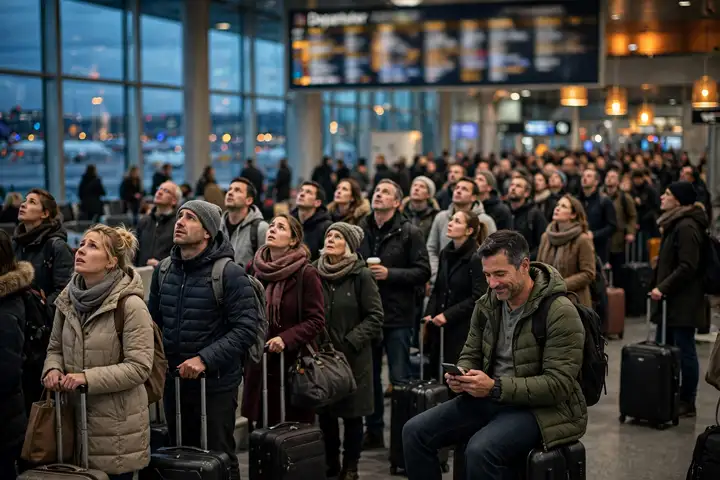
Let me tell you about the last eight days in America, because if you wrote this week as a movie script, the studio would send it back for being unrealistic. Planes stopped. Ships crashed. The ground moved. The biggest bank in the country broke twice. And somewhere in the middle of all of it, 81.5 million people packed a bag and headed out for Thanksgiving anyway.
Start with Friday the 13th — yes, it really was Friday the 13th. That afternoon, the FAA's radar and communications systems glitched and the agency did something it almost never does: it stopped flights nationwide. Not one airport. The whole sky. For more than four hours, the United States of America — a country that moves a million people a day through the air — just parked everything and waited. If you were sitting on a tarmac that day, you already know. If you weren't, your group chat knows somebody who was.
Same day, down on the Mississippi River in New Orleans, a 14,000-ton asphalt tanker lost its steering and rammed a river cruise ship tied up at the dock. Passengers slid off the second deck into the river. Dozens went to the hospital. Nobody died, which is the only reason I can write about it in the same tone as the rest of this week — but a cruise ship got hit by a tanker in the middle of an American city on the same day every plane in the country got grounded. Hold that thought, because the week was just getting started.
Going to check with your bank after this? Don't.
Your bank will show you one rate — theirs, with every layer of their overhead baked into it. I price the same loan across 200+ lenders and show you the number you actually qualify for. Free, no credit check, and nobody's going to hound you after.
Run My Free Rate Check — or call me direct: (904) 517-4049
★★★★★ "Douglas stepped into the deal providing a much lower interest rate than other lenders were offering, which was a game-changer for the buyers." — Katelyn Watford, Google review
The Short Answer
Yes — right now, a fixed-rate mortgage is genuinely one of the most stable financial objects in America, and this week is the proof. While flights, ships, banks, and markets were breaking in public, my rate sheet this morning printed the same boring numbers it prints every morning: VA at 6.25%, FHA at 6.25%, Conventional at 6.625% on a $450,000 loan, 30-year fixed. A fixed mortgage rate cannot be grounded, delayed, hacked, or surge-priced. It is set once, in writing, at closing — and then it repeats, unchanged, 360 times. Nothing else in your financial life works like that, and this week showed exactly why that matters.
Eight Days of Everything Breaking
Let me lay the whole week out, because the details are better than any summary.
Friday, November 13. The FAA ground stop, as above — radar and communications problems, more than four hours, flights snarled through the weekend. The same day, the tanker Atlantic Asphalt suffered a steering failure on the Mississippi and smashed into the moored American Heritage paddleboat cruise ship just north of the Crescent City Connection in New Orleans. The ship flipped partway and sank into the mud at the dock. A 16-person NTSB team was on the tanker by Saturday. This week, the lawsuits started arriving — passengers, two police officers who were hurt in the rescue, and the Port of New Orleans, which is seeking at least a million dollars for its wharf.
Monday, November 16. JPMorgan Chase — the largest bank in the United States — had a software bug in an on-premises system that delayed transaction processing. Because Chase sits in the middle of so much of the country's money movement, the slowness bled outward: customers of Bank of America, Wells Fargo, U.S. Bank, and Capital One reported problems, and some Zelle payments were delayed. Chase got it fixed by Monday evening. The same evening, United Airlines had an outage of its own that hit departing flights. If your money and your flight both glitched on the same Monday, congratulations — you had the full 2026 experience in a single day.
Thursday, November 19. Chase again. The bank disclosed that hackers had hit third-party vendors who provide services to the firm and accessed marketing data — names and email addresses. A ransomware group calling itself n0n published what appears to be more than 16,000 customer email addresses, some with phone numbers, reportedly tied to Chase's invitation-only Reserve card program — the one for clients with eight figures at the bank. Visa and Mastercard vendors were hit in the same campaign. Chase says the hack has no connection to Monday's outage. Maybe so. But from a customer's chair, the distinction is academic: the bank broke on Monday and got robbed on Thursday.
Today, Friday, November 20. The ground itself got in on it. "Earthquake Los Angeles" is one of the most-searched terms in America today — over half a million searches and still climbing. Tampa departures are running about 90 minutes behind in thunderstorms. Orlando and Fort Myers are backed up. San Diego is under a ground delay program. Delta issued a Florida travel waiver for yesterday and today. And out at sea, the Caribbean Princess is sailing home to Fort Lauderdale with 148 sick passengers and crew — a stomach bug the CDC is still investigating — due back Monday. Meanwhile the S&P 500 is one of the top searches in the country because the market can't decide which direction it wants to fall.
And through all of it, the Thanksgiving machine rolls on: AAA projects 81.5 million travelers, about 5.9 million of them flying, at fares Hopper calls the most expensive in at least a decade — roughly $402 for the average domestic round trip. Today is United's busiest pre-Thanksgiving day of the year, around 540,000 customers. Next Sunday, the 29th, is the peak of the whole season. America is stressed, delayed, slightly queasy, possibly hacked — and traveling anyway.
Why Your Mortgage Didn't Notice Any of This
Now notice what is not on that list: your mortgage. Nobody's fixed-rate payment changed this week. Nobody's loan terms got grounded. Nobody opened their servicer's app on Monday, found it down, and discovered their interest rate had moved. That is not luck. That is design.
A mortgage is a contract — a note you signed — and the note fixes the three numbers that matter: your rate, your principal-and-interest payment, and your balance schedule. The bank's software can fail, the bank itself can get acquired, your loan can be sold and transferred to a new servicer (that happens constantly, and you barely notice) — and through every one of those events, the terms travel with the loan, unchanged. An outage can inconvenience how you pay. It cannot touch what you owe or what rate you owe it at.
There is also no surge pricing in a fixed mortgage. Think about what everything else in this story does when demand spikes or systems strain: airfare reprices by the minute — $402 average this Thanksgiving, the most expensive in a decade. Your mortgage payment was priced once, on the day you closed, and it will be priced identically on the worst travel day of 2036. Payment number 1 and payment number 360 are the same number. In a country where everything else reprices, reroutes, delays, and occasionally sinks, the fixed-rate mortgage just sits there, repeating itself. Boring is not a flaw in this product. Boring is the product.
The Math: Boring, In Writing, 360 Times
Here is my actual rate sheet from this morning — Friday, November 20, 2026, priced at 11:35 AM Eastern, on a $450,000 loan, 30-year fixed. This is not a national survey average. It is what I can actually write today.
- VA, 720+ credit: 6.25% rate, 6.408% APR — $2,770.73 a month, principal and interest
- VA, 580 credit: 6.75% rate, 7.129% APR — $2,918.69 a month
- FHA, 720+ credit: 6.25% rate, 7.136% APR — $2,770.73 a month (the APR runs higher because FHA mortgage insurance is priced into it)
- FHA, 580 credit: 6.75% rate, 7.666% APR — $2,918.69 a month
- Conventional, top tier: 6.625% rate, 7.125% APR — $2,881.40 a month
- Conventional, 620 credit: 6.75% rate, 6.917% APR — $2,918.69 a month
Now run the stability math on the VA example. $2,770.73 a month, times 360 payments, is $997,462.80 of total payments over 30 years — and every single one of those 360 payments is identical. Not approximately. Not "subject to availability." Identical, in a signed contract, immune to ground stops, software bugs, ransomware gangs, earthquakes, and whatever next week invents. Your landlord cannot offer you that. Your bank's savings app cannot offer you that. The airline charging you $402 for a middle seat to Cleveland definitely cannot offer you that.
The sheet also shows you, in dollars, what your credit score is worth. Same loan, same day, same lender pool: the 720-credit veteran pays $2,770.73; the 580-credit veteran pays $2,918.69. That is $147.96 a month — $53,265.60 across the life of the loan — for the same house and the same money. Stability is available at both tiers. It is just cheaper at the top one, and the gap between those two numbers is the most honest credit-score advertisement ever printed.
What It Takes to Get a Number Like This
A rate sheet is scenario pricing, and I would rather tell you that plainly than let an ad pretend otherwise. The numbers above assume a $450,000 loan, a 30-year fixed term, and the credit tiers shown. Change the loan size, the down payment, the property type, or the score, and your number moves — which is exactly why the only rate that matters is the one priced on your actual file.
The moment stability actually starts is the rate lock. When you are under contract and your file is ready, we lock the rate for a set window — commonly 30 to 60 days — and from that moment the market can do whatever it wants. Rates can spike while you are stuck in an airport, at your mother's table, or on a cruise ship with 148 of your closest friends feeling unwell. Your number does not move. If you are traveling this week and find the house — and thousands of people will, because Thanksgiving trips turn into relocations every single year — the sequence is: run your rate, get the pre-approval in writing, then fall in love with the house. In that order.
The Honest Catches
Fixed means fixed in both directions, and you deserve to hear that from me instead of discovering it. If rates fall hard next year, your payment does not fall with them — refinancing is how you capture a drop, and a refinance costs money and paperwork. Stability is a one-way ratchet you control, not an automatic one.
Second catch: the principal-and-interest core of your payment never changes, but the escrow part can. Property taxes and homeowner's insurance are re-priced by your county and your insurance carrier, and in Florida, insurance re-pricing is its own contact sport. When people say "my mortgage went up," it is almost always the escrow line, not the rate. The note holds. The county and the carrier are another conversation.
Third: a sheet rate is not your rate until it is priced on your file, and sheets re-print every morning. The numbers in this post are real, dated, and mine — and they will be replaced by tomorrow's sheet, because that is how wholesale pricing works. What does not change is the spread between a broker who shops 200+ lenders and a bank that shows you the one rate on its own shelf.
Who This Week's Lesson Is For
It fits: anyone traveling this week who is even thinking about buying where they land — get priced before you tour. Veterans, full stop: a 6.25% VA rate with zero down is the single most stable piece of paper most families will ever sign. Anyone whose only quote so far came from the bank that just spent the week in the outage headlines. And anyone closing in the next two weeks — read my outage playbook (linked below) and guard your wire like it is the whole deal, because during a bank's bad week, it is.
It doesn't fit: if you know you will sell or move within two or three years, an adjustable rate can honestly beat a fixed on total cost — stability you will never use is not worth paying for. And if you are buying purely as a cash-flow investor, the math runs through a different product entirely. Stability is a homeowner's game first.
Frequently Asked Questions
Are mortgage rates actually stable right now?
On my sheet, yes — and more importantly, once you lock and close, your rate is stable by contract for the full 30 years regardless of what markets or banks do. Today's pricing (November 20, 2026) runs from 6.25% for top-tier VA and FHA borrowers to 6.75% at the lower credit tiers on a $450,000 loan.
What are today's mortgage rates?
Mine, this morning: VA 6.25% (6.408% APR) and FHA 6.25% (7.136% APR) at 720+ credit; Conventional 6.625% (7.125% APR) at the top tier; 6.75% across programs at the 580–620 tiers. Those are scenario rates on a $450,000, 30-year fixed loan — your number gets priced on your file, free, with no credit check through the rate check.
Can a bank outage or a hack change my mortgage rate or payment?
No. Your rate, payment, and balance are set by the note you signed. An outage can delay how you make a payment or slow a closing wire — which is a real risk to manage — but it cannot re-price your loan. Even if your bank fails or sells your loan, the terms travel with the loan unchanged.
I'm traveling for Thanksgiving and found a house where I'm visiting. What do I do first?
Run your rate before you tour it a second time. Get a real pre-approval in writing — mine takes your actual credit tier, loan size, and the state you're buying in, and I lend in 39 states, so the house being three states away is not a problem. Then make the offer with the lock strategy set.
Fixed or adjustable — which is safer in a market like this?
For a home you plan to keep, fixed, and this week is the argument: the fixed payment is the only number in the story that never moved. An adjustable can make sense for a short, certain horizon — a known move in two or three years — but you are renting stability instead of owning it, and the adjustment dates do not care what the world looks like when they arrive.
Sources
AAA's 2026 Thanksgiving travel forecast (81.5 million travelers; about 5.9 million by air) and Hopper's 2026 Holiday Travel Index (average domestic Thanksgiving round trip about $402, the most expensive in at least a decade) set the travel figures. The November 13 nationwide FAA ground stop and its radar/communications cause are from FAA statements and Associated Press reporting; today's delay picture is from the FAA's National Airspace System status (Tampa, Orlando, Fort Myers, San Diego) and Delta's November 19–20 Florida travel waiver. The New Orleans collision — the tanker Atlantic Asphalt's steering failure and the American Heritage — is from U.S. Coast Guard statements, the NTSB investigation, and Times-Picayune reporting on the lawsuits filed this week. The November 16 Chase transaction outage and its software-bug cause are from JPMorgan Chase's own statements; the November 19 vendor cyberattack disclosure is from Reuters' reporting of the bank's statement. The Caribbean Princess illness count (148 passengers and crew) is from the CDC. The Los Angeles earthquake and S&P 500 search figures are from Google Trends' Trending Now for the United States, November 20, 2026. The rates are my own: the Freeman Douglas Rate of the Day sheet, November 20, 2026, priced 11:35 AM Eastern.
Our Take
Here is what I actually think, after a week of watching the country's systems take turns failing. The most dangerous money in America right now is the money that depends on somebody else's computer staying up — the app balance you can't reach, the payment stuck in a queue, the flight that exists until the radar blinks. The safest money is the boring contract: a fixed rate, a fixed payment, and a house that doesn't care what trended today.
And notice who starred in this week's failures. The biggest bank in the country broke on Monday and got hacked on Thursday — and that same bank will happily show you exactly one mortgage rate, theirs, priced off a shelf that has to feed layers of managers and overhead before it feeds you. I price the same loan across 200+ wholesale lenders, and the wholesale sheet has no such machine to feed. That is the whole mechanism behind the 6.25% at the top of this post.
My verdict: if you are buying in the next six months, stop waiting for the world to calm down — it is not on the schedule — and lock in the one number that cannot be disrupted. Run the free rate check, get your real number in writing, and let everything else trend without you.
Be honest: this week, which felt less stable — your bank, your flight, or your rent?
Your Next Step
Get Your Free Rate Check — a Personalized Rate Quote: see what rate you actually qualify for across 200+ lenders, free, with no credit check and no pressure.
See the full breakdown of what a bank outage means for your mortgage payment and your closing and every other program we run on the mortgage programs page.
Ready to move? Start your application — or call Douglas direct: (904) 517-4049.
Douglas Wilkerson — NMLS #1680719
Direct: (904) 517-4049
[email protected] | [email protected]
1548 the Greens Way, Ste. 4, Jacksonville Beach, FL 32250
Freeman Douglas Corporation is a DBA of Edge Home Finance. This is not a promise to lend — all credit decisions are subject to approval. Douglas Wilkerson, NMLS #1680719 | Edge Home Finance, NMLS #891464. Verify licensing at nmlsconsumeraccess.org. Equal Housing Opportunity.
