What Is a USDA Home Loan? The Zero-Down Loan With an Income Cap Nobody Explains
The Short Answer
Yes — a USDA loan is a real zero-down mortgage, and you do not need to be a veteran, a farmer, or low-income to get one. A USDA loan is a regular mortgage made by a regular lender and guaranteed by the U.S. Department of Agriculture's Rural Development agency, under its Single Family Housing Guaranteed Loan Program. In exchange, the loan asks for no down payment and charges lower government fees than FHA. The trade is two tests most buyers have never heard of: the home must sit inside a USDA-eligible area, and your total household income must fall at or below 115% of the area median income. Pass both, and this is the cheapest way into a home with nothing down for anyone not using a VA loan. Fail either one, and the loan does not exist for that house — no matter how strong your credit is. Our verdict, up front: for non-veterans, this is the most underused zero-down option in American mortgage lending, mostly because so few buyers — and so few lenders — ever check the map. Details live on our USDA loans page.
What Is a USDA Home Loan, Exactly?
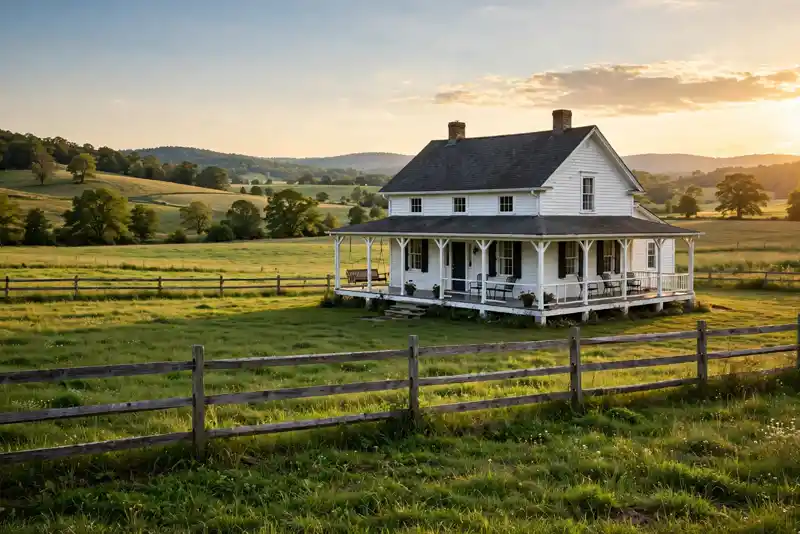
Start with what it is not. It is not a farm loan. You do not need acreage, livestock, or any connection to agriculture. The "rural" in Rural Development is a population test, not a lifestyle test — and the eligible map covers far more suburban ground than the name suggests.
Here is the actual structure, per USDA Rural Development. A private, USDA-approved lender — a bank, credit union, or mortgage company — makes the loan with its own money, under the Single Family Housing Guaranteed Loan Program (formally, the Section 502 Guaranteed program). USDA then guarantees 90% of the loan. That guarantee is the entire engine of the program: because the federal government absorbs most of the loss if the borrower defaults, the lender can approve a loan with no down payment and no private mortgage insurance, at a risk level it would never accept on its own.
Do not confuse the Guaranteed program with USDA's Direct program, where USDA itself is the lender, rates are subsidized, income limits are far lower, and waiting lists are common. When people say "USDA loan" in a normal home purchase, they mean the Guaranteed program — and everything in this post is about the Guaranteed program.
The basic shape: 30-year fixed rate, no down payment, primary residence only, single-unit home that is modest for the area. There is no USDA-set maximum loan amount like FHA's county caps — the ceiling is what your income can repay under USDA's debt guidelines (benchmark ratios of 29% for housing, 41% for total debts, with room above them when the automated system sees compensating factors like reserves and stable job history).
The First Gate: The Address Has to Be Eligible
USDA eligibility starts with the property, not the borrower. The home must be located in an area USDA defines as rural, and USDA publishes an eligibility map where you can check any specific address. According to USDA, roughly 97% of the land area of the United States falls inside the eligible map; what is excluded is the dense urban core of metro areas.
Around Jacksonville, that line is closer than most buyers assume. Jacksonville proper is ineligible, but the metro fringe is full of eligible ground: Callahan and Hilliard in Nassau County, Green Cove Springs, Middleburg, and the Keystone Heights side of Clay County, most of Baker County including Macclenny, and the Hastings and Elkton side of St. Johns County all read as eligible territory, and pockets on the fringe of growing suburbs can qualify street by street. Two houses a mile apart can land on opposite sides of the line, which is why the check is address-by-address on USDA's official map — not by ZIP code, not by county, and not by what the listing agent thinks. Run the address before you write the offer; it takes two minutes, and buyers lose homes every month by assuming a fringe address could not qualify.
The Second Gate: The Income Cap Nobody Explains
The address test is the one people half-know. The income test is the one that blindsides them — because USDA does not measure income the way every other loan program does.
The cap itself is simple: your household income cannot exceed 115% of the area median income for where you are buying. USDA publishes the dollar limit by county and household size. Under USDA's current income worksheet, the Jacksonville metro limit is $125,000 a year for a household of one to four people, and $165,000 for five to eight. Those are not poverty-line numbers — most two-income working households fit under them.
Now the part nobody explains. USDA counts the income of every adult who will live in the home — not just the people on the loan. Your spouse's income counts even if your spouse is not a borrower. A working 19-year-old living at home counts. A parent moving in with you counts. Borrowers get tripped up in both directions: a couple who qualifies on the borrower's salary alone gets denied because a non-borrower spouse pushes the household over the cap — and a household that looks over the cap on gross pay sometimes fits, because USDA measures adjusted income. Deductions for dependents, for childcare costs that let you work, and for elderly or disabled household members all reduce the income USDA counts. The cap test and the qualifying test are also two different calculations: the cap uses total household income, while your lender separately qualifies the borrowers' own income against the payment.
If you land over the cap, the house is not lost — the program is. The same buyer usually pivots to FHA, a conventional loan with 3% down, or down payment assistance. But check the USDA math first, with the household counted correctly — it is the most common place this loan gets wrongly ruled out.
What Does a USDA Loan Actually Cost?
USDA replaces mortgage insurance with two guarantee fees, and both are smaller than what FHA charges for the same job. The upfront guarantee fee is 1% of the loan amount, charged once, and it can be financed into the loan — on a $300,000 purchase with nothing down, that is $3,000 rolled into a $303,000 loan instead of cash at closing. The annual fee is 0.35% of the loan balance, collected monthly — about $88 a month on that same loan. Compare FHA: a 1.75% upfront premium and a 0.55% annual premium on most 30-year loans. On the same $300,000 house, FHA's upfront charge alone is $5,066.
Here is the honest math for one buyer, one house, three government-backed options. The example prices every loan at 6.250% — the FHA 720-credit rate from our Rate of the Day for Friday, November 20, 2026 — purely so program costs are the only thing moving. Taxes and homeowner's insurance are excluded; they are the same under all three.
| Program | Down payment cash | Loan amount | Principal & interest | Monthly gov't fee | Total |
|---|---|---|---|---|---|
| USDA | $0 | $303,000 | $1,865.62 | $88.38 | $1,954.00 |
| FHA (3.5% down) | $10,500 | $294,566 | $1,813.70 | $135.01 | $1,948.71 |
| VA (first use, no disability rating) | $0 | $306,450 | $1,886.87 | $0 | $1,886.87 |
Read that table the way a buyer actually lives it. USDA and FHA land within about five dollars a month of each other — but FHA needs $10,500 at the closing table and USDA needs none. VA is the cheapest month of the three because it carries no monthly fee at all, but it is fenced off behind military service and a larger upfront funding fee (2.15% on a first use, already included in the loan amount above). For a non-veteran who passes the map and the cap, USDA is not a consolation prize — on cost, it beats the loan most buyers get steered into.
One honest trade-off: the USDA annual fee runs for the life of the loan. It does not cancel at 20% equity the way conventional PMI does. The exit is the one most zero-down buyers plan anyway — build equity, then refinance into a conventional loan and drop the fee entirely. And keep the rate context in view: Freddie Mac's national average this week was 7.28% — and since each lender sets its own USDA pricing, the same file should be priced by more than one lender.
What Credit Score Do You Need for a USDA Loan?
Here is a fact that surprises people: USDA itself sets no minimum credit score for the Guaranteed program. The handbook does not publish a floor. What USDA runs instead is GUS — the Guaranteed Underwriting System — an automated engine that reads the whole file: score, debts, reserves, job stability, rental history. Files GUS accepts sail through; files it refers go to a human underwriter.
In practice, most lenders look for a 640 score to run a USDA file through automated approval cleanly, and 640 is the number you will see quoted as "the" USDA requirement. It is not USDA's rule — it is the industry's comfort line. Below 640, a USDA loan is still possible through manual underwriting with documented compensating factors, but many lenders simply will not do it, because manual files take more work. That refusal is a lender overlay — a private rule stacked on top of the program — not a USDA decision. This is the exact spot where a broker changes the outcome: an independent broker shops 200+ wholesale lenders, and their overlays are not identical. The lender who declines a 625-score USDA file and the lender who manually underwrites it are both "USDA lenders." Only one of them was ever going to tell you yes.
Beyond the score, expect standard government-loan hygiene: waiting periods after major credit events — generally three years after a foreclosure or Chapter 7 discharge — and federal debts or tax liens resolved or in a repayment plan. It is the same discipline FHA and VA apply, and all of it is knowable before you apply.
USDA vs. FHA vs. VA: How to Stack Them for the Same Buyer
If you are eligible for VA, start there — no monthly fee, no income cap, no map, and the strongest zero-down loan in the country for those who earned it. USDA is the answer to a different question: what does a non-veteran do to match it?
Against FHA, USDA wins on cost whenever it is available: nothing down instead of 3.5%, a 1% upfront fee instead of 1.75%, and a 0.35% annual fee instead of 0.55%. FHA wins on reach: it works at any address, at any income, and its credit door opens wider — on today's Rate of the Day sheet (Friday, November 20, 2026, 30-year fixed), our FHA pricing at a 580 score was 6.750% with a 7.666% APR, a file USDA's automated system would almost certainly refer. FHA is the universal fallback. USDA is the better loan with two gates in front of it.
Conventional belongs in the conversation too, mainly as the exit and the over-the-cap alternative: 3% down for first-time buyers, PMI that cancels at 20% equity, and pricing that rewards strong credit — our conventional 720 rate today was 6.625% with a 7.125% APR. If you are a first-time buyer sorting all of these at once, our first-time homebuyers guide lays out every program side by side. The mistake is not picking the second-best program. It is never being shown the best one you qualified for.
The Jacksonville Angle: Zero Down on the Metro Fringe
Northeast Florida is quietly one of the better USDA markets in the Southeast, because the growth pattern here pushes exactly toward the eligible map. Families priced out of St. Johns County's core or Duval's closer-in neighborhoods end up looking at Callahan, Green Cove Springs, Middleburg, and Macclenny anyway — and those are the addresses where zero down is still on the table, under a household income cap of $125,000 that most working households in those towns fit beneath.
The local trap is assumption. Listing agents write "no USDA" into offers without checking the map. Sellers hear "government loan" and picture a slow, fragile file. Buyers hear "rural" and picture farmland. All three are working from a program that has not existed for decades. The modern Guaranteed loan closes on a normal timeline through normal lenders, in subdivisions full of people who commute into Jacksonville every morning.
Frequently Asked Questions
Do you have to be a first-time buyer to get a USDA loan?
No. USDA has no first-time buyer requirement. The home must be your primary residence, and you generally cannot own another home in the local area that is adequate to live in when you buy. Selling your current home and buying in an eligible area keeps USDA on the table.
How do I check whether a specific address is USDA-eligible?
Use USDA's official eligibility map and search the exact address — eligibility is property-by-property, and the line can run through the middle of a neighborhood. Around Jacksonville, the urban core is ineligible while fringe communities like Callahan, Green Cove Springs, Middleburg, and Macclenny generally qualify. Any USDA-approved lender can run the same check in minutes.
Whose income counts toward the USDA income cap?
Everyone adult who will live in the home — including a spouse who is not on the loan, working adult children, and parents moving in. USDA then applies adjustments, including deductions for dependents and childcare costs, to reach the adjusted income it tests against the cap: currently $125,000 for a household of one to four in the Jacksonville metro area, and $165,000 for five to eight.
Does the USDA annual fee ever go away?
Not on its own. The 0.35% annual fee runs for the life of a USDA loan — it does not cancel at 20% equity the way conventional PMI does. Most buyers treat USDA as the entry loan: buy with nothing down, build equity, then refinance into a conventional loan and drop the fee.
Can I get a USDA loan with a credit score under 640?
Possibly. USDA sets no minimum score; 640 is the common benchmark lenders use for automated approval through USDA's GUS system. Below that, approval requires manual underwriting with compensating factors, and many lenders will not do manual USDA files. That is a lender's choice, not USDA's rule — a broker can take the same file to lenders who will work it.
Sources
USDA Rural Development, Single Family Housing Guaranteed Loan Program — program structure: approved private lenders originate, USDA guarantees 90% of the loan; no down payment; primary residence, single-unit homes; benchmark debt ratios 29%/41%. USDA Rural Development — guarantee fees: 1% upfront (financeable), 0.35% annual for the life of the loan. USDA Rural Development, income eligibility — household income cap at 115% of area median income, counting all adult household members with adjustments for dependents and childcare; current income worksheet: Jacksonville metro limit $125,000 (households of 1–4), $165,000 (5–8). USDA Rural Development — no program minimum credit score; decisions through the Guaranteed Underwriting System (GUS), with 640 the common lender benchmark for automated approval. Consumer Financial Protection Bureau — consumer guidance on comparing mortgage offers and government-backed loan costs on the Loan Estimate. Freddie Mac Primary Mortgage Market Survey, week of November 20, 2026 — 30-year fixed national average 7.28%. Rate examples: Freeman Douglas Rate of the Day, Friday, November 20, 2026 (pulled 11:35 AM ET) — FHA 720: 6.250% / 7.136% APR; FHA 580: 6.750% / 7.666% APR; Conventional 720: 6.625% / 7.125% APR; payment math at 6.250%, 30-year fixed, excluding taxes and insurance.
Our Take
USDA is the clearest example in mortgage lending of a great program losing to a bad first impression. The name says "agriculture." The rules say "zero down, low fees, and a six-figure income cap in most of the places regular families actually live." Buyers never hear the second sentence because so much of the industry never says it: a retail bank sells one rate sheet with its own overhead baked into the price, and plenty of retail lenders do not offer USDA at all — steering the same buyer into an FHA loan with $10,500 down and higher fees, and calling it the only option. As an independent broker, we shop 200+ wholesale lenders, including the ones who actively work USDA files and manually underwrite the ones the automated system refers. The map takes two minutes to check. The income math takes one honest conversation about who lives in the house. There is no excuse for a buyer in Callahan or Green Cove Springs to put 3.5% down without somebody running those two checks first.
Have you ever been told you needed a down payment — or steered into FHA — without anyone checking your address against the USDA map or your household income against the cap? What did that down payment cost you, in cash or in time?
Your Next Step
Check Your Rate — Free — see what rate you actually qualify for across 200+ lenders, free, with no credit check and no pressure. It is a personalized rate quote, not an application.
Think your address and income might fit USDA? Start your application and we will run the map check and the household income math on your real file.
Run your own numbers on the mortgage calculators — payment, affordability, and buy power, on the same math this post used.
Prefer to talk it through? Call Douglas direct: (904) 517-4049.
Douglas Wilkerson — NMLS #1680719
Direct: (904) 517-4049
[email protected] | [email protected]
1548 the Greens Way, Ste. 4, Jacksonville Beach, FL 32250
Freeman Douglas Corporation is a DBA of Edge Home Finance. This is not a promise to lend — all credit decisions are subject to approval. Douglas Wilkerson, NMLS #1680719 | Edge Home Finance, NMLS #891464. Verify licensing at nmlsconsumeraccess.org. Equal Housing Opportunity.
