
What Your Monthly Payment Actually Buys in Jacksonville: The Payment-to-Price Math, in Dollars
What Your Monthly Payment Actually Buys in Jacksonville: The Payment-to-Price Math, in Dollars
By Douglas Wilkerson, Mortgage Broker, NMLS #1680719
Short answer
At the Freddie Mac weekly average 30-year fixed rate of 7.32% for the week ended October 22, 2026, a $2,500-a-month principal-and-interest payment supports a loan of about $363,938. What price home that buys depends entirely on your down payment: about $364,000 with $0 down, about $404,000 with 10% down, and about $455,000 with 20% down. Every extra $100 a month buys roughly $14,558 more loan. And every full percentage point of rate moves the payment on a $300,000 loan by about $200 a month. That is the whole affordability equation in three numbers — and once you know them, you can stop guessing at list prices and start shopping by payment.

A Jacksonville home is not bought by its price tag. It is bought by its monthly payment — and the payment is built from the loan amount, the rate, and the term.
Why do buyers shop by price when they pay by the month?
Almost every buyer starts the same way: pick a price range on a search site, then ask whether the payment works. That order is backwards. Nobody writes a check for the price of the house. You write a check every month for principal, interest, taxes, insurance, and any mortgage insurance or HOA dues. The price is just one input into that monthly number — and it is not even the most powerful one. The rate moves the payment more, dollar for dollar, than most buyers expect, and the down payment changes what price a given payment can reach.
Flip the order and the search gets honest fast. Decide the monthly payment you are actually comfortable with, work backwards to the loan amount that payment supports, add your down payment, and you have your real price ceiling. This post does that math for you, on real Jacksonville numbers, at a real published rate — so you can map it onto your own situation instead of trusting a rule of thumb.
How does a monthly payment turn into a loan amount?
A fixed-rate mortgage payment is built from a single formula. Each month you pay interest on the balance you still owe, plus a slice of principal. Early on, most of the payment is interest; over 30 years, the balance shrinks and the principal slice grows until the loan is gone. The formula is:
Monthly payment = loan amount × [monthly rate × (1 + monthly rate)360] ÷ [(1 + monthly rate)360 − 1]
Run it backwards and a payment becomes a loan amount. At 7.32% — the Freddie Mac Primary Mortgage Market Survey average 30-year fixed rate for the week ended October 22, 2026, down from 7.40% the prior week and up from 6.19% a year earlier — the monthly rate is 0.61%. Plug that in and the payment-to-loan ladder looks like this:
| Monthly principal & interest | Loan amount it supports (30-year fixed, 7.32%) |
|---|---|
| $2,000 | $291,150 |
| $2,500 | $363,938 |
| $3,000 | $436,725 |
The useful rule of thumb falls out of the same math: every $100 a month buys about $14,558 of loan at this rate. So if the payment on the house you love is $200 over your comfort zone, you are not $200 away from owning it — you are roughly $29,000 of loan amount away, which is a smaller house, a bigger down payment, or a rate conversation away. That is a solvable gap, not a dead end.

Work backwards from the payment you can live with, not forwards from a list price. The payment is the number you actually pay.
What price does that payment actually buy?
The loan amount is not the price. The price is the loan amount plus your down payment. Same $2,500 payment, very different house, depending on what you bring to the table:
| Down payment | Loan amount | Purchase price |
|---|---|---|
| $0 down (VA-eligible buyers) | $363,938 | ~$364,000 |
| 3.5% down (FHA) | $363,938 | ~$377,000 |
| 10% down | $363,938 | ~$404,000 |
| 20% down | $363,938 | ~$455,000 |
Read that table the way a broker reads it: the down payment is leverage on your monthly budget. A buyer with 20% down and a buyer with nothing down can carry the exact same monthly payment and buy houses $91,000 apart. Neither buyer is doing it wrong — they are just starting from different cash positions, and the loan programs reflect that. VA loans, under the actual VA guidelines, allow $0 down for eligible veterans with no monthly mortgage insurance. FHA allows 3.5% down. Conventional loans allow as little as 3% down for qualified buyers. The point is not which program is "best" in the abstract. The point is that your payment buys a different price in each one, and a broker shopping 200 lenders can price all of them on the same house, on the same day, instead of letting one lender's single program set your ceiling.
Put it against the Jacksonville market: Realtor.com's citywide median listing price for Jacksonville was $294,750 in data through September 2026. A $2,000-a-month principal-and-interest payment supports a $291,150 loan — right around that median, before any down payment is added. In other words, the median Jacksonville listing is not out of reach for a buyer comfortable at $2,000 a month in principal and interest, even before counting a down payment. That surprises a lot of buyers who assumed they were priced out of the whole city.
What does the rate do to the payment?
This is the mechanism most buyers underestimate, and it is the reason rate headlines matter even when you are not refinancing. Take a $300,000 loan, 30-year fixed, and move the rate one point in each direction:
| Rate (30-year fixed) | Monthly principal & interest on $300,000 |
|---|---|
| 6.32% | $1,860.83 |
| 7.32% (week ended October 22, 2026) | $2,060.79 |
| 8.32% | $2,268.58 |
One percentage point is about $200 a month on a $300,000 loan — and, at the same $2,500 payment, a point lower buys about $39,000 more loan. And the year-over-year comparison makes the same point in reverse: a year ago, the same survey averaged 6.19%. At 6.19%, a $2,500 payment supported a $408,617 loan — $44,679 more house than the same payment buys today. Rates did not just make payments bigger. They shrank what every payment buys.
That cuts both ways, and it is worth saying plainly. If rates fall a point from here, the same $2,500 payment suddenly buys roughly $39,000 more loan. Nobody should buy a house on the hope that rates fall — but nobody should treat today's payment-to-price math as permanent, either. The math is a snapshot at a dated rate, not a verdict on your future. When the rate moves, rerun the ladder. It takes two minutes and it changes the answer.
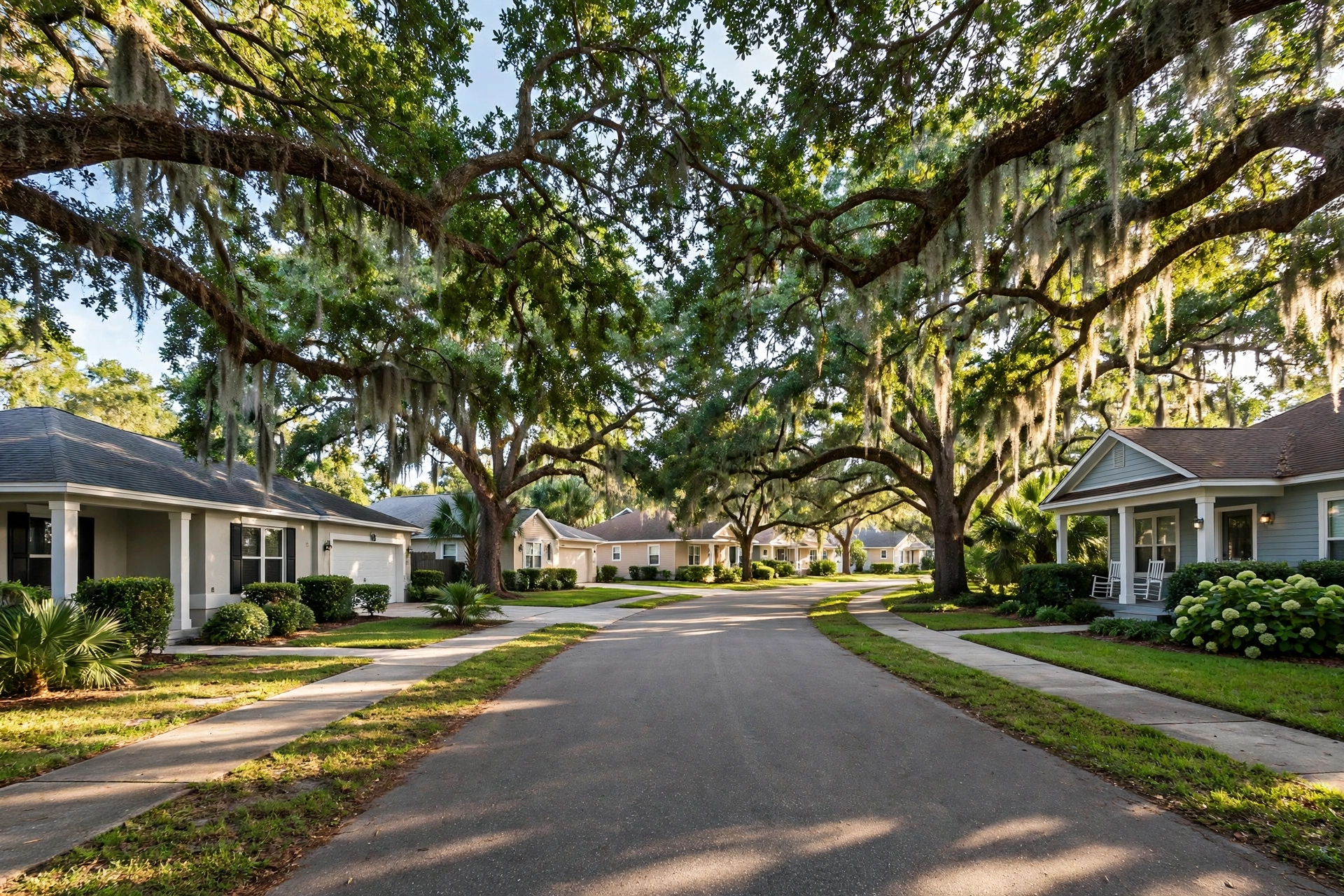
Jacksonville's median listing price sits near $295,000 — which means a $2,000-a-month principal-and-interest payment reaches further here than most buyers assume.
What about taxes, insurance, and the rest of the payment?
Everything above is principal and interest only — the P&I. Your actual monthly check is PITI plus more: principal, interest, property taxes, homeowners insurance, and, where they apply, mortgage insurance, HOA dues, flood insurance, and any community development district (CDD) assessment. In Northeast Florida those add-ons are not rounding errors. A prior breakdown on this site showed HOA dues, flood insurance, and a CDD fee adding $598 a month on one Jacksonville-area example — roughly $87,000 of loan amount that buys no house at all.
So the honest way to use this post's ladder is in two steps. First, find the P&I your total budget allows by subtracting your estimated taxes, insurance, and dues from the total monthly payment you are comfortable with. Then run the ladder on the P&I that remains. A buyer with a $2,500 total budget and $500 of taxes, insurance, and dues is really shopping with a $2,000 P&I — a $291,150 loan, not a $363,938 one. That is not bad news. It is the difference between an approval that feels good on paper and a payment that still feels good in month fourteen.
Does a 15-year loan change the math?
Yes — sharply, and in both directions. The 15-year fixed averaged 6.68% in the same Freddie Mac survey week. On a $300,000 loan, the 15-year payment is $2,643.10 a month versus $2,060.79 on the 30-year — about $582 more per month for the same loan amount, in exchange for owning the home free and clear in half the time and paying far less total interest. Run backwards, a $2,500 payment on a 15-year term supports a much smaller loan than on a 30-year term. Most first-time buyers choose the 30-year for the payment room and pay extra principal when they can — which is the same wealth-building direction, without the contractual obligation. The right term is the one whose payment you can carry in a bad month, not just a good one.
What should you do with this math?
First, pick your number honestly — the total monthly payment you can carry without strain, not the maximum a calculator approves. Second, subtract taxes, insurance, and dues to get your P&I. Third, run the ladder: divide your P&I by 100, multiply by $14,558, and you have your approximate loan amount at today's 30-year fixed rate of 7.32% (week ended October 22, 2026). Add your down payment and you have your price ceiling. Fourth — and this is the step most buyers skip — get that ceiling priced across programs before you choose. A VA $0-down file, an FHA 3.5%-down file, and a conventional 3%-down file on the same house produce three different monthly payments, three different cash-to-close figures, and sometimes three different answers about which house you can buy. With 200 lenders to shop, one lender's overlay or one program's pricing is never the last word on your file. Always apply and let the real guidelines decide — the actual agency guidelines, not a bank's stricter version of them.
If your payment math says you are $100 or $200 a month away from the house you want, that is a structuring conversation, not a rejection: a temporary buydown funded by a seller concession, a different program, a different down payment split, or a lender credit can close a gap that size. Intelligent structuring beats a headline rate every time, and it starts with knowing your real number.
Knowing your payment-to-price number before you tour is what turns house hunting from guessing into shopping.
What monthly payment are you actually comfortable with — and has anyone ever run the backwards math on it to show you the price that payment buys?
Start Here
Take the free rate check: find out what rate you actually qualify for across 200+ lenders — free, no credit check, no pressure. Then bring your payment number and let's run your price ceiling together, across VA, FHA, and conventional programs, on the actual agency guidelines. Apply now or take the quiz to start — either way, you will talk to a broker who prices your file, not a form that screens you out.
Douglas Wilkerson — NMLS #1680719
Direct: (904) 517-4049 | Office: (904) 906-8869
[email protected] | [email protected]
1548 the Greens Way, Ste. 4, Jacksonville Beach, FL 32250
Freeman Douglas Corporation is a DBA of Edge Home Finance. This is not a promise to lend — all credit decisions are subject to approval. Douglas Wilkerson, NMLS #1680719 | Edge Home Finance, NMLS #891464. Verify licensing at nmlsconsumeraccess.org. Equal Housing Opportunity.
