
Your ARM Is About to Adjust — Refinance to Fixed Before the Reset, or Ride It Out?
The Short Answer
If your adjustable-rate mortgage is coming up on its first adjustment, do not wait for the new payment to surprise you. On a standard 5/6 ARM, the first adjustment can move your rate by up to 2 percentage points at once. On a $350,000 loan, a jump from 6.25% to 8.25% adds $474.42 a month in principal and interest alone. Refinancing into a fixed rate before that reset does not have to beat your old starter rate to be the right move — it only has to beat the rate you are about to get.
That distinction is the whole decision. Borrowers compare a refinance offer to the rate they have today and decide it is not worth it. The rate they have today is already gone. The comparison that matters is the refinance rate against the adjusted rate — and against the second and third adjustments after that.

How Your ARM Actually Resets
An adjustable-rate mortgage has two phases. First comes the fixed period, when your rate does not move. In a 5/6 ARM, that period lasts five years. After that, the rate adjusts every six months for the rest of the loan. The first number in the name is the fixed period; the second is how often it adjusts once that period ends.
At each adjustment, your new rate is set by a formula in your note, not by your servicer's mood. The Consumer Financial Protection Bureau (CFPB) describes it plainly: your rate becomes the current value of an index plus a fixed margin, subject to any caps in your loan. The index moves with the broader market. The margin is set when you close and does not change for the life of the loan. The caps are the guardrails.
For conforming SOFR ARMs, the standard cap structure on a 5/6 ARM is 2/1/5: up to 2 percentage points at the first adjustment, up to 1 point at each later adjustment, and up to 5 points over the life of the loan above your starting rate. Your own note controls — some ARMs carry different caps — so read the adjustment section of your note before you assume anything. But 2/1/5 is the structure most borrowers with a recent conforming 5/6 ARM will find.
That first cap is the one that bites. A 2-point first move is not a worst case buried in fine print; it is the normal maximum for the first reset. If the index has risen since you closed, your servicer does not need a dramatic market move to hand you a much bigger payment. It only needs the index plus your margin to land 2 points above where you started.
The Math on a $350,000 Jacksonville Example
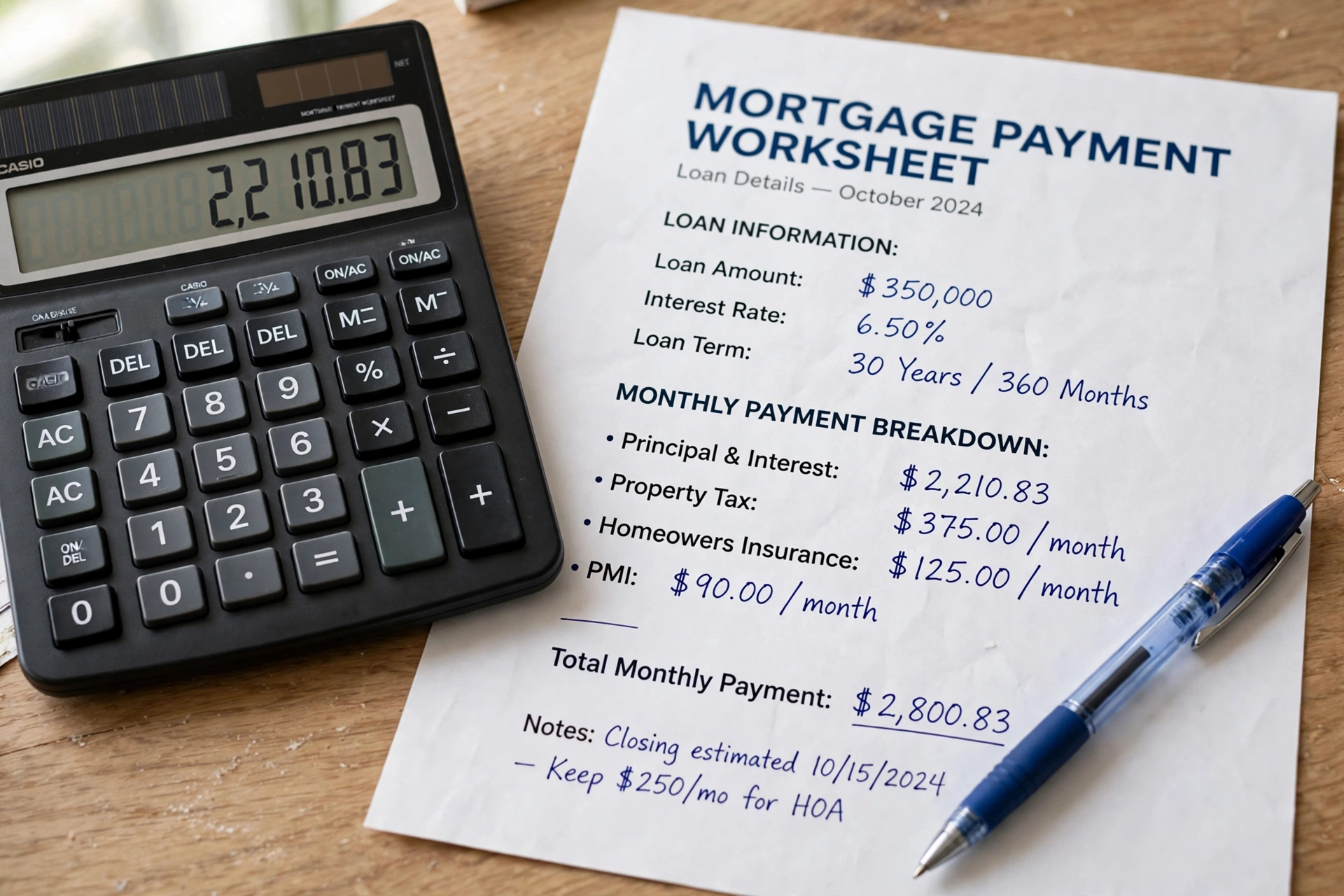
Take a $350,000 loan that started at 6.25%. Principal and interest on a 30-year amortization at that rate is $2,155.01 a month. Now run the first adjustment at its maximum:
- Today, at 6.25%: $2,155.01 a month in principal and interest.
- After a full 2-point first adjustment, at 8.25%: $2,629.43 a month — $474.42 more, every month.
- Refinanced to a fixed 7.24%: $2,385.24 a month — $244.19 less than the adjusted payment.
That 7.24% figure is Freddie Mac's Primary Mortgage Market Survey average for a 30-year fixed mortgage for the week ended October 29, 2026. It is a conventional benchmark for well-qualified borrowers, not a quote for your loan and not a VA rate. Your actual rate depends on your credit, your equity, your loan type, and the lender. The point of the example is the shape of the math, not the promise of a number: refinancing to a rate below your adjusted rate saves money even when that rate is above the starter rate you enjoyed for five years.
Now apply the break-even test from every refinance decision. If refinancing costs $4,500 in total and saves $244.19 a month against the adjusted payment, the math is $4,500 divided by $244.19, which is 18.4 months to break even. If you expect to stay in the home and the loan beyond 18 months, the refinance has paid for itself — and every month after that is money you are not handing to the adjusted rate. If you plan to sell or refinance again within a year, the same math argues the other way. The division, not the headline rate, is the decision.
Ride It Out, Refinance to Fixed, or Start a New ARM?
There are really three options at the reset, and each one wins in a different situation.
1. Ride the adjustment. This wins if you will sell or pay the loan off soon, if the index has fallen enough that your adjusted rate is close to — or below — your current rate, or if you genuinely expect rates to fall before the next adjustment and you can absorb one higher payment in the meantime. It loses if the index is high and stays high, because the periodic cap only slows the climb: another point at the next adjustment, and another after that, up to the lifetime cap.
2. Refinance into a fixed rate. This wins when the adjusted rate is already above what a fixed refinance would cost, when you plan to stay put for years, and when you want the payment to stop moving. The cost is real — closing costs, a new appraisal in most cases, and a fresh underwriting file — but the break-even division tells you exactly how long it takes to earn those costs back. It loses when you will move soon, or when your adjusted rate is still below the fixed rate you would refinance into.
3. Refinance into a new ARM. This is the option people forget, and sometimes it is the right one. If you plan to move in three to five years, a new fixed period at a lower starter rate can be cheaper than either riding the old loan or locking a 30-year fixed rate you will never keep for 30 years. The risk is the same as the first time: you are buying a fixed period, not a fixed rate, and the reset will come again. Only take this path with the reset date written down and a plan for it.
What to Check Before You Decide
Four facts from your own paperwork decide this faster than any rate forecast.
Your caps and your margin. Find the adjustment caps and the margin in your note. The margin never changes, so index plus margin is your fully indexed rate before caps. If that number is well above your current rate, the adjustment is not a possibility — it is a scheduled event.
Your adjustment date and your notice. Your servicer must warn you before the payment changes. Mark the adjustment date on your calendar and start the refinance conversation at least 60 days before it, so a slow appraisal or a document request does not push your closing past the reset.
Your equity and your credit. A refinance is a new loan, and it is underwritten on today's file, not the one from five years ago. Equity, credit, income, and debts all get a fresh look. That is also why the 200-lender point matters: one lender's overlay is never the last word. The actual agency guidelines — Fannie Mae and Freddie Mac for conventional loans, VA, FHA, and USDA where they apply — are the starting point, and a broker who shops across 200 lenders can find the lender whose guidelines fit your file instead of screening you out at the first no.
Your time horizon. Be honest about how long you will keep this loan. The break-even division is only honest if the horizon is. A refinance that breaks even in 18 months is a good deal for a borrower staying five years and a bad deal for a borrower selling in nine months.
The Jacksonville Angle
Jacksonville borrowers took out a lot of ARMs when fixed rates were high and the starter rate was the only way the payment worked. That was a reasonable trade at the time, and it is still a reasonable trade if the reset is managed. What turns it into a problem is silence: the fixed period ends, the letter arrives, the payment jumps, and the borrower discovers the refinance conversation should have started two months earlier.
If your ARM was taken out in 2021 or 2022, your five-year fixed period is ending now or soon. That cohort is the one this post is for. Pull the note, run the index-plus-margin math, and get a real refinance quote — not a rate from a headline — before the adjustment does the deciding for you.

The Bottom Line
An ARM is not a trap and a fixed rate is not a religion. An ARM is a loan with a calendar attached, and the calendar is doing exactly what it said it would do. The question is never whether your starter rate was good. It was. The question is what your payment becomes at the reset, what a fixed refinance costs against that payment, and how many months it takes to break even. On the $350,000 example here, a full first adjustment adds $474.42 a month, and refinancing to the 7.24% benchmark saves $244.19 of it, breaking even in 18.4 months on $4,500 of costs. Your numbers will differ. The division will not lie to you.
What would you do — ride the adjustment, refinance to fixed, or start a new ARM fixed period, and what is the one number that would change your mind?
Your Next Step
(1) Check Your Rate — Free
(2) Run your own numbers on the refinance quiz
(3) Prefer to talk it through? Call Douglas direct: (904) 517-4049.
Douglas Wilkerson — NMLS #1680719
Direct: (904) 517-4049
[email protected] | [email protected]
1548 the Greens Way, Ste. 4, Jacksonville Beach, FL 32250
Freeman Douglas Corporation is a DBA of Edge Home Finance. This is not a promise to lend — all credit decisions are subject to approval. Douglas Wilkerson, NMLS #1680719 | Edge Home Finance, NMLS #891464. Verify licensing at nmlsconsumeraccess.org. Equal Housing Opportunity.
