
Does Rental Income From the Other Units Count to Qualify for a VA Loan?
Does Rental Income From the Other Units Count to Qualify for a VA Loan?
Short answer: yes — if you live in one unit of a two- to four-unit property, a lender can count 75% of the rent from the other units toward your qualifying income. That is the VA's own rule. But the rent only counts when two conditions are met: the lender must see a reasonable likelihood you will succeed as a landlord, and you must document six months of mortgage payments (principal, interest, taxes, and insurance — PITI) in your own funds as reserves. Miss either, and the rent counts for nothing, even if tenants are already paying.
VA financing covers up to four units when you occupy one as your primary residence, with no down payment required when you have full entitlement. The qualifying math is where deals are won or lost: a fourplex costs more than a single-family home, and the rent from the other units is often what bridges the gap between your paycheck and the payment. Here is how the rule works, where the 25% haircut comes from, what the reserves really cost, and the three rental situations the VA treats completely differently.
What does the VA actually count — and why only 75%?
Under the VA Lenders Handbook (Pamphlet 26-7), Chapter 4, the amount included in your effective income is 75% of the rent on the lease for an existing property, or 75% of the appraiser's opinion of fair monthly rent for proposed construction. A higher percentage can be used only if adequately documented.
The 25% that disappears is not a penalty. It is the VA's vacancy and maintenance allowance — units sit empty between tenants, repairs cost money, and gross rent is never net income. The VA simply writes that haircut down as 75%.
On round numbers: if the three rented units of a fourplex bring in $4,500 a month in total rent, the lender counts $3,375 a month toward your qualifying income — not $4,500. That $3,375 is real income for underwriting purposes. It raises the income side of your debt-to-income ratio and your residual income calculation, which are the two tests the VA uses to decide whether you can carry the payment.
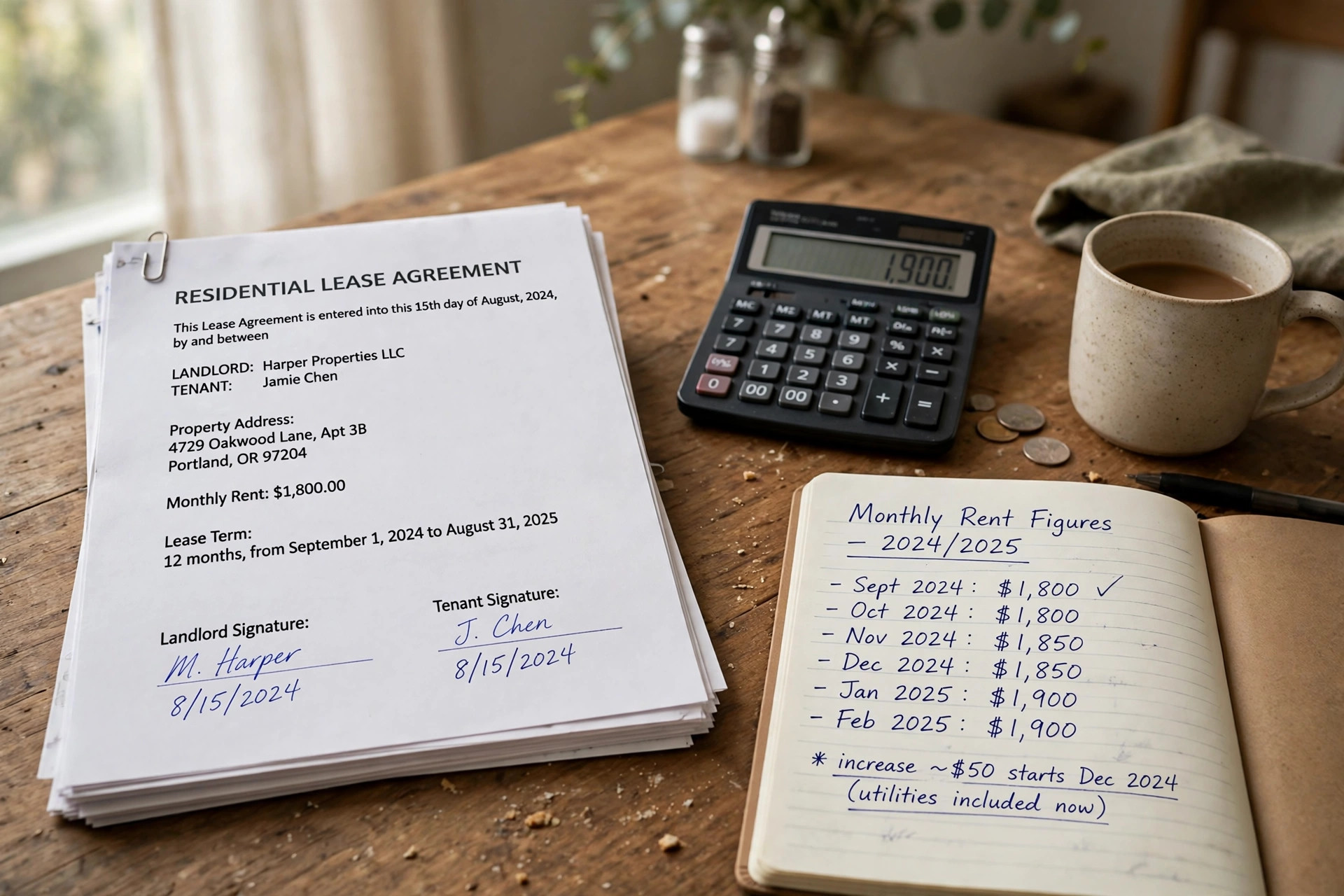
Caption: The lease is the starting document — the lender counts 75% of it.
What are the two conditions that unlock the rent?
The handbook allows the lender to include prospective rental income from the property securing the VA loan only when both of these are true:
1. A reasonable likelihood of success as a landlord. The lender must verify documentation of your prior experience managing rental units, or your use of a property management company to oversee the property. First-time landlord is not a disqualifier — but a file with no experience and no manager is a harder file. If you have never been a landlord, hiring a property manager before you apply is not just good business; it is the document that satisfies this condition.
2. Six months of PITI in reserves, in your own funds. The lender must verify cash reserves totaling at least six months of mortgage payments. This is the condition that surprises people, because the VA does not generally require reserves on a single-family purchase at all. The reserve requirement exists precisely because rental income is being used to qualify — it is the least certain income in the file, so the VA wants a cushion behind it.
The reserves must be your own funds, not a gift, and equity in the property cannot be used as reserves. If each unit is financed under a separate mortgage, six months of PITI must be verified for each separate unit.
How do the reserves work in dollars?
Take an illustrative Jacksonville example — not a quote, because your taxes, insurance, and rate will differ. Suppose you buy a fourplex for $520,000 with a VA loan and no down payment. Using the Freddie Mac Primary Mortgage Market Survey national average of 7.24% for a 30-year fixed loan for the week ending October 29, 2026, as a benchmark only (a conventional average, not a VA rate quote), principal and interest on $520,000 comes to $3,543.79 a month.
Add illustrative taxes and insurance to reach a total PITI of $4,200 a month. Six months of reserves is then $25,200 — money that must be in your account before closing, separate from closing costs and from the down payment (zero on a VA loan with full entitlement). That $25,200 is not spent at closing; it stays yours, as proof you can carry the building through a vacancy or a repair.
Now put the rent beside it. Three rented units at $1,500 a month each is $4,500 gross; at 75%, $3,375 counts toward your qualifying income. On a $4,200 PITI payment, that counted rent covers most of the payment on paper — which is exactly why the reserve rule exists alongside it.

Caption: Six months of PITI in your own funds is the price of counting the rent.
What rent figure does the lender use — the lease or the appraiser?
It depends on what exists when you apply. For an existing property with tenants in place, the lender starts from the lease or rental agreement — verified prior rent collected on the units. For proposed construction, there is no lease, so the calculation uses 75% of the appraiser's opinion of fair monthly rent.
Either way, the number must be supportable: signed leases at market rents, or an appraisal supported by comparable rentals. A lease written the week before closing far above neighborhood rents will draw questions. One lender's overlay on rental documentation is never the last word when you broker through 200 lenders.
What about rent from a home you already own?
This is the second rental situation, and it works differently. When you already own other rental properties, that rental income can be considered — but the reserve rule is three months of PITI for each such property, not six, and the income must be documented, typically through tax returns and leases. The cushion is smaller because a property with a track record is more certain income than rent projected on a building you have not yet bought.
What about rent from the house you are leaving?
This is the third situation, and it is the one most often misunderstood. If you intend to rent out the home you currently occupy when you buy your new home with a VA loan, that rent may not be included in your effective income. It may only be used to offset the mortgage payment on that departing property.
In plain English: the rent on your old house can cancel out its payment in your debt-to-income math, but it cannot be added to your income to help you qualify for the new loan, and no reserves are required for that offset. Only rent from the property securing the VA loan becomes qualifying income, and only with the six-month reserve condition met.
Does the rent change your debt-to-income and residual income tests?
Yes — that is the whole point. The VA's debt-to-income guideline is 41%, but the VA's real test is residual income: the money left over each month after the mortgage payment, taxes, insurance, utilities, and debts, measured against a table by region and family size. Florida sits in the VA's South region. For a loan of $80,000 or more, a family of four in the South needs at least $1,003 a month in residual income; above a 41% debt-to-income ratio, the lender looks for 20% more than the table figure.
Counted rental income improves both tests at once: it lowers your debt-to-income ratio and raises your residual income. That is why a veteran whose paycheck alone looks tight on a fourplex can still qualify once the rent is properly counted — and why the same veteran can be denied on the same building without the reserves documented. The rent does not change the payment; it changes whether your income is judged sufficient for it.
One more VA fact: the VA itself sets no minimum credit score. Individual lenders set their own score requirements, which is why a file one lender declines on credit deserves a second look across other lenders. The guideline is the VA's; the overlay is the lender's.
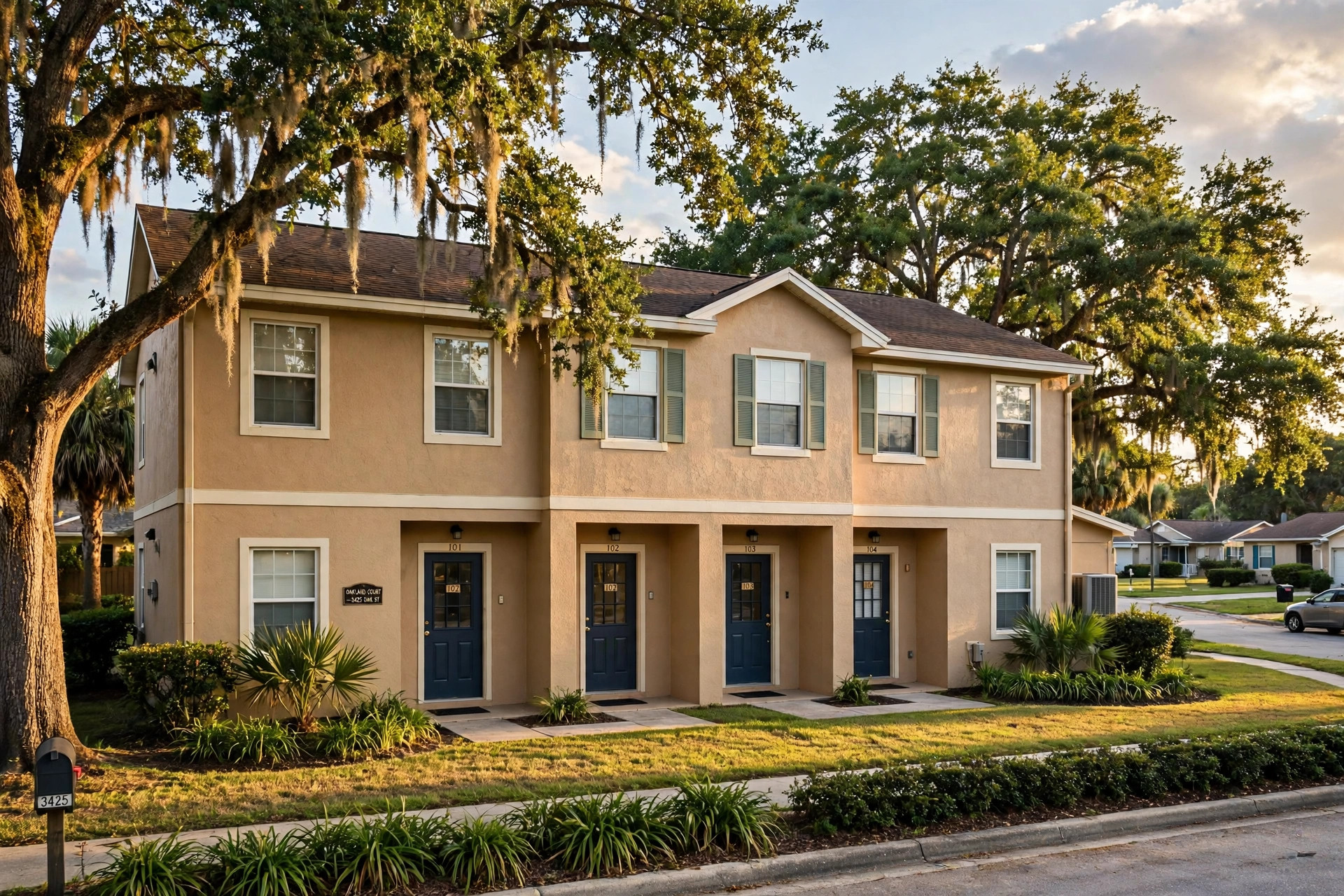
Caption: In Northeast Florida, the math is the same rule — but the rents and the reserves are local numbers, not national ones.
What does this look like for a Jacksonville buyer?
For a service member at NAS Jacksonville or Mayport, or a veteran settling in Duval County, the fourplex play is often less about a landlord empire and more about making the payment livable. You live in one unit, the other units' rent offsets much of the PITI, and you build equity in a whole building instead of one unit.
The local discipline is the same: verify rents against the neighborhood, not the seller's brochure; confirm the property meets VA Minimum Property Requirements on all units, not just yours; and save the six months of PITI before you offer, so the reserve condition is already documented rather than a scramble at underwriting.
Source: what this post stands on
The rental-income rules here come from the VA Lenders Handbook, Pamphlet 26-7, Chapter 4, Topic 2 on income: the 75% figure for leases and appraiser rent opinions, the six-month PITI reserve requirement for the property securing the loan, the landlord-experience or property-management documentation, the three-month PITI rule for other rental properties, and the offset-only treatment of rent from a departing residence. Occupancy rules come from the same handbook: up to four units, veteran occupies one as a primary residence. Residual income figures are the handbook's Chapter 4 tables for the South region. The 7.24% figure is the Freddie Mac Primary Mortgage Market Survey national average for a 30-year fixed loan for the week ending October 29, 2026 — a conventional benchmark for illustration only, not a VA rate quote. Every payment figure in the worked example is labeled illustrative; your taxes, insurance, rate, and entitlement will produce a different number.
Our Take
Here is Douglas's position, plainly stated. The VA's rule is generous in exactly the right place and strict in exactly the right place: generous, because it lets a veteran's tenants help carry a building the veteran could not carry on salary alone; strict, because it demands six months of real reserves and real landlord readiness before a dollar of that rent counts. Build the file around the reserves first and the rent second: save the cushion, document the landlord plan, verify the rents against the market, and then let the 75% do its work. If one lender tells you the rent cannot count, or demands more than the handbook requires, get a second opinion from a broker who works the actual guideline across 200 lenders — one lender's overlay is never the last word.
Would you buy a fourplex and live in one unit if the rent from the other three could count toward qualifying — or does the six months of reserves change the math for you? Tell us in the comments: what is the part of the rental-income rule you wish someone had explained before you started shopping?
Your Next Step
Run your own numbers on the VA Buy Power Calculator — plug in the payment, the rents, and the reserves, and see what your file actually supports before you offer.
Prefer to talk it through? Call Douglas direct: (904) 517-4049.
Douglas Wilkerson — NMLS #1680719
Direct: (904) 517-4049
[email protected] | [email protected]
1548 the Greens Way, Ste. 4, Jacksonville Beach, FL 32250
Freeman Douglas Corporation is a DBA of Edge Home Finance. This is not a promise to lend — all credit decisions are subject to approval. Douglas Wilkerson, NMLS #1680719 | Edge Home Finance, NMLS #891464. Verify licensing at nmlsconsumeraccess.org. Equal Housing Opportunity.
