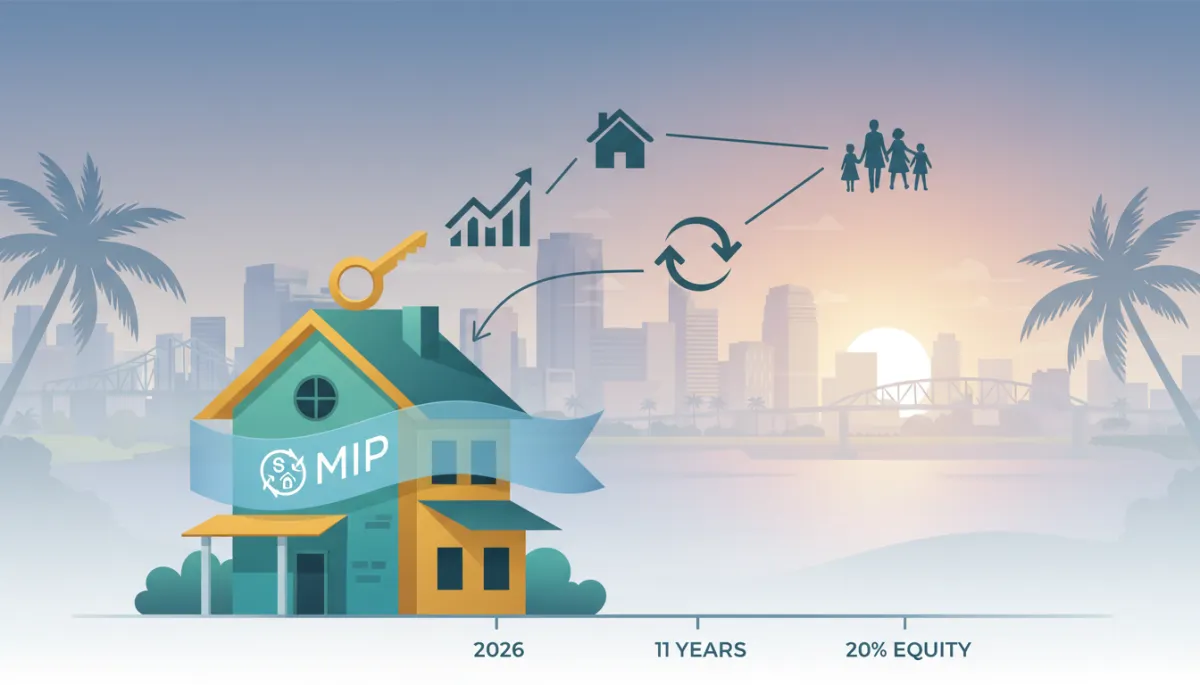
FHA Mortgage Insurance Costs & Exit Strategies 2026
Industry News & Trends, FHA Mortgage Insurance, Jacksonville Real Estate
FHA Mortgage Insurance in 2026: What MIP Really Costs, When It Ends, and Your Exit Plan
If you are buying with FHA in Jacksonville or anywhere in Northeast Florida in 2026, mortgage insurance is not a footnote—it is the line item that can quietly add thousands to your cost of ownership. Here is what FHA mortgage insurance (MIP) really costs today, how long it sticks around, and the exits you should plan for before you sign.
FHA Mortgage Insurance in 2026: The Real Cost on a Jacksonville Purchase
FHA mortgage insurance in 2026 still has two parts: an upfront premium and an annual premium paid monthly. The upfront mortgage insurance premium (UFMIP) is a flat 1.75% of the base loan amount on forward FHA loans, unchanged under HUD’s current schedule (HUD / answers.hud.gov). Almost every buyer finances this into the loan instead of paying it in cash at closing.
The annual MIP—what shows up in your monthly payment—depends on your loan term, loan amount, and loan-to-value (LTV). For a standard 30‑year FHA loan with a base loan amount at or below the conforming threshold and more than 95% LTV (which is what 3.5% down buyers have), the current annual MIP is 0.55% of the base loan amount per year, billed monthly (fhaloanlimitcalc.com).
A $350,000 Jacksonville Example in 2026
Let’s run the real numbers on a $350,000 home in Jacksonville with 3.5% down and a 580+ credit score:
Down payment: 3.5% × $350,000 = $12,250
Base loan amount: $350,000 − $12,250 = $337,750
Upfront MIP: 1.75% × $337,750 ≈ $5,911, typically financed, giving a starting balance around $343,661
Annual MIP: 0.55% × $337,750 ≈ $1,858 per year, or about $157/month added to your payment
On a $300,000 purchase, the monthly MIP runs roughly $137. At $400,000, it is about $180. The rate itself does not change with your credit score—a 580 borrower and a 780 borrower pay the same FHA MIP percentage. That flat pricing is one reason FHA can beat conventional for buyers with lower scores, even with the added insurance cost (fha.com).
💡 Pro Tip: Financing the 1.75% upfront MIP keeps cash in your pocket at closing, but it also means you start slightly underwater relative to your down payment—important when you map out your refinance timeline.
Why FHA Charges MIP—and Why It Still Exists in 2026
FHA is not a lender; it is an insurer. MIP is what protects lenders against the extra risk of low‑down‑payment loans, and it is what allows FHA to keep offering 3.5% down financing at credit scores where conventional would say no. In 2026, HUD’s schedule still pegs upfront MIP at 1.75% and annual MIP between 0.15% and 0.75% across different terms and LTV tiers (fhaloanlimitcalc.com).
Think of it as a trade: you get into a home in Jacksonville with $10,000–$12,000 down instead of $60,000–$70,000, and in return you pay a monthly insurance premium. For a renter paying around $2,200 a month while trying to save 20% down, the math often favors buying sooner with MIP over waiting years while prices and rents climb.
When Does FHA MIP Actually End in 2026?
This is the part most buyers never hear at the kitchen table. Since HUD’s 2013 rule changes, the duration of FHA MIP depends on your down payment and LTV at origination, not just your balance today (hud.gov).
Less than 10% down on a 30‑year FHA loan: annual MIP is charged for the life of the loan under the current schedule. It does not fall off automatically when you hit 20% equity or 78% LTV. It ends only when the FHA loan ends—through refinance, sale, or payoff (fhaloanlimitcalc.com).
10% or more down: annual MIP typically cancels automatically after 11 years on longer‑than‑15‑year terms, as long as the loan fits FHA’s lower‑LTV tiers. That 11‑year rule is the main built‑in off‑ramp for today’s purchase loans (answers.hud.gov).
Older FHA loans with case numbers before June 3, 2013 follow a different cancellation schedule that can allow automatic termination once the scheduled balance reaches 78% of the original value (HUD Mortgagee Letter 2025‑12). But for today’s buyers using 3.5% down, the working assumption should be: your MIP does not go away by itself.
Understanding how and when MIP ends is often worth thousands over your first decade of ownership.
Your Three Exit Plans from FHA MIP
Exit Ramp #1: Refinance into a Conventional Loan at 20% Equity
This is the exit most FHA buyers actually use. Once your loan balance is at or below 80% of your home’s current value, you can refinance into a conventional mortgage. The FHA loan—and its MIP—are paid off in the process. Any conventional PMI you carry cancels automatically at 78% LTV under federal rules, without a future refinance required (consumerfinance.gov).
In a market like Jacksonville, appreciation often does much of the heavy lifting. A buyer who purchased at $300,000 a few years ago may already sit at 20%+ equity purely from market gains. If you bought with FHA recently, the single highest‑value question you can ask is: What is my home worth today, and do I already have the equity to refinance out of MIP?
💡 Pro Tip: A refinance resets your term and locks in whatever rate the market is offering that day. Always weigh MIP savings against the new rate, costs, and how long you plan to keep the home.
Exit Ramp #2: FHA Streamline Refinance When Rates Drop
If you do not yet have 20% equity but rates fall, the FHA streamline refinance is FHA’s built‑in pressure valve. It lets you refinance from one FHA loan to another with reduced documentation—often no appraisal and minimal income paperwork—as long as the new loan provides a “net tangible benefit” like a meaningful rate reduction (fhaloanlimitcalc.com).
With the 10‑year Treasury recently flirting with 5% and government‑backed mortgage rates typically 1.00–1.50% above that, buyers in 2026 are very aware that today’s rate may not be tomorrow’s. The streamline gives you a way to capture a lower rate later without re‑doing your entire purchase file. You keep MIP, but you may cut your payment enough to more than offset it while you wait for equity to build.
Exit Ramp #3: Sell or Pay the Loan Off
The simplest exit: when you sell the home or pay the FHA loan off in full, MIP stops that day. Most first‑time buyers do not keep their original mortgage for 30 years. They move for a new job, a growing family, or they refinance into a different program. In that sense, MIP is usually a temporary toll on the road to building equity, not a life sentence.
FHA MIP vs. Conventional PMI vs. the VA Funding Fee
FHA MIP (2026): 1.75% upfront + 0.50%–0.55% annually for most standard 30‑year loans under the conforming cap, with life‑of‑loan MIP when LTV starts above 95% (fhaloanlimitcalc.com).
Conventional PMI: usually no upfront premium; monthly cost varies with credit score and down payment. PMI must cancel automatically at 78% LTV by law, and borrowers can request removal earlier once they hit 80% (consumerfinance.gov).
VA funding fee: a one‑time fee (commonly 2.15% for first‑use zero‑down, 3.3% for subsequent use) and no monthly mortgage insurance at all. Veterans with a 10%+ service‑connected disability rating pay no funding fee, which can make VA dramatically cheaper over time.
If you are a veteran, always run the VA option before defaulting to FHA. If you are buying outside the city, USDA can offer 0% down with lower monthly fees than FHA. And if your credit is strong enough for 5%‑down conventional, compare the long‑term cost of PMI that cancels versus MIP that may last for the life of the loan.
The Overlay Warning: FHA’s Rules vs. Your Bank’s Rules
Everything above reflects FHA’s published guidelines—3.5% down at 580 credit, 1.75% upfront MIP, 0.50%–0.55% annual MIP, the 11‑year rule for certain low‑LTV loans, and the streamline refinance (answers.hud.gov). Individual lenders, however, often add their own overlays: higher minimum scores, extra reserves, or internal “no streamline” policies. Those are their rules, not FHA’s.
This is exactly where a broker can change the outcome. With access to dozens or even hundreds of lending partners, one lender’s overlay is never the final word. If your profile fits FHA’s real guidelines, there is usually a lender whose guidelines fit you.
The Bottom Line for 2026—and Your Next Step
In 2026, FHA’s 3.5% down payment remains one of the fastest honest paths into a Jacksonville home for buyers without 20% saved. On a metro where many starter homes cluster around $300,000, that $10,500 entry point can move you from renter to owner years sooner. The price of admission is MIP: 1.75% upfront and roughly $137–$180 a month on a typical purchase, often for the life of the loan if you put less than 10% down.
Go in with your eyes open: know what MIP costs, know when it ends under today’s rules, and have an exit plan the day after you close—whether that is a conventional refinance at 20% equity, an FHA streamline when rates fall, or selling into your next home. MIP is a toll, not a trap, as long as you have the map before you start driving.
Start Here: Get Your Personal MIP Exit Math
If you bought with FHA and 3.5% down, do you know the exact terms of your MIP—and have you checked whether you already have the equity to refinance out of it? Drop your purchase year and price in the comments, or text me at (904) 517‑4049, and I will run your MIP exit math free. I read every message.
Thinking about buying with FHA—or already in an FHA loan and wondering about your MIP? Get the real numbers for your situation: your payment with MIP, your exit options, and a side‑by‑side against VA, USDA, and conventional so you choose the loan on math, not habit.
Douglas Wilkerson — Mortgage Broker
Branch Manager | Edge Home Finance
NMLS #1680719
Direct: (904) 517‑4049 | Office: (904) 906‑8869
[email protected] | [email protected]
1548 The Greens Way, Ste. 4, Jacksonville Beach, FL 32250
Freeman Douglas Corporation is a DBA of Edge Home Finance. This is not a promise to lend—all credit decisions are subject to approval. Douglas Wilkerson, NMLS #1680719 | Edge Home Finance, NMLS #891464. Verify licensing at nmlsconsumeraccess.org. Equal Housing Opportunity.
