Florida Amendment 3: What the $150,000 Homestead Exemption Would Actually Do to Your Monthly Payment
Eleven days from now, Florida voters decide Amendment 3. You've probably seen the headline numbers: a $150,000 homestead exemption in 2027, $250,000 in 2028 — the biggest property-tax change in recent Florida history. What most coverage buries in paragraph nine is the line that changes everything about the math: it only touches non-school taxes. Your school tax bill doesn't move a dime.
So let's do what nobody's doing: run the actual dollars, on a real Jacksonville home, in monthly-payment terms — the number that actually comes out of your escrow account. And then let's be honest about what could keep those savings from ever reaching you.
What a Homestead Exemption Actually Is
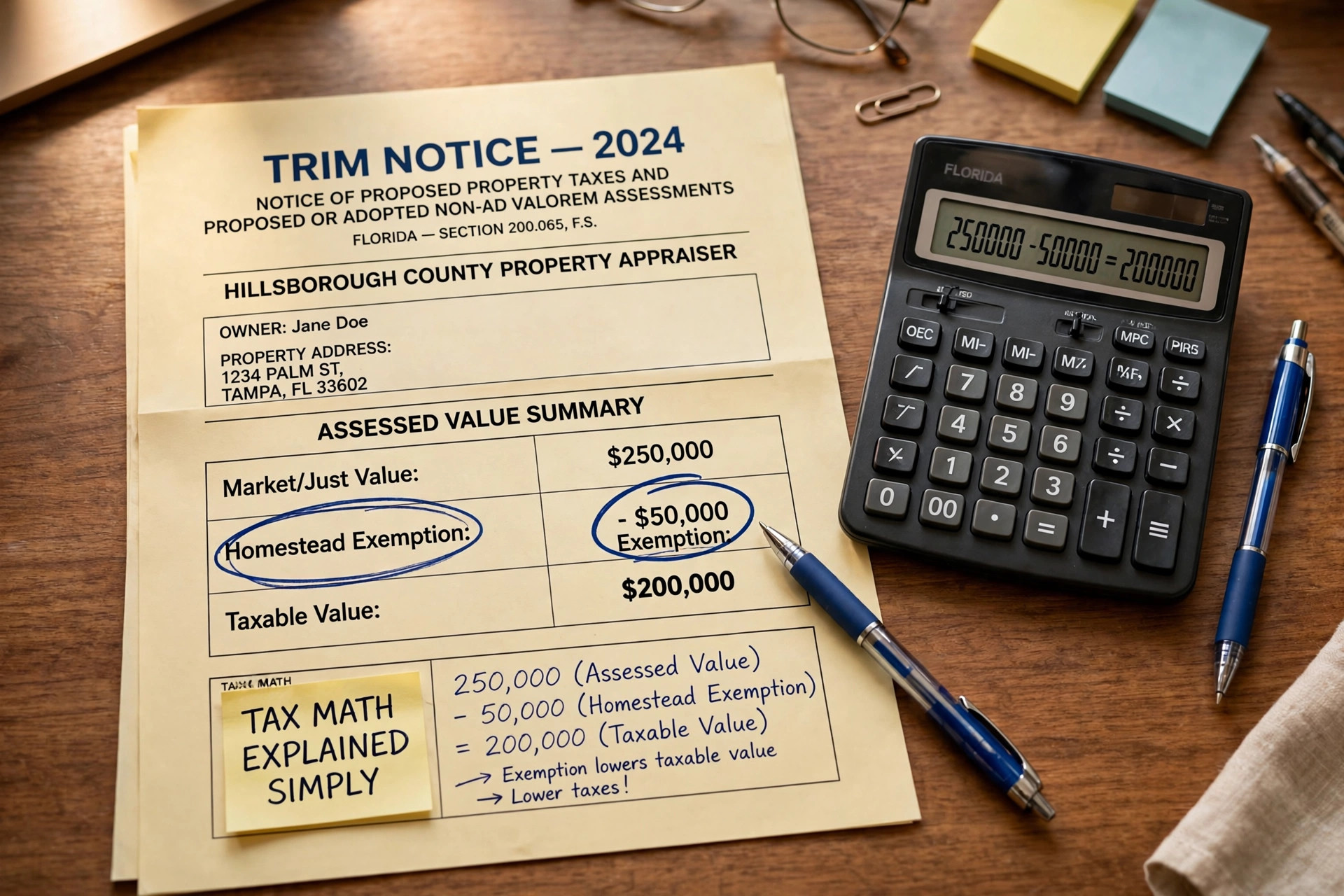
Strip away the politics and it's simple subtraction. Your property tax bill is:
Assessed value − exemptions = taxable value. Taxable value × millage rate = your bill.
The exemption comes off the top, before the millage rate multiplies anything. That's why an exemption increase is worth exactly: (the extra exempted value ÷ 1,000) × your non-school millage rate.
Right now, a Florida homestead gets two layers: $25,000 off all taxes (including school taxes) and an additional $26,411 off non-school taxes only on value above $50,000 — that second piece has been indexed to inflation since 2025, per the Florida Department of Revenue. Total non-school exemption today: $51,411. School taxes: just the first $25,000.
The Worked Example: A $400,000 Assessed Home in Duval County
Here's the napkin math for a home the Duval County Property Appraiser assesses at $400,000. Duval's total effective millage runs roughly 17.8 mills, and about 6.34 of those mills are the school district's — the part Amendment 3 can't touch. That leaves roughly 11.46 non-school mills (city, water management, and other district levies).
Today's bill (current $51,411 non-school exemption):
- Taxable non-school value: $400,000 − $51,411 = $348,589
- Non-school taxes: $348,589 ÷ 1,000 × 11.46 = $3,995/year ≈ $333/month
If Amendment 3 passes — 2027 ($150,000 exemption):
- Taxable non-school value: $400,000 − $150,000 = $250,000
- Non-school taxes: $250,000 ÷ 1,000 × 11.46 = $2,865/year ≈ $239/month
- Savings vs. today: about $1,130/year — roughly $94/month
2028 ($250,000 exemption):
- Taxable non-school value: $400,000 − $250,000 = $150,000
- Non-school taxes: $150,000 ÷ 1,000 × 11.46 = $1,719/year ≈ $143/month
- Savings vs. today: about $2,276/year — roughly $190/month
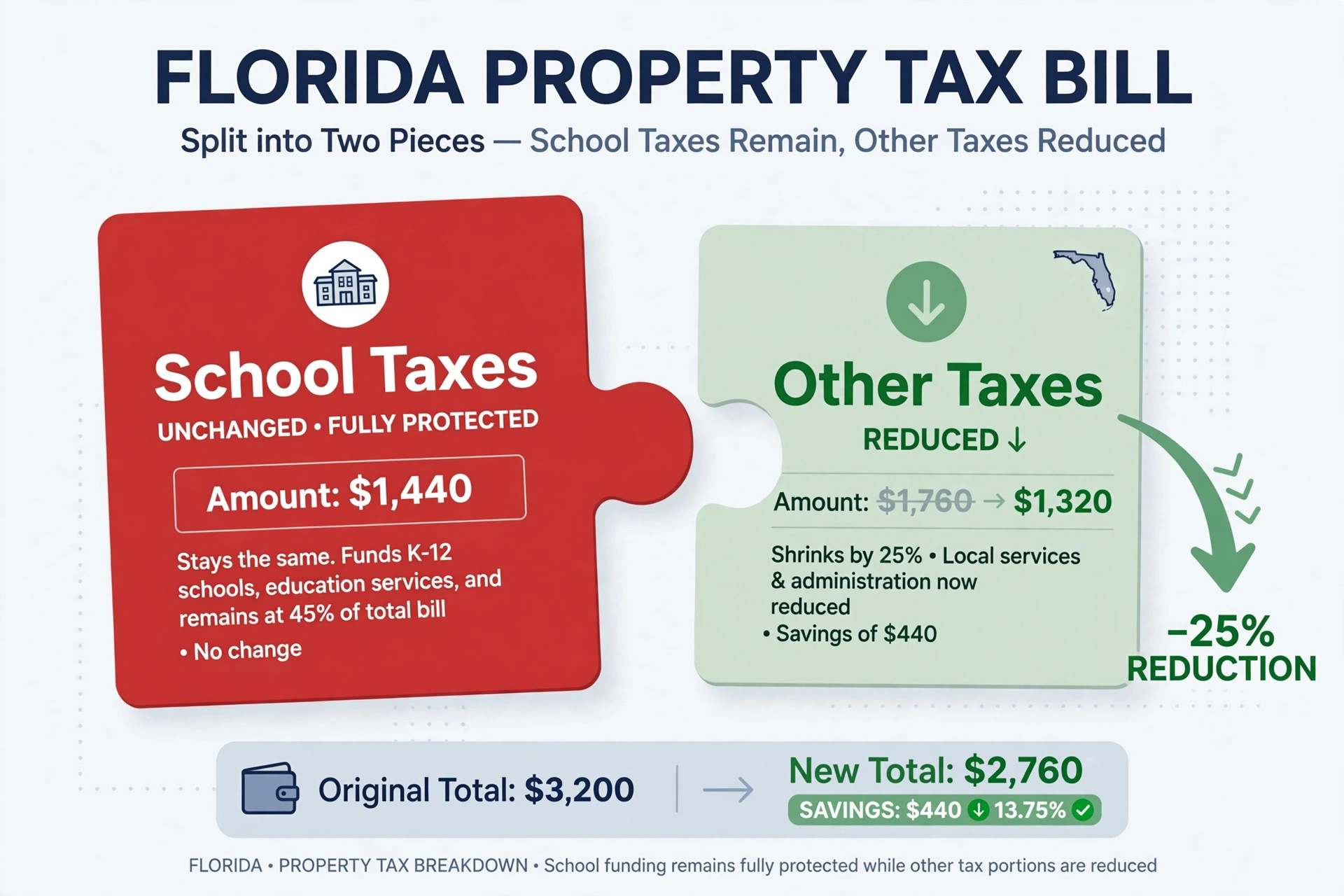
And here's the part that matters: the school tax line — ($400,000 − $25,000) × 6.343 mills ≈ $2,378/year, about $198/month — doesn't change. Florida TaxWatch estimates school levies are roughly 40% of the average property tax bill. So the amendment reaches a little over half of your bill, not all of it.
For context, TaxWatch's statewide estimate — using a $10.50-per-$1,000 average non-school rate — lands in the same neighborhood: about $1,035 saved in 2027 and $2,085 in 2028 for homes assessed above $250,000. The numbers check each other.
What's Actually in Amendment 3
This is proposed, not law. It needs 60% voter approval on November 3, 2026 to become part of the Florida Constitution. Per the official ballot summary published through the Florida Division of Elections (ballot title: "Increased Homestead Exemption; Lower Cap on Increases in Non-Homestead Property Assessments," placed on the ballot by the Legislature in a June 2026 special session as CS/HJR 1F):
- $150,000 homestead exemption for all non-school taxes, beginning January 1, 2027
- $250,000 beginning 2028, adjusted for inflation from 2029 onward
- The school-tax exemption stays at $25,000 — unchanged
- The annual cap on assessment increases for non-homestead property drops from 10% to 5% (matters for rentals, second homes, commercial — they get no new exemption, but their assessed value can climb more slowly)
- The Legislature must prescribe a procedure for counties and cities to raise the exemption further — up to full assessed value — for their own levies
- Save Our Homes, portability, and the existing veteran, senior, widow/widower, first-responder, and disability exemptions all stay as they are
One more detail worth knowing: the original ballot language was ruled misleading by a Leon County circuit judge in August 2026, and the Attorney General issued revised wording. The amendment itself didn't change — but it's a reminder to read the actual ballot summary, not the yard signs.
The Five-Year Rule Newcomers Must Know
If you're relocating to Jacksonville — and plenty of people are — this one is for you. The ballot language says: a person who is not a Florida resident on December 31, 2026 receives the existing exemption when they qualify for homestead, and the increased exemption only beginning with the fifth year of exemption.
Translation: move to Florida in 2027, buy a house, file homestead — and you budget with the current ~$51,411 exemption, not the $150,000 headline, until year five. The proposed larger exemption doesn't ride along with the moving truck.
This matters enormously for payment math. A relocating buyer who pencils in $190/month of savings that won't arrive until year five is underwriting a payment that doesn't exist yet. Run your PITI with today's exemptions. Anything else is a wish.

What Buyers Should Actually Do
- File homestead by March 1. Whatever the amendment does or doesn't do, this is the step most people leave on the table. You must own and occupy the home as your permanent residence on January 1 of the tax year, and you file with the Duval County Property Appraiser by March 1. No filing, no exemption — current or future.
- Run the full PITI math before ruling a payment out. A tax bill that could drop by $190/month in 2028 is real money in the escrow calculation — but so is the school tax that stays. If a payment looks tight today, model it both ways: today's bill and the post-amendment bill. Buy the payment you can afford now; treat the savings as upside.
- Read your TRIM notice every August. That's the first document that would show the new exemption if it passes — and it's your annual chance to spot assessment errors before the bill arrives.
- Talk to a broker who works the actual guidelines. Property taxes are a quarter of most PITI payments, and the person running your numbers should be running all of them — not just the loan. We broker through 200 lenders against the actual agency guidelines, so one lender's overlay is never the last word on your file.
The Honest Caveats
- It might not pass. Sixty percent is a high bar for a constitutional amendment. An August poll had support at 63% — three points of margin, and polls aren't ballots.
- Cities and counties are warning about funding gaps. The Florida Revenue Estimating Conference puts the recurring cost to local governments at roughly $12 billion a year once fully phased in. Lower bills get paid for somehow — over time that can show up in budgets, fees, and services.
- Never buy a house assuming the savings exist. This is the steady-hand rule: underwrite the purchase on today's tax bill. If the amendment passes, the savings are a bonus. If it doesn't, you're exactly where you planned to be.
- Millage rates aren't capped. Even with a bigger exemption, local governments can still raise millage rates — and the assessed value side of the equation keeps moving on its own.
Property taxes don't decide whether you buy a house. They decide whether the monthly payment works — and now, more than most years, the payment depends on what happens at the ballot box eleven days from now.
Were you ever told the full property tax picture when you bought — or did you find the exemptions and the millage math on your own after the first bill arrived?
Start Here
Wondering what your actual monthly payment looks like — taxes, insurance, and all — on a real Jacksonville home? Take the 60-second quiz and find out where you stand in about a minute — or apply now and let us run your real numbers. One lender's overlay is never the last word when you have 200 lenders to choose from.
Douglas Wilkerson — Mortgage Broker, NMLS #1680719
Direct: (904) 517-4049 | Office: (904) 906-8869
[email protected] | [email protected]
1548 the Greens Way, Ste. 4, Jacksonville Beach, FL 32250
Freeman Douglas Corporation is a DBA of Edge Home Finance. This is not a promise to lend — all credit decisions are subject to approval. Douglas Wilkerson, NMLS #1680719 | Edge Home Finance, NMLS #891464. Verify licensing at nmlsconsumeraccess.org. Equal Housing Opportunity.
