Florida Condos Are Sitting: When Buying One Actually Makes Financial Sense | Freeman Douglas
Housing Market, Florida Condos, Investment Strategy, Mortgage Planning
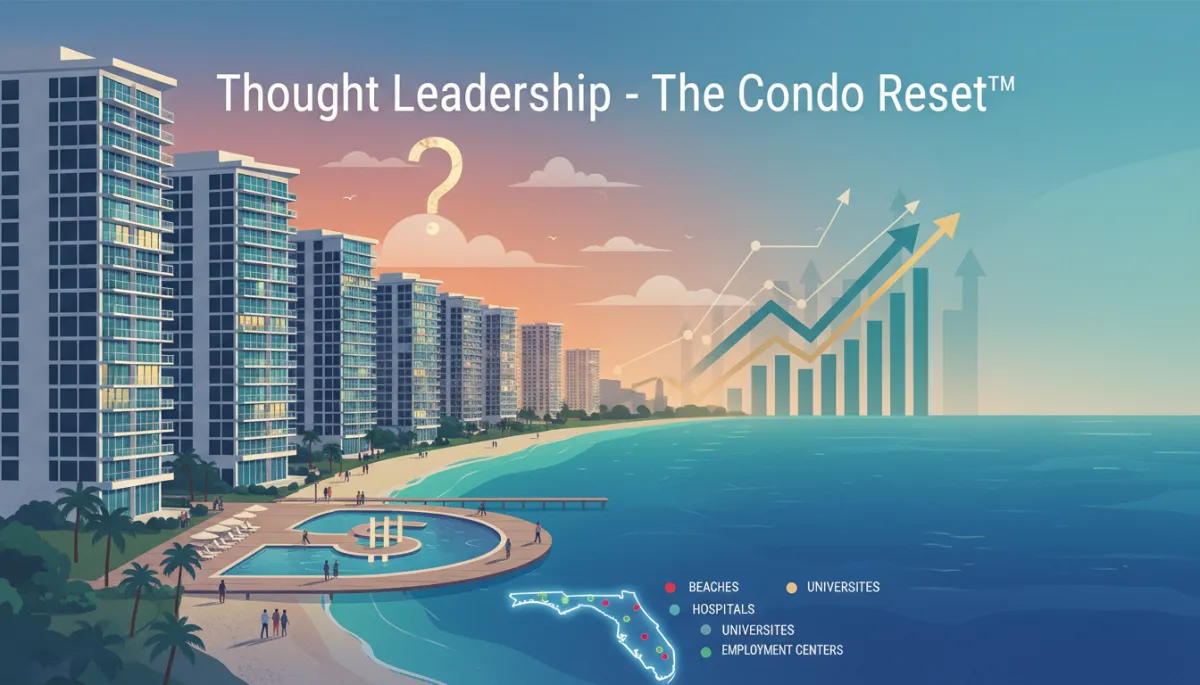
Thought Leadership – The Condo Reset™: Florida Condos Are Sitting. Is That a Warning—or an Opportunity?
Florida’s condo market looks broken at first glance—units in prime locations are sitting on the market, seeing repeated price cuts, and still not moving. As a quantitative trader and financial analyst, I see something different: a repricing event. The Condo Reset™ is not just a housing story; it is a risk–reward puzzle that disciplined buyers, homeowners, and investors—especially veterans and first-time buyers—can analyze with the same rigor used in capital markets.
1. The Condo Reset™: A Quantitative Way to Think About Florida Condos
In trading, when a market stops clearing at previous prices, we call it a repricing, not a collapse. Florida condos are in that phase right now. Listings in desirable locations—near beaches, hospitals, universities, and employment centers—are sitting for six, nine, twelve months or longer. Prices get cut, yet units still linger. The right question is not, “What’s wrong with it?” It is, “What is the market actually discounting—and is it over-discounting certain risks?”
The Condo Reset™ is a framework that treats each unit like a security. You are not buying a floor plan; you are buying a stream of cash flows, a bundle of risks, and an exit profile. Your first question should always be: What job is this property supposed to perform in my financial life?
2. Florida Housing Market: Two Markets, Two Speeds
Start with the data. As of July 2026, Florida had roughly 4.5 months of single-family supply, versus about 7.8 months of condo and townhouse supply statewide (Florida Realtors; Cameron Academy, September 2026). That is a material gap—condos are clearly the slower tape. Condos took about 76 days to go under contract, compared with 47 days for single-family homes, and sellers received around 93% of original list price versus 96% for houses (Move With Momentum).
Yet volume is strengthening. Closed condo/townhouse sales in July 2026 rose 11% year-over-year, the 11th consecutive month of annual gains, while the median condo price held flat at $295,000. In Miami‑Dade, condo sales were up about 11.4% year-over-year even as the median price slipped roughly 1.5% to $400,000, with 12 months of supply—a clear buyer’s market (Manhattan Miami).
Segment (July 2026 | Single-Family | Condos/Townhouses |
|---|---|---|
Months of supply (statewide) | ~4.5 months | ~7.8 months |
Days to contract | 47 days | 76 days |
% of original list price received | ~96% | ~93% |
Southwest Florida shows the same split: condo sales up roughly 17% year-over-year in Q2 2026, but real median prices down about 8% (FGCU RERI). The message is clear—buyers have not abandoned condos, but they are aggressively repricing risk and monthly cost.
3. Why People Buy Condos: The Economic Function, Not the Floor Plan
Condos exist to solve real problems that single-family homes sometimes cannot. In quantitative terms, they offer location efficiency—access to high-demand locations with lower upfront capital. Common legitimate reasons include:
Living near a beach, hospital, university, or employment center where detached homes are prohibitively expensive.
Desire for a lock‑and‑leave lifestyle with limited exterior maintenance—valuable for frequent travelers and retirees, including many veterans using VA benefits to relocate or downsize.
Access to amenities—pools, fitness centers, security, covered parking, walkability—that would be expensive to reproduce in a single-family setting.
Second-home or eventual rental strategies near durable demand generators such as universities, hospital corridors, or tourism hubs.
In Jacksonville Beach, for example, 2026 listing data show median single-family prices substantially above entry‑level condo pricing. That spread is location arbitrage—you accept a different structure to buy into an otherwise unaffordable location. That can be rational, but only if the total economics support the decision.
4. The Real Comparison: Total Economic Position vs. Sticker Price
A $300,000 condo next to a $450,000 house looks “cheap” until you run the math. The correct comparison is not house price vs. condo price. It is total economic position vs. total economic position—what this asset does to your balance sheet and monthly cash flow over time.
📌 Key Takeaway: For homebuyers, especially VA borrowers and first‑time buyers, affordability is not just about principal and interest. It is about all‑in monthly cost and long‑term flexibility.
Mortgage principal and interest (factoring in VA, FHA, or conventional terms).
Property taxes, insurance, and unit‑level coverage.
HOA dues, master‑association fees, and any known or probable special assessments.
Interior maintenance, utilities, potential management fees, and vacancy if the condo becomes a rental.
Florida condos have been hit by a series of shocks—higher insurance, higher operating costs, higher mortgage rates, and post‑Surfside structural and reserve requirements. The market is not saying “no one wants condos.” It is saying, “At this price plus these recurring obligations, we do not want this condo.”
5. When a Condo Sits for a Year: Reading the Market’s Message
In markets like Miami and Fort Lauderdale, condo supply ranges from roughly 8.7 to 13.4 months depending on the city (PBP Real Estate). Long market times are common. A listing that has been active for 400–500 days is not automatically a bargain or a toxic asset—it is information. The market has repeatedly rejected the previous combinations of price and terms. Your job is to figure out why.
Is the HOA unusually high relative to comparable buildings?
Are there special assessments, underfunded reserves, or looming capital projects?
Are rental restrictions killing investor demand?
Has the seller simply refused to adjust to the new pricing reality?
Street-level view of Florida mid-rise condo building with for-sale signs and quiet sidewalk,...
Extended days on market signal mispriced risk—not necessarily a bad asset.
Time also has a balance sheet. If a seller’s carrying costs are $2,500 per month, eighteen months of waiting represents roughly $45,000 in out‑of‑pocket drag. That does not entitle you to a $45,000 discount, but it tells you the seller is bearing real economic pain—information you can incorporate into your negotiation strategy.
6. Condo Association Financial Health: The Hidden Balance Sheet You Are Buying
As an investor or homeowner, you are not just buying a unit—you are buying into a shared balance sheet. Florida’s post‑Surfside regulations require Structural Integrity Reserve Studies and milestone inspections for many buildings. Those studies often surface deferred capital needs that were previously ignored. A “cheap” HOA can be more dangerous than an expensive one if it reflects chronic underfunding.
Review the full association budget, reserve schedules, and recent financial statements.
Examine Structural Integrity Reserve Studies and milestone inspections where applicable.
Identify active or pending special assessments, association debt, and owner delinquencies.
💡 Pro Tip: A higher monthly HOA in a building with strong reserves and completed major work can be safer than a low HOA masking deferred liabilities that will eventually show up as large assessments.
7. Rental Strategies and Restrictions: Optionality vs. Handcuffs
From a trader’s perspective, the ability to change an asset’s use is a form of optionality. Two identical condos with identical prices can have very different economic value if one allows flexible leasing and the other does not. Before you ever underwrite “I’ll rent it,” you must know what is legally allowed.
Minimum lease duration and maximum lease frequency.
Waiting periods before first lease and owner‑occupancy requirements.
Rental caps, short‑term rental prohibitions, and rules affecting furnished mid‑term rentals.
Do not trust “I think they allow rentals.” Get the documents and read them—especially if you are counting on mid‑term housing for traveling nurses, graduate students, or corporate tenants. A single paragraph in the declaration can invalidate your entire business plan before you close.
8. Five Core Condo Investment Strategies—and How to Underwrite Them
Strategy 1: Traditional Long‑Term Rental
The classic model: buy, rent on a 12‑month lease, renew. The temptation is to run a simple rent minus mortgage calculation. A more professional approach uses: Rent – true ownership cost – operating cost = operating result.
Include mortgage, taxes, insurance, HOA, management, vacancy, interior repairs, and reserves for capital items and association obligations.
Strategy 2: College‑Demand Condo
Near universities, condos can house students, graduate students, faculty, and visiting academics. A parent may buy a unit for four years of college housing, then retain it as a rental. The thesis is: housing expense today → potential income‑producing asset tomorrow.
Verify roommate rules, parking, lease length, and turnover realities. Do not assume “there’s a college nearby” is sufficient justification.
Strategy 3: Traveling‑Professional Condo
Hospitals and medical centers create recurring mid‑term demand for traveling nurses, contract clinicians, and executives. This sits between hotel stays and 12‑month leases. A well‑located furnished condo can serve this niche—if association rules allow shorter leases and if local regulations support it.
Strategy 4: Second Home with Future Conversion
Many buyers—especially veterans planning for retirement—want a beach‑area or walkable second home now, with the possibility of converting it to a long‑term rental later. That path: primary → second home → rental asset can work, but only if the documents support future leasing and financing remains available for the building type.
Strategy 5: Short‑Term Vacation Rental
This is the most seductive—and the most dangerous—strategy. “Beach condo, ocean view, Airbnb, easy money” is not a plan; it is a slogan. You must account for local ordinances, condo rules, licensing, taxes, management fees, platform costs, furnishings, seasonality, and vacancy. Critically, some condo projects that behave like resorts face tighter mortgage eligibility, shrinking your future buyer pool and complicating your eventual exit.
9. Cash‑on‑Cash Return: Measuring the Job the Condo Actually Performs
As a financial analyst, I am less interested in whether a condo “cash flows” and more interested in return on capital actually at risk. Suppose:
Purchase price: $250,000
Down payment: $62,500 (25%)
Closing costs, reserves, furnishings: $17,500
Total initial capital: $80,000. Now estimate realistic rent and subtract realistic expenses (mortgage, taxes, insurance, HOA, utilities, vacancy, management, reserves, and expected association obligations). The resulting annual net cash flow, divided by $80,000, is your cash‑on‑cash return. Then compare that return to what you could earn with the same capital elsewhere—paying down other debt, investing in diversified portfolios, or pursuing different real‑estate strategies, including VA‑financed primary homes with stronger long‑term flexibility.
10. Exit Strategy: Liquidity Is Part of Your Return
In trading, you never enter a position without knowing how you will exit. The same applies to condos. Many Florida markets now show double‑digit months of supply for condos, especially in South Florida. If your future buyer pool is constrained by financing rules, rental restrictions, or high HOA costs, your holding period risk increases—even if the property “cash flows” on paper today.
Who is the likely future buyer—primary occupant, retiree, second‑home buyer, investor, VA borrower, or cash buyer?
Will association rules or project characteristics limit mortgage options, shrinking that pool?
How sensitive is this building to changes in insurance costs, assessments, or regulatory shifts?
📌 Key Takeaway: A condo that produces $300 per month in cash flow but takes 18 months to sell when you need your capital back has a very different risk profile from one in a building with broad financing eligibility and deep buyer demand.
11. Applying The Condo Reset™: A Seven‑Question Test
What job does it have? Primary residence, second home, student rental, mid‑term furnished rental, long‑term rental, or retirement pivot? If you cannot define the job, do not buy the asset.
Why this location? Which demand generator—beach, hospital, university, military base, walkable downtown—creates durable need that is hard to replicate elsewhere?
What is the true ownership cost? Not just principal and interest, but every recurring obligation and known capital requirement.
What is the association’s financial condition? Budget, reserves, inspections, assessments, insurance, debt, and delinquencies all belong in your spreadsheet.
What can I legally do with it? Read the documents. Your rental strategy must survive the fine print.
Does the rental strategy actually work? Underwrite realistic income, realistic expenses, and realistic vacancy. Then calculate return on invested capital—not just gross yield.
Who buys it from me? Your exit is part of your entry strategy. Liquidity is part of return.
12. Warning or Opportunity? How to Use This Market to Your Advantage
Florida’s condo segment is not a dead market; it is a repricing market. Inventory is elevated, days on market are long, investor purchases have retreated, and yet sales volumes are rising again. That combination often creates mispricings—assets that are cheap for a reason, and others that are underpriced relative to their true, quantified risk.
For disciplined buyers—especially veterans leveraging VA options, families planning long‑term housing strategies, and investors willing to do the work—this is exactly the kind of environment where thoughtful analysis can separate warning from opportunity. Do not buy a condo because it looks cheap. Buy it because you know precisely what job it is supposed to perform—and the numbers prove it can do that job under conservative assumptions.
This material is for educational purposes and does not constitute investment, tax, legal, insurance, or financial advice. Condominium restrictions, association finances, mortgage eligibility, rental regulations, and tax treatment vary by property and individual circumstances. Rental projections are not guarantees of future income.
