Florida Property Tax Reset: The Homebuyer Payment Trap | Freeman Douglas
Florida Homebuying, Property Taxes, Save Our Homes, VA Loans, Financial Planning
Tips & Best Practices – The Payment Reset™: Why the Florida Seller’s Property Tax Bill May Not Be Yours
In Florida, one misunderstood number can quietly derail an otherwise solid homebuying plan—the seller’s property tax bill. The Payment Reset™ is about replacing that number with a realistic estimate of what the house is likely to cost you to own, not what it costs the current owner.
1. Start With The Payment Reset™ Mindset
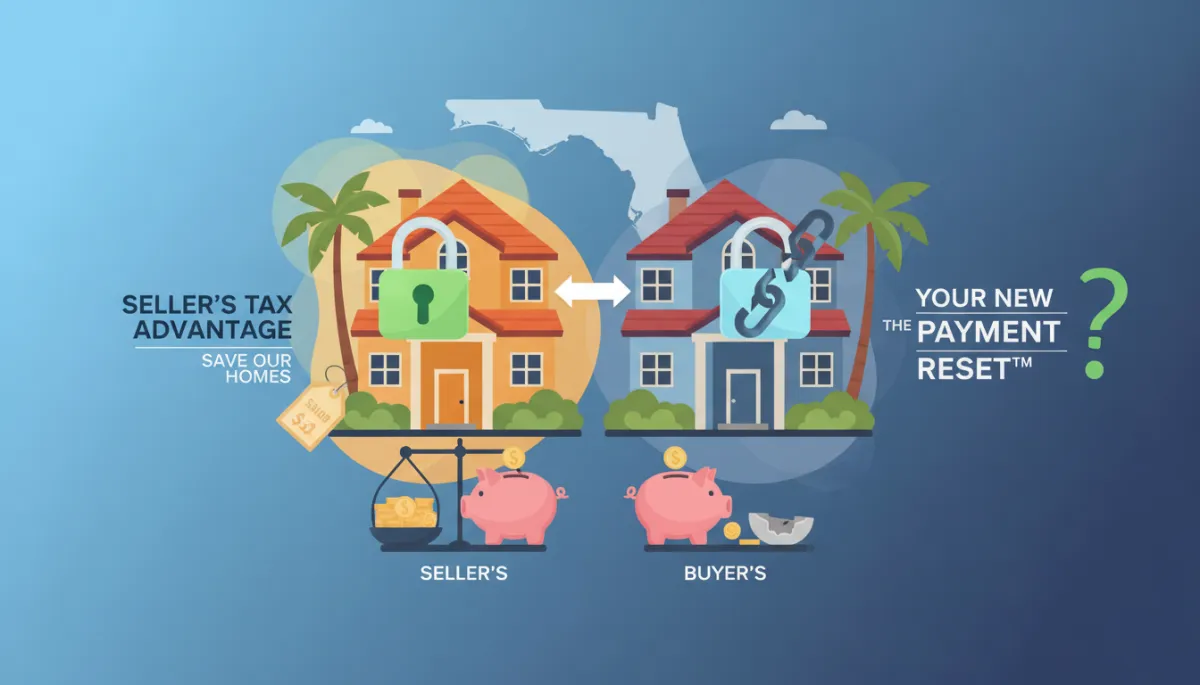
The Payment Reset™ is a simple but powerful shift in how you evaluate a Florida home. Instead of asking, “Can I afford the seller’s payment?”, you ask, “What will my payment reset to after I own this property?” That reset often begins with property taxes—especially in a state where the Save Our Homes assessment limitation can create a large gap between what the seller pays and what you may pay after closing.
💡 Best Practice: Treat the seller’s tax bill as a data point, not a decision point. Use it to ask better questions, not to build your final budget.
2. Why the Florida Seller’s Property Tax Bill May Not Be Yours
When you see “Property Taxes: $4,800” on a listing or county website, it feels concrete. It looks like a monthly number you can plug into your payment estimate. The problem is that the bill you see reflects the seller’s history—when they bought, how long they have owned the home, what exemptions they receive, and how much Save Our Homes protection they have accumulated over time.
Under Florida law, when a homesteaded property changes ownership, it is generally reassessed at current just (market) value, subject to applicable rules and exceptions. The seller’s exemptions and Save Our Homes benefit do not simply transfer to you. You may qualify for your own homestead exemption, portability, or veteran benefits—but those are your systems, not the seller’s. This is why building your budget around the current tax bill can be misleading, and in some cases, financially dangerous.
📌 Key Takeaway: A listing can show perfectly accurate taxes—and still show the wrong number for your long-term payment.
3. Understand Save Our Homes Before You Rely on Any Tax Number
Save Our Homes is one of the most important features of Florida property taxation—and one of the most misunderstood. For property owners who qualify for homestead exemption, annual increases in assessed value are generally capped at the lower of 3% or the change in the Consumer Price Index (CPI) under Article VII, Section 4 of the Florida Constitution and section 193.155, Florida Statutes. For the 2026 tax year, that cap is approximately 2.7%, according to the Florida Department of Revenue and local property appraisers.
Over time, this limit can create a significant gap between what the property is worth in the market and the value used to calculate the owner’s taxes. That gap is often called the Save Our Homes differential. Longtime Florida homeowners can carry very low assessed values relative to current prices—especially in appreciating markets like Jacksonville, where prices have moved over the years even as the 2026 median sale price sits near $310,000 and has softened modestly year-over-year (Momentum Realty, NEFAR, Redfin).
💡 Best Practice: Whenever you see a low tax bill on a long-held property, assume Save Our Homes is part of the story until proven otherwise.
4. Market Value vs. Assessed Value vs. Taxable Value – Know All Three
A Florida home does not have “one” value. For property-tax purposes, it has several. Understanding the differences is essential to any serious Payment Reset™ analysis:
Market (Just) Value: The property appraiser’s estimate of what the property is worth in the current market, based on statutory requirements and local data. This is conceptually close to what an informed buyer might pay in an open market, but it is not the same as your contract price in every case.
Assessed Value: The value after assessment limits, such as Save Our Homes, are applied. For homesteaded property, this is where the 3% / CPI cap shows up over time, often pulling assessed value well below market value.
Taxable Value: The amount that remains after exemptions (homestead, veteran, disability, senior, and others) are subtracted from the assessed value. Millage rates are applied to this number to calculate the actual tax bill.
In practice, you may see something like this on a long-held homestead:
Market Value: $500,000
Assessed Value (after Save Our Homes): $300,000
Taxable Value (after exemptions): lower still
That $200,000 gap between market and assessed value is the seller’s Save Our Homes differential. It is a financial advantage they built over time. You do not automatically step into that position when you buy the home.

The gap between market and assessed value is often the seller’s Save Our Homes advantage.
5. What Happens to Property Taxes After an Ownership Change?
After a qualifying change in ownership, Florida law generally requires the property appraiser to reassess the property at current just (market) value for the next tax year, then apply any new owner exemptions and caps going forward. The previous owner’s Save Our Homes cap and exemptions fall away. This is the core of the Payment Reset™ in Florida.
You buy the home—say, for $500,000.
The property appraiser reassesses it closer to current market value, subject to statutory requirements and timing.
You apply for homestead exemption, portability, and any other exemptions by the March 1 deadline, if eligible.
Your new assessed and taxable values are set for the coming tax year, and future increases are then subject to Save Our Homes caps for your ownership period.
⚠️ Warning: A low current tax bill on a long-owned home can jump substantially after sale. Ignoring this can lead to escrow shortages, higher monthly payments, and budget stress.
6. Portability: Bringing Your Own Save Our Homes Differential With You
If you already own a Florida homestead and you are moving to another Florida homestead, you may be carrying a hidden asset—your own Save Our Homes differential. Florida’s portability rules allow eligible homeowners to transfer, or “port,” some or all of that differential to a new homestead, subject to statutory limits and deadlines (see Florida Department of Revenue guidance on portability).
Example: Your current home has a market value of $500,000 and an assessed value of $350,000. Your Save Our Homes differential is $150,000.
If you qualify and apply correctly, a portion of that $150,000 can reduce the assessed value of your new homestead, lowering your future property-tax base.
Two families can buy the same Jacksonville house at the same price, with similar mortgages, insurance, and HOA dues—yet end up with different property-tax bills because one buyer ports a substantial Save Our Homes differential and the other does not. The house is the same. The payment is not.
💡 Best Practice: If you already own a Florida homestead, ask your county property appraiser or a qualified professional to help you estimate your portability benefit before you write an offer on the next home.
7. How Property Taxes Shape Your Household Budget and Mortgage Qualification
Lenders do not underwrite a purchase price—they underwrite a payment. Property taxes feed directly into that payment through your escrow account. An underestimated tax bill can:
Increase your total monthly housing expense (principal, interest, taxes, insurance, HOA).
Push your debt-to-income ratio higher than expected, affecting loan approval or loan options.
Trigger escrow shortages and payment adjustments in future years if the lender initially collected too little for taxes.
In a Jacksonville market that is more balanced—with roughly a 3.6–3.7 month inventory, more price reductions, and buyers gaining leverage (NEFAR, Momentum Realty, Realtor.com)—accurate property-tax planning becomes a competitive advantage. Negotiating $10,000 off the price while underestimating taxes by $300 per month can erase that “win” over just a few years of ownership.
📌 Key Takeaway: You do not live in a purchase price—you live in a monthly budget. The Payment Reset™ keeps the focus there.
8. Separate the Seller’s Tax Position From Your Tax Position
Every Florida homeowner has a unique tax profile. The seller’s property-tax position reflects:
How long they have owned the property.
Whether and when they established homestead exemption.
The size of their Save Our Homes differential.
Any additional exemptions—veteran, disability, senior, or others.
Your position, by contrast, will depend on your purchase price, your eligibility for homestead, any portability you bring, and any exemptions you personally qualify for. The Payment Reset™ forces a clean separation between these two profiles so you do not accidentally inherit someone else’s assumptions along with their house keys.
💡 Best Practice: Before you rely on any tax number, ask: “Whose number is this—mine or the seller’s?”
9. Special Focus: VA Homebuyers and Florida Property Taxes
VA loans open powerful financing options for eligible veterans, active-duty service members, and some surviving spouses—often with no down payment and competitive interest rates. But VA loan eligibility and Florida property-tax eligibility are separate systems. Florida offers additional property-tax relief to certain veterans, particularly those with qualifying service-connected disabilities, combat-related disabilities, or other specific circumstances under Chapter 196, Florida Statutes.
Two VA buyers can purchase the same home with similar VA loans—but end up with different property-tax bills because one qualifies for a significant veteran exemption and the other does not.
A veteran buyer may see a seller’s tax bill and assume it applies, when the veteran’s own exemptions could actually reduce their taxes below the current amount—or, in some cases, the reverse.
For VA homebuyers, the Payment Reset™ means coordinating three conversations: your VA loan options, your Florida property-tax eligibility, and your overall household budget. Each one can materially change what the home really costs to carry over time.
💡 Best Practice: If you are a veteran, review both your VA loan benefits and your potential Florida property-tax exemptions before finalizing your payment estimates.
10. January 1: A Critical Date in Your Florida Tax Timeline
In everyday life, January 1 is New Year’s Day. In Florida property taxation, it is also the assessment date. Homestead eligibility generally depends on owning and occupying the property as your permanent residence as of January 1 of the tax year, subject to statutory requirements. That means the timing of your closing and move-in can affect when your homestead exemption and Save Our Homes protection begin—and when your new tax position fully takes effect.
📌 Key Takeaway: In Florida, January 1 is not just a holiday—it is a financial line in the sand for property taxes.
11. A Practical Payment Reset™ Checklist Before You Buy in Florida
Pull the property record. Review market value, assessed value, taxable value, and the current tax bill from the county property appraiser or tax collector.
Identify the Save Our Homes differential. Compare market and assessed values to see whether a large gap exists—and remember that gap belongs to the seller, not automatically to you.
List the seller’s exemptions. Homestead, veteran, senior, disability, and other exemptions may be visible on the tax bill. Assume none of them transfer to you unless you separately qualify and apply.
Estimate the post-sale assessment. Work with a knowledgeable mortgage professional or consult the property appraiser’s office to estimate a realistic assessed and taxable value after the ownership change, based on current market value and your expected exemptions.
Evaluate your homestead and portability. Determine whether you will qualify for homestead exemption, whether you are bringing a Save Our Homes differential from another Florida homestead, and how portability may affect your new assessed value.
Account for veteran or other special exemptions. If you are a veteran or otherwise eligible for additional relief, incorporate those benefits into your projected tax structure—separately from your VA loan terms.
Rebuild the full payment. Only after adjusting taxes for your situation should you finalize the projected monthly payment, including principal, interest, taxes, insurance, and HOA dues.
💡 Best Practice: Share your Payment Reset™ analysis with your loan officer so your preapproval and loan structure reflect your likely, not theoretical, payment.
12. Send This to Someone Shopping for a Florida Home
Especially in markets like Jacksonville—where buyers have more leverage, inventory is higher, and prices are more negotiable—sophisticated homeownership is about more than chasing a discount on the purchase price. It is about designing the entire economic structure of the transaction: financing, property taxes, insurance, liabilities, cash flow, and long-term affordability.
The next time someone sends you a listing and says, “Look—the taxes are only $4,000 a year,” ask one clarifying question: “Whose $4,000?” Because the answer can completely change the payment—and whether the home truly fits your budget.
This material is for educational purposes only and is not tax or legal advice. Property assessments, exemptions, portability, and tax liabilities depend on individual circumstances and applicable Florida law. Buyers should verify property-tax estimates and exemption eligibility with the appropriate county property appraiser, tax collector, and qualified professionals before making decisions.
