
HELOC or Home Equity Loan — Which One Fits a Renovation in Stages?
HELOC or Home Equity Loan — Which One Fits a Renovation in Stages?
By Douglas Wilkerson, Mortgage Broker, NMLS #1680719 | November 16, 2026
The Short Answer
If your renovation happens in stages — kitchen now, bathroom in three months, roof after that — a HELOC usually wins, because you only pay interest on the money you have actually drawn. A home equity loan hands you the whole amount on day one and charges interest on all of it from the first month, even the dollars still sitting in your checking account waiting for the next contractor. On a $60,000 renovation spread over nine months, that difference is about $1,181 in interest — real money, on the same project, with the same house. But the HELOC has a trap the lump sum does not: when the draw period ends, your payment jumps, and the rate floats the whole way there. The right choice is not about which product is "better." It is about matching the money to the shape of the job.
What a HELOC Actually Is
A home equity line of credit is a revolving line secured by your home. The Consumer Financial Protection Bureau (CFPB) describes it plainly: you can borrow, spend, and repay as you go, using your home as collateral — much like a credit card, except the credit limit comes from your equity.
A HELOC has two lives. During the draw period, which the CFPB gives as about 10 years, you can borrow up to your limit, pay some back, and borrow again. Most plans ask for interest-only payments on whatever balance is outstanding during this phase. When the draw period ends, borrowing stops and you enter the repayment period — the CFPB says lenders often schedule repayment over 10 or 20 years, and your payments are often much higher once repayment starts, because now you are paying principal plus interest.
Two more mechanics matter. First, the rate is almost always variable: an index, usually the prime rate, plus a margin the lender sets. The bank prime loan rate was 7.00% on November 9, 2026, according to the Federal Reserve's H.15 release — after the Fed cut its target to 3.75%–4.00% on September 16, 2026. When prime moves, your HELOC rate and payment move with it, even if you never draw another dollar. Second, the line is not guaranteed for the life of the plan: the CFPB notes a lender may freeze or reduce your line if your home's value drops significantly or your finances change. A home equity loan, once funded, has no line to freeze.
What a Home Equity Loan Actually Is
A home equity loan is the opposite shape. The CFPB's definition: a specific amount of money borrowed against the equity of your home, received as a lump sum, usually at a fixed interest rate that does not change. You get the whole amount at closing, and you repay it in equal monthly payments over a set term — commonly 5 to 30 years, depending on the lender.
That fixed payment is the product's entire personality. You know the payment on day one and it never moves. The trade is that you pay interest on the full amount from day one, whether you have spent it yet or not. As of early November 2026, the national average was about 8.27% for a 10-year home equity loan and 8.28% for a 15-year loan, according to Mortgage Research Center data reported by Fortune. The national average HELOC rate was 8.58% as of November 16, 2026. The rates are close — the difference between the two products is not the rate. It is the shape of the money.
How Much Can You Actually Borrow?
Both products are second mortgages, and both are sized the same way: a combined loan-to-value (CLTV) cap applied to your home's value, minus what you still owe on the first mortgage. The CFPB's own HELOC booklet works the example at 75% of appraised value: a $100,000 home with $40,000 still owed supports a $35,000 line.
Take a Jacksonville example with round, clearly illustrative numbers — not a quote, and not an offer. A home worth $400,000 with a $250,000 first mortgage balance holds $150,000 of equity. At the CFPB's 75% example, the line would be $300,000 minus $250,000, or $50,000. At an 89% combined loan-to-value cap — the cap on the Aven home equity line Douglas runs — the maximum combined liens would be $356,000, which leaves a line of up to $106,000. The exact cap depends on the lender and the file. The point is structural: the line is sized off your equity, not your income alone, and a low first-mortgage balance is what creates room.
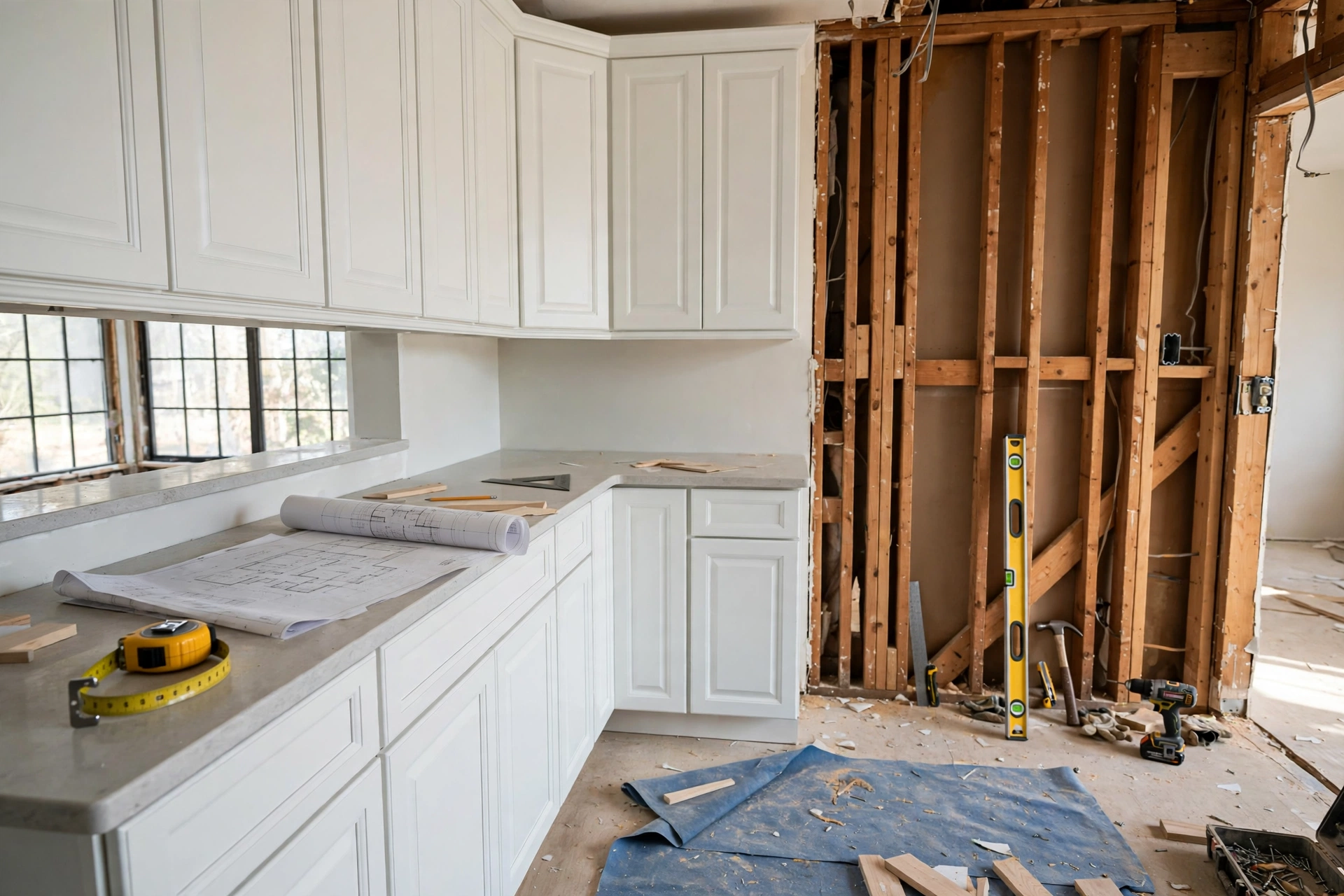
A renovation in stages is the HELOC's home turf: you draw when the contractor starts, not months before.
The Staged Renovation, in Dollars
Here is the job the question is really about. A Jacksonville homeowner plans three stages over nine months: a kitchen at $28,000, a bathroom at $18,000, and a roof at $14,000. Total: $60,000. The kitchen starts in month one, the bathroom in month five, the roof in month nine.
On a HELOC at the 8.58% national average, interest-only: months one through four, the balance is $28,000 and the payment is $200.20 a month. Months five through eight, the balance is $46,000 and the payment is $328.90 a month. In month nine, the full $60,000 is drawn and the payment is $429.00 a month. Total interest over the nine months: $2,545.40. You paid for the money only after you spent it.
On a home equity loan of $60,000 at 8.28% fixed for 15 years: the payment is $583.13 a month from the very first month — before the bathroom contractor has been hired and before the roofer has been called. Interest alone on the full $60,000 over those first nine months runs about $3,726. The difference between the two paths over the same nine months is about $1,180.60, and the gap is not a rate difference. It is the cost of borrowing money you have not used yet.
That is the HELOC's case, and for a staged job it is a strong one. But the comparison is not finished until the HELOC's second life is priced in.
The Three Traps in the HELOC
1. The payment jump at the end of the draw period. This is the one the CFPB flags by name: end-of-draw payment shock. Take that same $60,000 balance at 8.58%. Interest-only, it costs $429.00 a month. When the draw period ends and the balance amortizes over 20 years, the payment becomes $523.74 a month — $94.74 more, a 22% jump, on the same balance, the same rate, the same day. Some plans are worse: a few demand the entire outstanding balance as a balloon payment when the plan ends. Read the agreement for which one you are signing.
2. The rate floats. A HELOC priced at prime plus a margin moves when prime moves. Prime was 7.00% on November 9, 2026. If the Fed raises rates, your payment rises even if your balance does not. A home equity loan's fixed rate has no such exposure — the payment set at closing is the payment for the life of the loan. If rate certainty matters more to you than draw flexibility, that alone can settle the choice.
3. The line can be frozen, and the draw has a cost. If your home's value drops significantly, the lender can stop further draws — right in the middle of your renovation. And on the Aven card Douglas runs, moving money to your bank account costs 2.5% of the amount — on a $60,000 renovation paid to contractors by bank transfer, that is $1,500 in fees, which eats the first $1,181 of interest savings if you move the whole amount that way. Spending directly on the card avoids the transfer fee and earns 2% cash back, but a contractor who wants a check or a wire is a bank transfer. Price the fee before you price the rate.
The Tax Angle: Renovation Is the Deductible Use
There is one more reason a staged renovation is the HELOC's best case, and it comes from the IRS, not the lender. Under IRS Publication 936, interest on a home equity loan or HELOC is deductible only if the borrowed funds are used to buy, build, or substantially improve the home that secures the loan — and the total mortgage debt generating deductible interest is capped at $750,000 for loans taken after December 15, 2017. A kitchen, a bathroom, and a roof all clear the "substantially improve" bar. The same loan used to consolidate credit cards or pay for a vacation does not: that interest is not deductible at all, no matter how the loan is labeled. You must itemize to claim it, and this is education, not tax advice — your CPA owns the final call. But the structure matters: a renovation is the one use of home equity where the tax code is on your side.
When the Lump Sum Wins
The home equity loan wins when the job is one fixed price, one contractor, one start date. A single $45,000 roof replacement with a signed contract and a known cost does not need a revolving line — it needs a fixed payment that never moves. It also wins when discipline is the risk: a HELOC's available credit is a standing temptation to keep drawing, and every dollar drawn is a dollar secured by the house. A lump sum that is spent and gone cannot be re-drawn. And it wins when the rate environment worries you — a fixed 8.28% that never changes beats a variable 8.58% that can.
There is also a third option worth naming so nobody picks it by accident: a cash-out refinance. It replaces your entire first mortgage with a larger one. If your first mortgage is at 3.5% or 4%, refinancing it to pull $60,000 out means repricing the whole balance at today's rates — Freddie Mac's Primary Mortgage Market Survey put the 30-year fixed at 7.11% for the week ended November 12, 2026. A HELOC or home equity loan leaves the first mortgage exactly where it is. That is the whole point of a second mortgage: the cheap money stays cheap, and only the new money carries today's rate.

Run the staged math before you sign: the cheapest product is the one that matches when the money actually leaves.
Sources
Consumer Financial Protection Bureau, "What is a home equity line of credit (HELOC)?" and "What is the difference between a Home Equity Loan and a Home Equity Line of Credit (HELOC)?" — draw period about 10 years, repayment often 10 or 20 years, variable rates, payment shock, line freezes; CFPB HELOC booklet, 75%-of-value sizing example. Federal Reserve H.15 Selected Interest Rates — bank prime loan rate 7.00% on November 9, 2026; federal funds target 3.75%–4.00% after the September 16, 2026 cut. Freddie Mac Primary Mortgage Market Survey — 30-year fixed 7.11% for the week ended November 12, 2026. IRS Publication 936 (2026) — home equity interest deductible only for buy, build, or substantially improve; $750,000 combined debt limit. Mortgage Research Center via Fortune — national average home equity loan about 8.27% (10-year) / 8.28% (15-year), early November 2026; national average HELOC rate 8.58% as of November 16, 2026. Aven account disclosures — line up to $400,000, variable APR 6.49%–14.99% for primary residences, 18% lifetime cap, 2.5% cash-out and balance-transfer fee, 2% cash back on card purchases.
Our Take
Douglas's position is simple, and it is the same one he takes on every loan: match the money to the job, and never let one lender's structure be the only option you see. A staged renovation is a HELOC-shaped job — draw when the work starts, pay interest only on what you have drawn, keep the first mortgage untouched. But a HELOC is a variable-rate, two-life product with a payment jump built into it, and the Aven card's 2.5% transfer fee changes the math if your contractors want bank transfers instead of card payments. The way to decide is not to argue about the products in the abstract. It is to put your actual stages, your actual contractor quotes, and your actual equity on one page and run the interest both ways — the way this post just did. If the lump sum wins on your numbers, take the lump sum. Douglas brokers through 200 lenders, and the HELOC is one product among many: the file gets priced across the lenders that actually offer it, against the actual agency guidelines, not one bank's overlay. A 600 credit score does not end the conversation — it starts it.

Jacksonville homeowners sit on real equity — the question is how to spend it without paying interest on money you have not used yet.
Would you take the lump sum and pay interest on money you haven't spent yet — or take the line and live with a payment that jumps when the draw period ends?
Your Next Step
Check Your Rate — Free — see what you actually qualify for across 200+ lenders. Free, no credit check, no pressure.
Then run your own staged math on the HELOC page — and if you want the Aven flow Douglas runs, the terms are a 600 credit score, funding in as little as 5 days, and no appraisal up to $400,000.
Prefer to talk it through? Call Douglas direct: (904) 517-4049.
Douglas Wilkerson — NMLS #1680719
Mortgage Broker | Branch Manager, Freeman Douglas Corp
Direct: (904) 517-4049
[email protected] | [email protected]
1548 the Greens Way, Ste. 4, Jacksonville Beach, FL 32250
Freeman Douglas Corporation is a DBA of Edge Home Finance. This is not a promise to lend — all credit decisions are subject to approval. Douglas Wilkerson, NMLS #1680719 | Edge Home Finance, NMLS #891464. Verify licensing at nmlsconsumeraccess.org. Equal Housing Opportunity.
