2026 Q4 Homebuyer Leverage Index | Jacksonville FL Housing Market | Freeman Douglas
Industry News, Housing Trends, Homebuyer Strategy
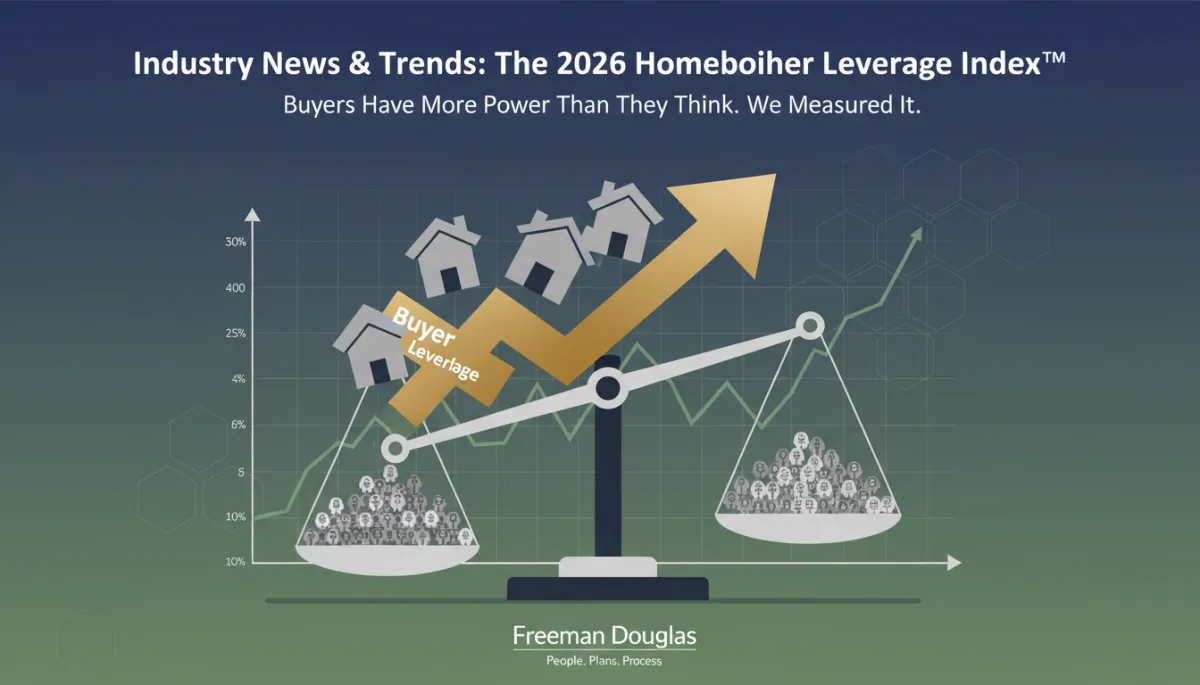
The 2026 Homebuyer Leverage Index™: Buyers Have More Power Than They Think
Something unusual is happening in the 2026 housing market: costs remain high, yet buyers are quietly regaining leverage. The Freeman Douglas Homebuyer Leverage Index™ is designed to measure that power—and help you turn it into real financial advantage.
Industry News & Trends: A Market That Looks Tough but Behaves Differently
On the surface, the 2026 housing headlines do not sound buyer-friendly. Home prices remain elevated in many markets, insurance and taxes have crept higher, and 30-year mortgage rates are hovering in the mid-6% range, near their highest levels in more than a year (AP News). Monthly payments have climbed enough to push many would-be buyers to the sidelines (Redfin).
Yet underneath those headlines, a quieter story is unfolding. Active inventory is modestly higher than a year ago, buyer activity has cooled, and pending sales have slipped (Realtor.com). Redfin recently reported that in August 2026 there were roughly 58% more home sellers than buyers nationwide—the largest imbalance in its records. In other words, sellers are still listing, but many buyers have stepped back.
That imbalance is not what most people picture when they think of a “hot” seller’s market. It is a sign that qualified buyers are becoming scarce—and scarcity is the raw material of negotiating leverage.
The 2026 Homebuyer Leverage Index™: Measuring What Buyers Can Actually Do
Traditional housing statistics—median prices, mortgage rates, days on market—tell you what the market is doing in general. They do not tell you what that market allows you to do on a specific transaction. The Freeman Douglas Homebuyer Leverage Index™ was built to close that gap.
Instead of asking, “Is this a buyer’s market?” the Index asks a more practical question: How much leverage does a qualified buyer have in this environment—and where can that leverage be converted into real dollars?
The Five Pressures Behind Buyer Leverage
Seller Pressure: When sellers substantially outnumber buyers, each serious buyer becomes more valuable. In August 2026, Redfin estimated that Jacksonville had 12,157 sellers and 7,284 buyers—about 167 sellers for every 100 buyers. That is a textbook example of seller pressure creating buyer leverage.
Price Pressure: Rising shares of price reductions signal a disconnect between seller expectations and actual demand. Nationally, median list prices have softened and price cuts have become more common in 2026 (Realtor.com).
Concession Pressure: Redfin found that 46.2% of home sales it analyzed in May involved seller concessions, the highest May share in its records, and about 16% included both a price reduction and a concession. That is leverage that rarely shows up in the list price alone.
Time Pressure: Longer days on market often translate into more flexible negotiations. In Jacksonville, depending on the data source, typical days on market range from the mid-20s to around 40–80 days, with several reports describing the area as a more balanced environment (Momentum Realty; NEFAR).
Buyer Withdrawal: Google searches for “homes for sale” were down roughly 15% month-over-month and year-over-year in early September, and mortgage purchase applications have softened. Fewer active buyers can materially improve the negotiating position of those who remain.
Together, these pressures allow the Index to measure something a simple median price chart cannot: the practical leverage a buyer can bring to a specific negotiation.

Leverage emerges where rising supply, concessions, and buyer pullback intersect.
Buyer Behavior Hasn’t Caught Up with the New Market
For years, buyers were conditioned by a seller-dominated market. Multiple offers, bidding wars, appraisal gaps, waived inspections, and buyers paying far above asking all trained people to believe they were competing simply for the chance to buy a house. That psychology does not disappear overnight, even when the underlying conditions change.
Today, many buyers are still watching the wrong number. They stare at mortgage rates—which matter—but forget that they are not purchasing a rate. They are purchasing an entire transaction made up of price, rate, closing costs, prepaid expenses, concessions, repairs, incentives, timelines, loan structure, and the cash they will have left after closing.
📌 Key Takeaway: The lowest price or the lowest rate does not automatically create the best outcome. The strongest deal is the one that produces the best overall financial position for the buyer.
Seller Pressure, Price Pressure, and the Rise of Concessions
When there are dramatically more sellers than buyers, as Redfin’s August 2026 data suggests, the balance of power begins to shift. Sellers who might once have expected multiple offers now find themselves competing for a smaller pool of qualified purchasers. That competition often shows up in three places:
List-price adjustments: Price reductions are a visible sign that initial expectations overshot real demand.
Behind-the-scenes concessions: Closing-cost credits, rate buydowns, repair allowances, and builder incentives are increasingly used to keep contracts together.
Flexibility on terms: Move-in dates, contingencies, and inspection negotiations can all become more favorable to buyers when sellers feel pressure.
Jacksonville illustrates this tension well. Recent reports describe a market that appears “balanced” on paper, with roughly 3–5 months of inventory and modest price softening (Momentum Realty; Homes by Marco). Yet when you zoom in on the ratio of sellers to buyers—167 to 100—you see a very different story about who may quietly hold negotiating power.
Negotiating Strategies: Turning Leverage into Real Dollars
The $10,000 Problem: Same Money, Different Outcomes
Imagine you are purchasing a home for $425,000 and, after negotiations, the seller is willing to give up another $10,000 in economic value. Most buyers default to a single question: “How far can I get them to drop the price?”
But that $10,000 can be deployed in multiple ways, depending on the loan program and allowable contributions:
Reducing the purchase price from $425,000 to $415,000.
Applying it toward closing costs and prepaid expenses to reduce your cash at closing.
Using it for discount points or an eligible rate buydown to lower monthly payments.
Structuring the deal so you preserve cash to pay off other high-interest debt, strengthening your overall household budget.
The key insight: $10,000 is not worth the same amount to you in every location of the transaction. Reducing the mortgage balance, reducing your upfront cash requirement, lowering your rate, or eliminating another monthly payment all produce different long-term results. Negotiating the concession is only half the job; knowing where to place it is the other half.
Price Is Only One Form of Leverage
Consider two identical homes, both listed at $450,000:
Home A: The seller accepts $440,000 and offers no concessions.
Home B: The seller holds closer to the asking price but provides substantial allowable credits toward closing costs and a rate buydown, significantly reducing the buyer’s monthly payment and cash out of pocket.
On paper, Home A “sold for less.” In reality, Home B may deliver the stronger financial position. Without analyzing the entire transaction—price, rate, costs, concessions, and cash preserved—you cannot know which buyer truly got the better deal. That is exactly the kind of nuance the Homebuyer Leverage Index™ is designed to highlight.
Beyond Preapproval: Measuring Your Real Negotiating Power
A mortgage preapproval answers an important question: Can you qualify for the proposed financing? What it does not answer is:
What is this property actually worth to you?
How aggressive might this particular seller be willing to become?
Are seller concessions more valuable than a lower price in your situation?
Is preserving cash wiser than increasing your down payment?
Qualification and strategy are related, but they are not the same thing. The Index is built to connect market conditions with transaction strategy, so that buyers stop asking only, “Can I buy?” and start asking, “What is my position as a buyer worth in this negotiation?”
What Comes Next for the Homebuyer Leverage Index™
Freeman Douglas will continue updating the Homebuyer Leverage Index™ as conditions evolve. But the work does not stop at market statistics. We will also be tracking real-world transaction outcomes, including:
Seller concessions and closing-cost contributions.
Price reductions and days on market.
Builder incentives and inspection negotiations.
Buyer cash preserved, loan structure, and financing type.
By comparing what buyers initially requested with what sellers ultimately agreed to, we can begin answering a question most housing reports ignore: What are sellers actually giving buyers—in completed transactions, not theory?
Rethinking the Question Every Buyer Should Ask
The housing market does not need to become universally “good” for a transaction to make sense. Different conditions create different advantages. Low rates favored borrowers. Rapid appreciation favored existing owners. Tight inventory favored sellers. Today’s shortage of active buyers can create leverage for the buyers who remain—if they recognize it and know how to use it.
So if you or someone you know is considering a purchase in a market like Jacksonville—where roughly 167 sellers are competing for every 100 buyers—the most important question is no longer just: “What does the house cost?”
The better question is: “What is my position as the buyer worth in this negotiation, and how do I turn that into a stronger financial outcome for my household?”
The Freeman Douglas Homebuyer Leverage Index™ is an analytical framework intended to help consumers understand housing-market and transaction conditions. Market statistics change over time, individual transactions differ, and examples are illustrative. Financing options, concessions and allowable contributions depend on the applicable loan program, transaction and underwriting requirements. This is not a guarantee to lend. Credit due on approval - not all who apply will qualify.
About Douglas Wilkerson
Douglas Wilkerson is the Founder and President of Freeman Douglas Corporation and Branch Manager / Sr. Mortgage Broker with Edge Home Finance.
Based in Jacksonville, Florida, Douglas works with homebuyers, homeowners, veterans, active-duty military families, real estate professionals and housing partners throughout Northeast Florida and nationwide.
His work focuses on mortgage and homebuying strategy, including VA home loans, FHA loans, conventional financing, jumbo financing, renovation loans, construction financing, investment-property financing, military relocation and complex mortgage scenarios.
Douglas is also the founder of Veteran Legacy, a Freeman Douglas initiative focused on helping veterans and military families better understand and strategically use their VA home loan benefit.
Rather than treating mortgage qualification as the final answer, Douglas's approach examines the entire housing decision — income, liabilities, cash, credit, property, taxes, insurance, loan structure, household expenses and the buyer's longer-term financial objectives.
Douglas Wilkerson
Branch Manager / Sr. Mortgage Broker
Founder & President | Freeman Douglas Corporation
Edge Home Finance Corporation
NMLS #1680719
Edge Home Finance Corporation | NMLS #891464
Branch NMLS #2609641
Direct: 904-517-4049
Office: 904-906-8869
Email: [email protected]
FreemanDouglas.com
Veteran Legacy
Ready to Talk About Buying a Home?
If you're considering purchasing a home, already looking at properties, have been preapproved elsewhere, or simply aren't sure whether your current financing strategy makes sense, the first step is understanding the complete transaction.
Don't start with “How much can I borrow?”
Start with:
“What's the strongest financial position I can create with what I have?”
Call or text Douglas directly at 904-517-4049.
Or, if you're ready to begin:
Start Your Home Loan Application
Jacksonville, Florida | Northeast Florida | Nationwide Mortgage Lending
