How Do I Get a Better Mortgage Rate? The Levers That Actually Move Your Number
The short answer: you get a better mortgage rate by moving the levers on your own file — your credit band, your down payment, whether you pay points, which loan type you use, your term, and how the deal is structured. Freddie Mac's Primary Mortgage Market Survey for the week ended November 19, 2026 put the average 30-year fixed rate at 7.28% — but that average describes a strong, clean file. Where your number lands against that average is decided by the levers below, and most of them are in your control before you ever lock. (Rates referenced November 19, 2026; 30-year fixed term unless noted. Douglas Wilkerson, NMLS #1680719.)
What actually sets my rate?
Every lender prices a mortgage off the same basic grid: a base rate for the loan type and term, then adjustments up or down for risk. Lenders call those adjustments "loan-level price adjustments" — in plain English, they are surcharges and discounts for how risky your file looks on paper. A bigger down payment is a discount. A lower credit band is a surcharge. The loan type, the property, and the term all move the number too. Nobody hands you "the rate." Your file earns a rate, lever by lever — which means a better rate is usually built, not found.
How much is a credit-score band worth?
Lenders do not price credit one point at a time. They price it in bands — ranges of scores that share the same surcharge. Sit just below a band line and you pay the higher band's price on the whole loan. Here is what one band step looks like in dollars, using the November 19, 2026 survey average as the strong-file anchor on a $400,000, 30-year fixed loan:
At 7.28% (the strong-band price): principal and interest of $2,736.85 a month.
At 7.66% (0.375% higher — one weaker band's typical surcharge): $2,840.81 a month.
That is $103.96 more every month — about $6,238 in extra payments over five years — for the same house, the same loan, and the same lender. The score itself is not the point; the band is. If your score sits a few points under a band line, the highest-value move in your whole transaction may be the unglamorous one: paying a card down, fixing an error, and waiting for the band to change before you lock. This is also why a real file review beats a rate quote — a quote prices the file you have today, not the file you could have in 45 days.
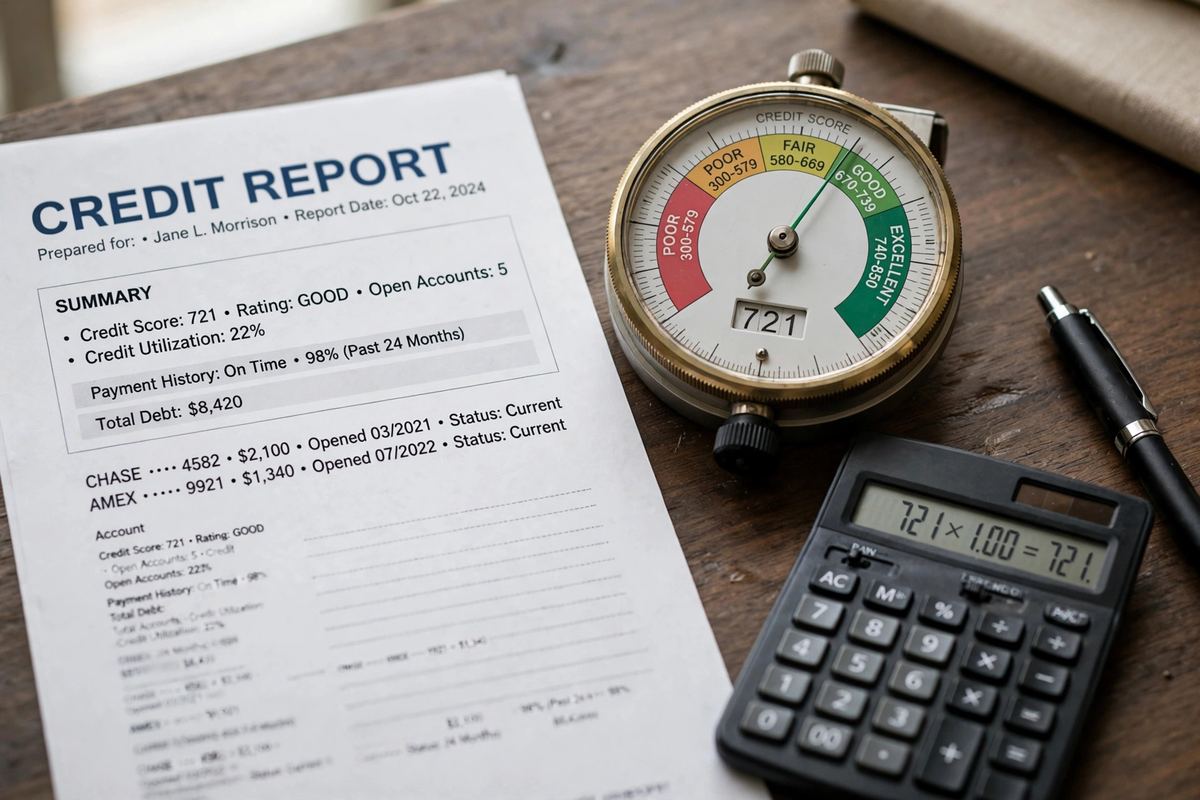
Your rate is priced in credit bands, not point by point — one band step on a $400,000 loan is worth about $104 a month.
Does a bigger down payment lower my rate?
Yes — twice. First, the pricing grid rewards lower loan-to-value (what you owe versus what the home is worth): putting 20% down prices better than putting 5% down on the same file. Second, below 20% down on a conventional loan you carry private mortgage insurance — PMI, the monthly premium that protects the lender, not you. At a typical 0.50% per year, PMI on a $400,000 loan runs about $166.67 a month until you reach 20% equity. So the honest comparison is never just rate versus rate: a slightly higher rate with no PMI can cost less per month than a lower rate carrying PMI. Run both numbers before you decide how much to put down — the math decides, not the rule of thumb.
Should I pay points to buy my rate down?
A "point" is 1% of the loan amount paid at closing in exchange for a lower rate — on a $400,000 loan, one point is $4,000. Points are neither smart nor stupid; they are a break-even problem. Say one point buys your rate from 7.28% down to 7.03% on that $400,000 loan: your payment falls from $2,736.85 to $2,669.27, saving $67.58 a month. Divide the $4,000 cost by the $67.58 savings and the break-even is about 59 months — just under five years. Keep the loan longer than that and the points paid off. Sell or refinance before it, and you bought a discount you never collected. Points are a trap when a lender leads with the bought-down rate and never shows you the division. Ask for the break-even in months, in writing, every time.
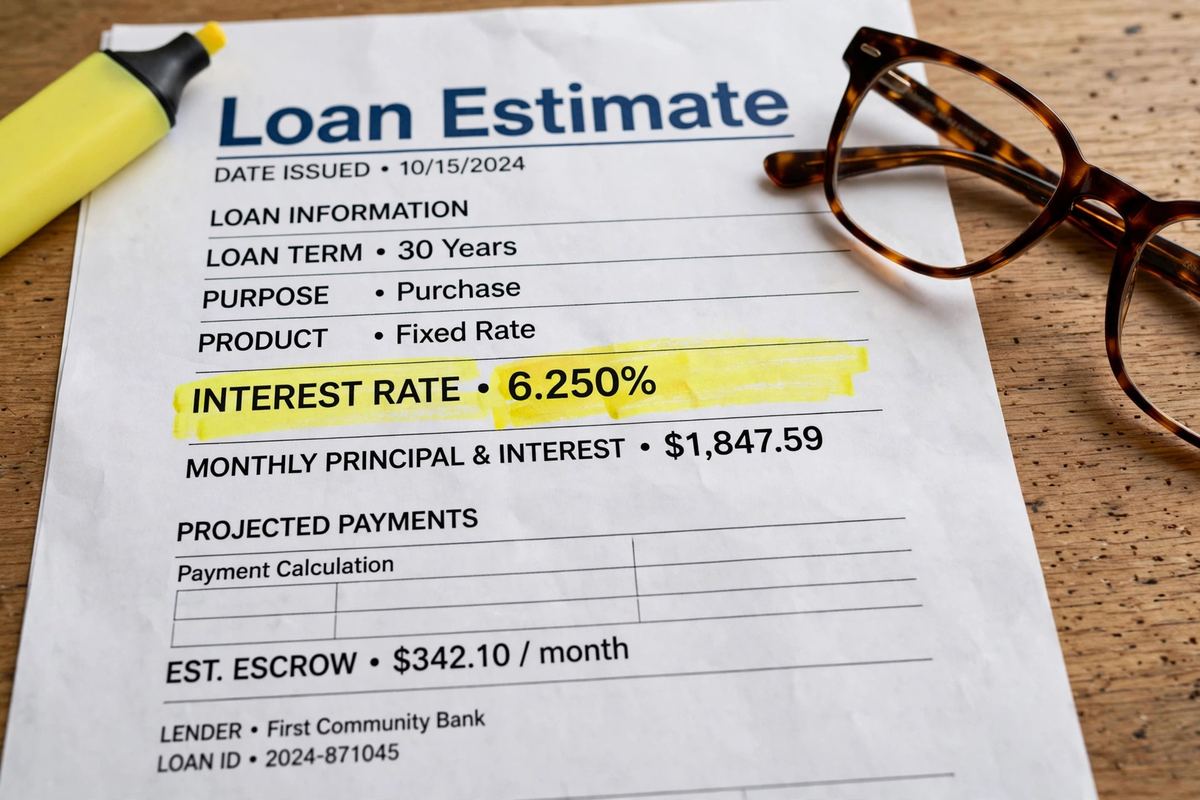
The Loan Estimate shows the rate and the points on page one — the break-even math is the part you have to ask for.
Does the loan type change my rate?
It does. Government-backed loans (VA and FHA) and conventional loans are priced off different markets, and VA and FHA rates often print lower than conventional on the same day — but they carry their own costs: the VA funding fee (2.15% of the loan for a first use, if you are not exempt) and FHA's upfront mortgage insurance premium (1.75%) plus annual MIP (0.55%). The right comparison is total cost on your file, not the headline rate on a program you may not even be using. If you have VA eligibility, a conventional quote is the wrong measuring stick; if you do not, a VA rate in an advertisement is a number you cannot have. Price the programs you actually qualify for, side by side, on the same day.
Can the seller pay to lower my rate?
Yes — and in a market where sellers are offering concessions, this is the lever most buyers never pull. A seller credit can fund a rate buydown: money the seller was going to concede anyway gets pointed at your rate instead of shaving a few thousand off the price, and a dollar aimed at the rate usually buys more monthly payment than a dollar aimed at the price. I walked through how a big bank's relationship discount really prices in "Chase Is Offering Up to 1% Off Your Mortgage Rate — Here's the Math the Discount Doesn't Show", and how seller credits stack up against a price cut in "Seller Credits and Price Reduction". The structure of the deal — who pays what, aimed where — is a rate lever, and it is negotiated before you lock, not after.
What about a shorter term?
The 15-year fixed averaged 6.66% in the November 19, 2026 survey against 7.28% for the 30-year — a lower rate, honestly earned. But on a $400,000 loan the 15-year payment is $3,519.71 against $2,736.85 for the 30-year. A shorter term is a wealth lever, not a payment lever: it builds equity fast and slashes total interest, and it only works if the higher payment fits your real budget with room to spare. Some borrowers split the difference — a 30-year loan paid on a 15-year schedule when cash flow allows, with the lower required payment as the safety valve.

Jacksonville buyers: the levers are the same everywhere — what changes is how your file, your program, and your contract structure them.
Why borrowers check in before they lock
Every lever above is a decision made under time pressure, usually in the wrong order — rate first, structure later. The borrowers who land well run the file first: bands, down payment, points break-even, program, and structure, priced together. Here is what that looks like from the other side of the closing table, in a client's own words from a Google review:
"If you're a veteran looking to buy a home, I can't recommend Douglas highly enough. As a fellow Marine veteran, he truly understands every aspect of the VA home loan process and knows how to navigate it from start to finish. His knowledge, professionalism, and commitment to serving veterans are second to none. What really sets Douglas apart is that he's much more than just a mortgage loan officer. He works seamlessly with your real estate agent to make sure everyone is aligned and the entire process runs smoothly. You never feel like you're just another transaction. The best part is that once you become part of Douglas's ecosystem, you never really leave it. He continues to be a trusted resource long after closing, providing guidance, connections, and support whenever you need it. It's not just a mortgage—it's a lifelong relationship and an incredible asset to have in your corner. If you're looking for someone who genuinely cares about your success and has the expertise to get the job done right, Douglas is the person to call. Semper Fi!" — Jason Haglund, July 31, 2026 (Google review)
That is the standard I hold a file review to: your levers priced honestly, across 200+ lenders, on the actual agency guidelines — before anyone asks you to lock.
Frequently asked questions
How do I get a better mortgage rate?
Work the levers on your file: move up a credit band if you are near a line, size your down payment to the pricing grid and the PMI cutoff, run the break-even before paying points, price the loan programs you actually qualify for, and use seller concessions to fund a buydown where the contract allows. Each lever is worth real dollars — on a $400,000 loan, one credit band is about $104 a month.
How much does my credit score change my mortgage rate?
Lenders price credit in bands, not point by point. One band step on a $400,000, 30-year fixed loan is roughly 0.375% — the difference between $2,736.85 a month at 7.28% and $2,840.81 at 7.66%, using the November 19, 2026 Freddie Mac survey average as the anchor.
Is it worth paying points for a lower rate?
Only if you will keep the loan past the break-even. One point ($4,000 on a $400,000 loan) buying the rate from 7.28% to 7.03% saves $67.58 a month — a break-even of about 59 months. Sell or refinance sooner and the points were a gift to the lender.
Can a seller buy down my rate?
Yes. A seller credit can be aimed at a rate buydown instead of a price cut, and a dollar aimed at the rate usually buys more monthly payment than a dollar off the price. It has to be structured in the contract and the loan file before you lock.
Sources
Freddie Mac Primary Mortgage Market Survey, week ended November 19, 2026 — 30-year fixed 7.28%, 15-year fixed 6.66% (week ended November 12, 2026: 7.11% / 6.45%; year ago 6.26% / 5.54%). Freddie Mac, "Understanding the costs of refinancing" and discount-point guidance — no significant financial benefit to buying discount points in many cases; points are a break-even calculation. Consumer Financial Protection Bureau — Loan Estimate and discount point explainers. VA.gov — VA funding fee 2.15% first use; HUD Handbook 4000.1 — FHA upfront MIP 1.75%, annual MIP 0.55%. All payment math in this post is original, computed on a $400,000 loan, and labeled with its rate and date.
Our Take
Most rate advice is weather reporting: here is the average, good luck out there. Your rate is not weather. It is the output of six decisions — band, down payment, points, program, term, and structure — and five of them are made before a lender ever quotes you. The borrowers who overpay are not the ones with bad files; they are the ones who priced the file they had on the day they called, instead of the file they could have had with 45 days of lever work. My job is that lever work: price the whole structure across 200 lenders, show you what each move is worth in dollars, and let the math — not a headline — pick the rate.
If you could only pull one lever before you lock — a credit band, the down payment, points, or a seller-funded buydown — which one is worth the most on your file? Do you know your number, or are you guessing?
Your Next Step
Check Your Rate — Free — see what rate you actually qualify for across 200+ lenders, free, no credit check, no pressure.
Run your own numbers with the Mortgage Calculators — payments, affordability, and buydown math on your own figures.
Prefer to talk it through? Call Douglas direct: (904) 517-4049.
Douglas Wilkerson — NMLS #1680719
Direct: (904) 517-4049
[email protected] | [email protected]
1548 the Greens Way, Ste. 4, Jacksonville Beach, FL 32250
Freeman Douglas Corporation is a DBA of Edge Home Finance. This is not a promise to lend — all credit decisions are subject to approval. Douglas Wilkerson, NMLS #1680719 | Edge Home Finance, NMLS #891464. Verify licensing at nmlsconsumeraccess.org. Equal Housing Opportunity.
