
Refinancing to Drop PMI: The 20% Equity Trigger, the Appraisal Gamble, and When the Math Actually Works
Refinancing to Drop PMI: The 20% Equity Trigger, the Appraisal Gamble, and When the Math Actually Works
Every month, your mortgage statement carries a line item that protects your lender — not you. Private mortgage insurance. Maybe $110 a month, maybe $200. It pays the bank if you ever default; you get nothing from it except having been allowed to buy with less than 20% down.
Here is the part most homeowners never hear: you might already be done paying it and not know it. And on September 16, 2026, Fannie Mae issued Lender Letter LL-2026-07 — at the FHFA's direction — allowing servicers to proactively contact borrowers who may be eligible for mortgage insurance termination on current value. The industry just admitted, in writing, that too many people are paying PMI they no longer owe.
Do not wait for your servicer to call. Here are the actual rules, the three routes out, the FHA trap, and the Jacksonville math — including when refinancing to drop PMI quietly costs you money.
The Short Answers
Can I remove PMI without refinancing? Yes — on a conventional loan. Request cancellation from your servicer once your balance is at or below 80% of your home's current value (backed by a valuation), or wait for automatic termination at 78% of the original value under federal law.
How much equity do I need? For a borrower-initiated request on current value, Fannie Mae's servicing rules require 20% equity (80% loan-to-value) if your loan is seasoned more than five years, or 25% equity (75% LTV) if it is two to five years old.
Can FHA MIP be removed without refinancing? Almost never. On FHA loans originated after June 3, 2013 with less than 10% down, annual MIP lasts the life of the loan regardless of equity. Refinancing into a conventional loan is the only exit. With 10%+ down, it drops automatically after 11 years.
Does refinancing to remove PMI make sense at 7.40%? Only if the PMI savings beat the higher rate plus closing costs. Freddie Mac's October 15, 2026 survey put the 30-year fixed at 7.40% — trading a 6.50% rate for 7.40% to save $137 a month in MIP can leave your total payment higher than when you started.
What Does "20% Equity" Actually Mean? There Are Two Rulers.
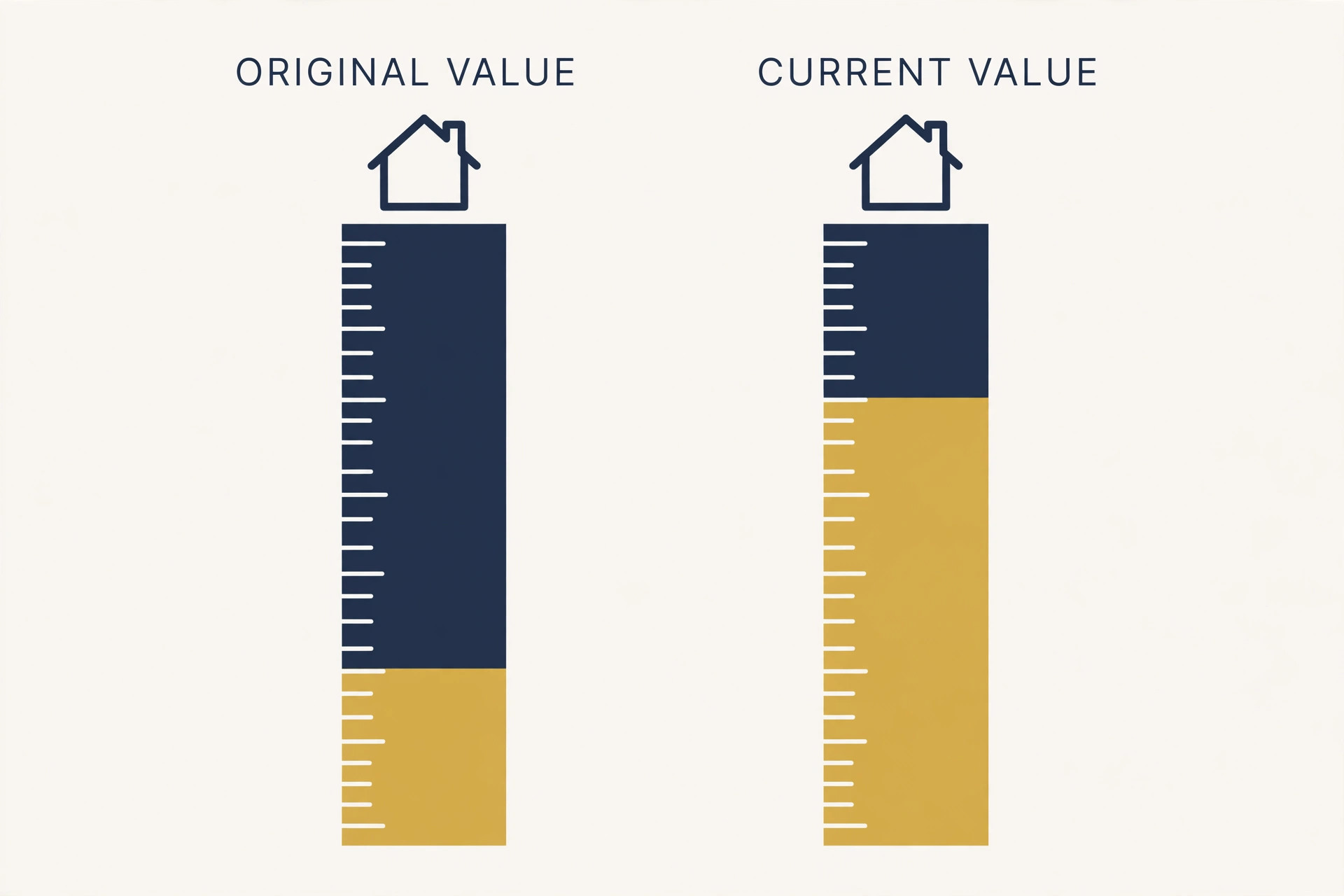
There are two completely different rulers for measuring equity, and which one applies decides everything.
Ruler #1: original value. Your purchase price (or appraised value at origination, whichever was lower). The Homeowners Protection Act measures against this number: automatic PMI termination when your balance is scheduled to hit 78% of original value while you are current. You can also request cancellation at 80%. Appreciation does not count here.
Ruler #2: current value. What your home is worth today, via a new valuation. Fannie Mae's servicing rules (B-8.1-04) let you request termination against this number — where appreciation does the work. A $300,000 purchase now worth $340,000 with a $250,000 balance is 73.5% loan-to-value. Done: one servicer call and a valuation, no refinance.
Route 1: Just Ask — Borrower-Initiated Cancellation (No Refinance)
The route almost nobody takes and almost everybody should check first. You call your servicer and request termination based on current value. The actual guidelines — not a bank's overlay version:
- Seasoned more than 5 years: current loan-to-value of 80% or less.
- Seasoned 2 to 5 years: current loan-to-value of 75% or less.
- Under 2 years: generally not eligible — unless documented property improvements increased the value, waiving the two-year rule. Then 80% or less (one-unit primary residence or second home).
- Investment property or 2–4 unit primary residence: 70% or less, seasoned more than two years.
- Payment history: no 30-day late payment in the past 12 months, none 60 days late in the past 24.
- Valuation: the servicer orders an interior/exterior valuation through Fannie Mae's servicing system. You typically pay a few hundred dollars.
About that September 2026 change: servicers are now permitted to proactively contact eligible borrowers — not required to. If yours has not called, that tells you nothing about whether you qualify. Some servicers also add their own extra requirements on top of these rules; the Fannie Mae guideline is the floor. If a servicer's answer feels like a runaround, that is a servicer problem — and exactly where a broker working from the actual agency guidelines earns their keep. We broker to 200 lenders. One lender's "no" is never the last word.
Route 2: Do Nothing — Let Federal Law Terminate It
Prefer not to lift a finger? The Homeowners Protection Act works on the original-value ruler: request cancellation in writing at 80% of original value, or let it terminate automatically at 78% per your original amortization schedule — no request, no appraisal, as long as you are current. Backstop: if the balance is not scheduled to hit 78% before the loan's halfway point, PMI terminates at the midpoint instead.
The catch is the word scheduled: extra principal payments get you to 78% faster in reality, but automatic termination follows the original schedule — which is why Route 1 usually wins by years for anyone whose home has appreciated.
Route 3: Refinance Out of PMI Entirely
A new conventional loan at 80% loan-to-value or less, based on a new appraisal, never has PMI — period. No request, no servicing rules, no seasoning clocks. It costs a few thousand in closing costs, and you trade your current rate for today's market: the 30-year averaged 7.40% as of October 15, 2026 (a year ago: 6.27%). That trade deserves real scrutiny — see the trap section below. And for most FHA borrowers, refinancing is the only route, which brings us to the trap.
The FHA Special Case: The MIP That Never Dies
FHA loans carry MIP, not PMI — an upfront premium of 1.75% of the loan amount (usually financed in) and an annual premium of 0.55% of the balance per year for most borrowers, per HUD Mortgagee Letter 2023-05. On a $300,000 loan, roughly $137 a month.
The rule that surprises everyone, for FHA loans originated after June 3, 2013:
- Less than 10% down: annual MIP lasts the life of the loan — not until 20% equity, not until 78% LTV. No extra payments, no appreciation, no perfect history changes it. Since the FHA minimum down payment is 3.5%, most FHA borrowers live under this rule.
- 10% or more down: annual MIP cancels automatically after 11 years. No request, no appraisal.
For the life-of-loan group, there are exactly three exits: sell, pay off, or refinance into a non-FHA loan — usually conventional, once you have the equity and credit profile. A FHA streamline refinance will not do it; that keeps you inside FHA, where the MIP rules follow.
Two myths to kill. "FHA MIP drops at 78% like PMI." That was the pre–June 2013 rule; some loan officers still teach the old version. "A better credit score lowers my MIP." It does not — FHA MIP is identical for every borrower on the same loan structure, unlike conventional PMI, where your score tier changes the price (see our credit-score price map). Small consolation: refinance out of FHA within three years and HUD refunds part of the upfront MIP on a sliding scale. After 36 months, zero.

The Appraisal Gamble
Routes 1 and 3 hinge on a valuation you pay for — typically a few hundred dollars for a full appraisal, non-refundable. If the appraiser brings your home in light and your LTV lands at 82% instead of 79%, you have purchased a very expensive piece of bad news. So check closed-sale comps (not list prices or automated estimates) before ordering anything; confirm which threshold is yours — four years of seasoning means 75% LTV, a much higher bar than the 80% most people assume; and ask whether your servicer accepts a cheaper broker price opinion instead of a full appraisal. Documented renovations that substantially improved the property can waive the two-year seasoning rule; routine maintenance cannot. When the numbers work, that appraisal fee is the highest-return few hundred dollars in personal finance: kill $130 a month in PMI and it pays for itself in months.
The Jacksonville Math
Real numbers, Jacksonville buyer. (Rounded and illustrative — your loan's exact figures will differ, which is the point of checking.)
The setup: January 2021, $300,000 purchase, 5% down — a $285,000 conventional loan at 3.25%, 30-year. Principal and interest about $1,240 a month; PMI roughly $110.
Today: balance around $250,000 after nearly six years of payments. The home appraises at $340,000 — reasonable against a Jacksonville 12-month median sale price near $315,000. Current loan-to-value: 73.5%.
The verdict: seasoned over five years, so the Fannie Mae threshold is 80% on current value — cleared easily. One servicer call, one valuation, and roughly $110 a month — about $1,320 a year — disappears. No refinance. No touching a 3.25% rate in a 7.40% world.

The trap version: a 2022 FHA buyer — $300,000, 3.5% down, 6.50% rate, about $137 a month in MIP, life-of-loan rule. The only exit is refinancing conventional at 7.40%. On the roughly $269,000 balance, principal and interest at 6.50% runs about $1,700 a month; at 7.40% about $1,862 — $162 more. MIP eliminated: $137. Net: the payment goes up ~$25 a month, plus several thousand in closing costs. Refinancing "to save" $137 a month would cost this borrower money every month for years. The insurance is one line on the payment. The rate is the whole payment.
The Breakeven Test (Run This Before Any PMI-Motivated Refinance)
Monthly PMI savings − monthly increase from the new rate − (closing costs ÷ months you will keep the loan) = your real answer. If it is negative, the refinance costs you money with extra steps. In this market: if your current rate is more than about half a point below today's 7.40% average, the rate increase usually eats the PMI savings whole — check Route 1 instead and leave your rate untouched. And never compare "with PMI" to "without PMI" while pretending the rate stayed the same. That is the oldest trick in the refinance pitch book.
One More Thing Veterans Should Know
If you are reading this on a VA loan: smile. VA loans have never carried monthly mortgage insurance — no PMI, no MIP, ever. And if you are still in a conventional or FHA loan with service-connected eligibility you have never used, that conversation may be worth more than any PMI strategy on this page. Do not assume you are stuck — but do not assume the obvious exit is the right one either. Check the equity. Know which ruler applies. Run the breakeven. Then act.
When is the last time you checked whether your home's value already pushed you past the 80% line — and if it has, what is stopping you from making the call this week?
Start Here
Two ways to get your real numbers — not generic advice, yours:
1. The 60-Second Quiz — a few quick questions, a read on where you stand: Check Your Options — 60-Second Quiz
2. Apply Now — ready to have a human run your PMI-removal math against the actual guidelines? Start Your Application
Douglas Wilkerson — NMLS #1680719
Mortgage Broker | Branch Manager
Direct: (904) 517-4049 | Office: (904) 906-8869
[email protected] | [email protected]
1548 the Greens Way, Ste. 4, Jacksonville Beach, FL 32250
Freeman Douglas Corporation is a DBA of Edge Home Finance. This is not a promise to lend — all credit decisions are subject to approval. Douglas Wilkerson, NMLS #1680719 | Edge Home Finance, NMLS #891464. Verify licensing at nmlsconsumeraccess.org. Equal Housing Opportunity.
