VA Energy Efficient Mortgage Explained: How Veterans Can Roll Up to $6,000 of Home Upgrades Into Their VA Loan
VA Energy Efficient Mortgage Explained: How Veterans Can Roll Up to $6,000 of Home Upgrades Into Their VA Loan
Most veterans know the VA home loan covers the house. Far fewer know it can also cover the upgrades that make the house cheaper to live in. The VA Energy Efficient Mortgage — the EEM — lets an eligible veteran, service member, or surviving spouse add the cost of energy efficiency improvements right into a VA purchase or refinance loan: insulation, a modern HVAC system, thermal windows, even solar heating.
It is not a separate loan or a rebate program. It is a feature of the VA loan itself, governed by the VA Lender's Handbook (VA Pamphlet 26-7, Chapter 7) — and most lenders never bring it up. Here's how it actually works, straight from the agency guidelines.
Short answers: the VA EEM in 60 seconds
- What is it? A VA loan feature that adds the cost of energy efficiency improvements to your VA purchase or refinance loan amount.
- How much? Up to $6,000 without VA's prior approval, in three documentation tiers. More than $6,000 is possible with a VA value determination.
- Who qualifies? Any veteran, active-duty service member, or eligible surviving spouse who qualifies for a VA home loan — no separate eligibility needed.
- Down payment on the improvements? None. The EEM dollars are part of the VA loan itself.
- Does the VA funding fee apply? Yes — it's calculated on the total mortgage amount, including the improvement costs.
- When must the work be finished? Generally within 6 months after closing, with funds held in an escrow or earmarked account.
- Purchase, refinance, or both? Both — a VA purchase loan or a VA refinance loan secured by the home.
What exactly is a VA Energy Efficient Mortgage?
The VA Lender's Handbook states that an Energy Efficient Mortgage "can be made in conjunction with a VA loan for the purchase of an existing dwelling, or a VA refinancing loan secured by the dwelling." The handbook gives lenders direct authority: a loan on an existing property "may be increased by up to $6,000 for energy efficiency improvements at the option of the lender and veteran at any time up to loan closing without VA's prior approval."
Two conditions come with that authority: the lender must determine the improvements are reasonable for the property, and must evaluate the veteran's ability to pay the increased loan payments. That's the program's design in one line — lower utility bills offset the slightly larger mortgage payment — and the three tiers below are the VA's way of verifying that math at different dollar amounts.
Can you use it on a purchase, a refinance, or both?
Both. Buying: the improvement amount is added to the purchase loan. Refinancing — including a VA cash-out refinance: it's added to the refinance loan. (New to VA eligibility? Start with our plain-English guide to the Certificate of Eligibility; weighing a refinance? Read how VA cash-out refinancing works.)
There's also a special rule for streamline refinances: with an IRRRL, up to $6,000 of loan proceeds may reimburse you for energy improvements already completed within the 90 days before the loan date. That's reimbursement for finished work — different from financing planned work, and it's where most of the "90-day" confusion online comes from. For planned improvements financed at closing, the completion window is six months (more below).
One more note: purchase and cash-out loans require a Notice of Value, and the NOV itself carries a written notice about the EEM and its tiers — so even if your lender never mentions it, the paperwork does.
How much can you add? The three dollar tiers
The tier structure comes straight from the VA's borrower notice. Each tier asks for more proof as the amount rises:
- Tier 1 — up to $3,000, on documented costs alone. A contractor bid or quote itemizing costs, plus manufacturer information for the products. The VA's assumption: a few thousand dollars of legitimate energy improvements pays for itself without line-by-line proof.
- Tier 2 — $3,001 to $6,000, with a savings test. The lender must determine that the increase in your monthly mortgage payment does not exceed the likely reduction in your monthly utility costs. This is where an energy audit or HERS report — a Home Energy Rating System assessment, the RESNET-standard energy rating — earns its keep, documenting expected savings against local utility data.
- Tier 3 — over $6,000, with VA value determination. The increase must be supported by an increased valuation in an equal amount — dollar-for-dollar appraisal support, typically an "as repaired" appraisal. This tier needs VA sign-off; the first two don't.
Key detail: at $6,000 or less, the improvements don't have to appraise into the home's value. Your loan can exceed the appraised value by the EEM amount — a real difference from standard renovation financing, where the after-improved value must carry every dollar.
What improvements actually qualify?
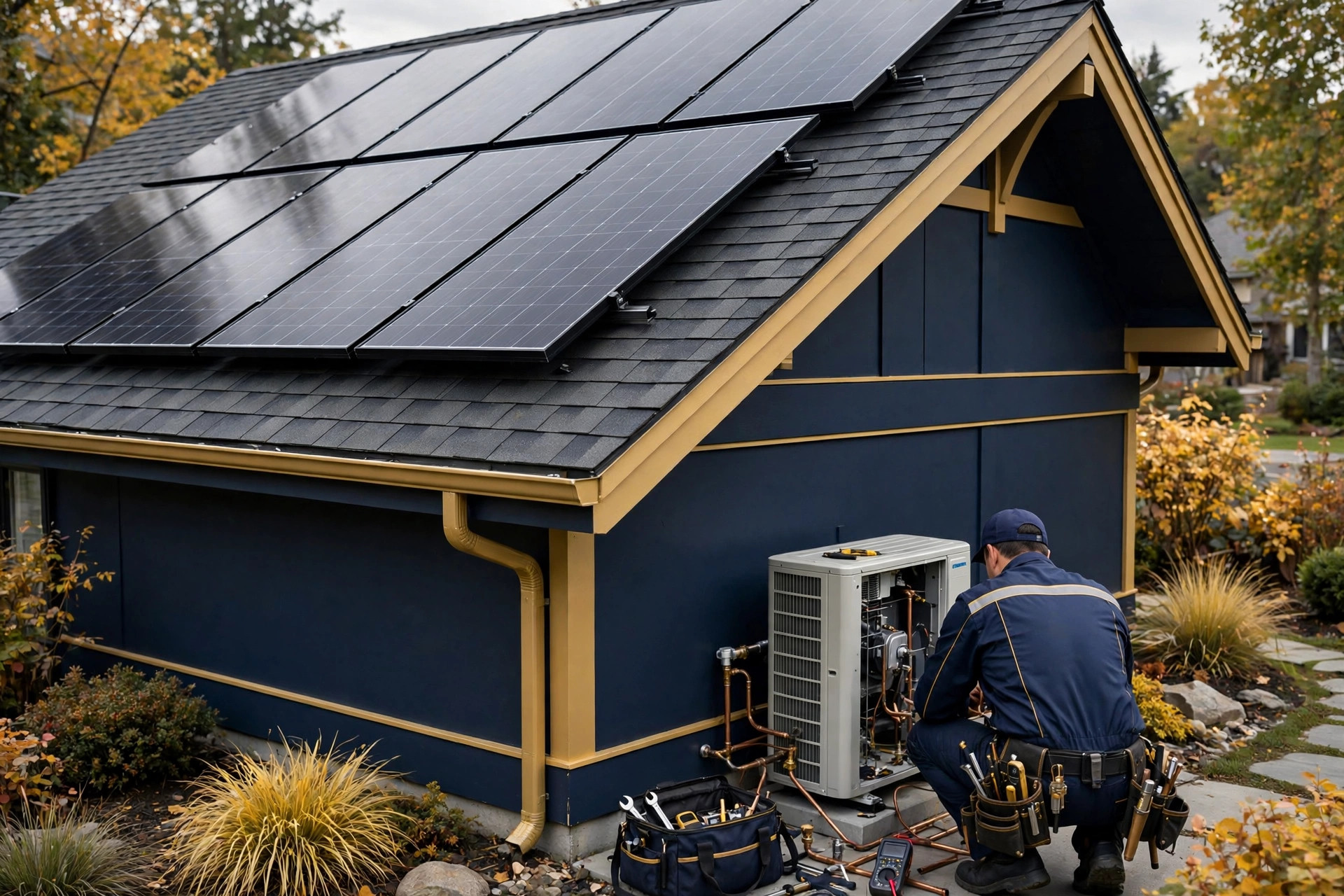
The VA's list: solar heating systems (including solar domestic hot water), solar heating and cooling systems, caulking and weather-stripping, furnace efficiency modifications, clock thermostats, new or additional ceiling, attic, wall, and floor insulation, water heater insulation, storm windows and doors (including thermal windows and doors), heat pumps, and vapor barriers — plus the honest catch-all, "other energy related improvements may also be considered."
Two practical notes. First, improvements must be cost-effective and reasonable for the property — the upgrade has to make sense for the house. Second, you may do the labor yourself, but then the loan increase is limited to materials cost. Your sweat equity doesn't get financed; the supplies do. And as with everything in a VA transaction, the finished work must leave the property meeting VA minimum property requirements.

How does the money move? Escrow, timelines, and unfinished work
Most EEM work happens after closing. If improvements aren't complete before closing, the lender may establish an escrow or earmarked account and close anyway — a formal escrow isn't required, and only the amount needed for the work is withheld. Generally, improvements should be completed within 6 months of the closing date. When the work is done, the lender notifies VA in writing and confirms the funds were properly applied.
If the work never gets done, the balance of the escrowed funds is applied to reduce the loan's principal balance, with written notice to VA. The money doesn't vanish and doesn't become spending cash — it pays down your mortgage.
What does an EEM cost you?
- No down payment on the improvement amount. The EEM dollars are folded into your VA loan. A $4,500 insulation and window package doesn't ask for a check at closing.
- The VA funding fee covers the whole loan. It's calculated on the total mortgage amount including improvement costs — a real but small cost against the utility savings. Veterans exempt from the funding fee pay nothing on the EEM amount either. (Here's who pays the funding fee and who doesn't.)
- Possible extras. An energy audit or HERS report has its own fee when your tier needs one, and some lenders charge added processing, inspection, or escrow fees. Get these in writing up front — they're allowable closing costs, not surprises.
A Jacksonville example: the numbers without the jargon
Why this matters in Northeast Florida right now: JEA raised residential electric rates 8.2% effective October 1 — its second increase in under a year — to fund a roughly $1.6 billion natural gas plant. Florida households average about 1,100 kilowatt-hours a month versus about 860 nationally, per 2024 federal energy data, and the average Jacksonville electric bill now runs about $282 a month per current EnergySage data. Here, the air conditioner is a line item.
Picture a veteran buying a 1978 concrete-block ranch on the Southside. Clean inspection, but a tired attic and August JEA bills pushing past $300 with the AC running nonstop. The Tier 1 play: blown attic insulation plus full weather-stripping and sealing — contractor bid $2,800. Under $3,000 means documented costs only — no savings test, no extra appraisal. Federal energy guidance credits insulation and air sealing with cutting energy costs roughly 10% a year — about $30 a month on a $300 bill, roughly $360 a year, for a project that cost zero out of pocket at closing.
Go bigger — add thermal windows for a $5,200 total — and you're in Tier 2: the lender verifies the monthly payment increase against audit-documented monthly utility savings. Energy Star data puts average annual savings from replacing single-pane windows around $500. If the audit's savings cover the payment bump, the tier clears. Caveat, stated plainly: audit savings are estimates, not guarantees — but the tiers force the math to work before the money moves.

Why Jacksonville veterans should look at this now
Two local factors sharpen the case. First, the JEA trajectory: two rate hikes in under a year, with heavy infrastructure spending behind them — today's utility bill is likely the cheapest you'll see for a while, so improvements that pay for themselves now only look better as rates climb. Second, the housing stock: big stretches of Jacksonville, Orange Park, and the Beaches date to the 1960s–80s — block construction, thin attics, original single-pane windows, aging ducts. Those homes start from the least efficient baseline, which is where a few thousand dollars of upgrades produces the biggest savings. (And if you're eyeing windows before storm season: energy-rated hurricane windows can serve double duty — just confirm the energy specs, since storm rating alone isn't the program's test.)
How to ask your lender about an EEM — and why the lender matters
Bring it up at the beginning of the process. The improvement amount must be structured into the loan from the start, bids documented, and the tier determines the paperwork — a lender hearing about the EEM the week before closing will say it can't be done in time.
And here's the part that matters most: the EEM lives in the actual VA Lender's Handbook — Chapter 7, Section 3. It's agency guideline, not a perk a bank can overlay with extra requirements. Plenty of lenders either don't know it exists or quietly add their own restrictions. We work from the real VA guidelines and broker across 200 lenders — so one lender's overlay saying "no" is one lender's answer, not the VA's. If you're eligible for a VA loan and the house could use energy improvements, you're allowed to ask. So ask.
Discussion question: If you could roll ONE energy upgrade into your VA loan at closing — a new AC, attic insulation, hurricane-rated windows, or solar — which would you pick, and what's been stopping you? Drop your answer in the comments; I read every one.
Start Here
Curious whether an EEM fits your purchase or refinance? Take the 60-second quiz — Start Your VA Loan Quiz — or go straight to Apply Now and we'll review your scenario against the actual VA guidelines, EEM tiers included.
Douglas Wilkerson — NMLS #1680719
Mortgage Broker
Direct: (904) 517-4049 | Office: (904) 906-8869
[email protected] | [email protected]
1548 the Greens Way, Ste. 4, Jacksonville Beach, FL 32250
Freeman Douglas Corporation is a DBA of Edge Home Finance. This is not a promise to lend — all credit decisions are subject to approval. Douglas Wilkerson, NMLS #1680719 | Edge Home Finance, NMLS #891464. Verify licensing at nmlsconsumeraccess.org. Equal Housing Opportunity.
