

Every VA homebuyer falls in love with the same two words: zero down. Then the Loan Estimate lands, and there's a line item nobody mentioned during the sales pitch: the VA funding fee — on a $300,000 Jacksonville purchase, that's $6,450 on your first VA loan, or $9,900 if you've used the benefit before. What stings most is this: thousands of veterans qualify to pay $0 and never find out until after they've already paid it.
Let's fix that. Here's the actual 2026 funding fee chart, the five exemption categories, whether you should pay the fee at closing or roll it in, and the refund most veterans never claim.
The Short Answers
- How much is the VA funding fee in 2026? For a purchase with less than 5% down: 2.15% of the loan amount on first use, 3.3% on subsequent use. Five percent down drops it to 1.5%; 10% down drops it to 1.25%. VA streamline refinances (IRRRL) are 0.5%.
- Who doesn't have to pay it? Veterans receiving VA disability compensation, those eligible for compensation but drawing retirement or active-duty pay instead, service members with a pre-discharge proposed rating before closing, DIC-eligible surviving spouses, and active-duty Purple Heart recipients.
- Can you roll it into the loan? Yes — most borrowers finance it. The fee is calculated on your base loan amount before the financed amount is added, and financing it raises your balance, not your rate.
- Can you get it refunded? Yes. If your disability rating comes through after closing with an effective date before your closing date, the VA owes you that money back. Call your VA regional loan center at (877) 827-3702.
What Is the Funding Fee — and Why Does It Exist?
The funding fee is a one-time payment to the Department of Veterans Affairs. It does two jobs: it keeps the VA loan program running for the next generation of veterans, and it reduces the cost to taxpayers. That's the trade the VA made decades ago: no down payment and no monthly mortgage insurance, in exchange for a single upfront fee.
Compare that to conventional or FHA. Private mortgage insurance runs every single month until you hit 20% equity — on a $300K home that can mean years of monthly payments totaling far more than the fee. FHA's mortgage insurance often lasts for the life of the loan. The VA funding fee is paid once and it's done.
One more thing worth knowing: this fee structure has been in place since April 7, 2023, when the VA unified the rates. Before that, active-duty veterans and Guard/Reserve members paid different percentages for the same down payment tier. Now everybody pays the same — which is exactly the kind of simplification the actual guidelines make when you read them instead of the lender memos.
The 2026 VA Funding Fee Chart
Your fee depends on three things: loan type, down payment, and whether it's your first VA loan or a subsequent use. Here are the current numbers:
| Loan type / down payment | First use | Subsequent use |
|---|---|---|
| Purchase, less than 5% down | 2.15% | 3.30% |
| Purchase, 5% to 9.99% down | 1.50% | 1.50% |
| Purchase, 10% or more down | 1.25% | 1.25% |
| Cash-out refinance | 2.15% | 3.30% |
| IRRRL (streamline refinance) | 0.50% | 0.50% |
| VA loan assumption | 0.50% | 0.50% |
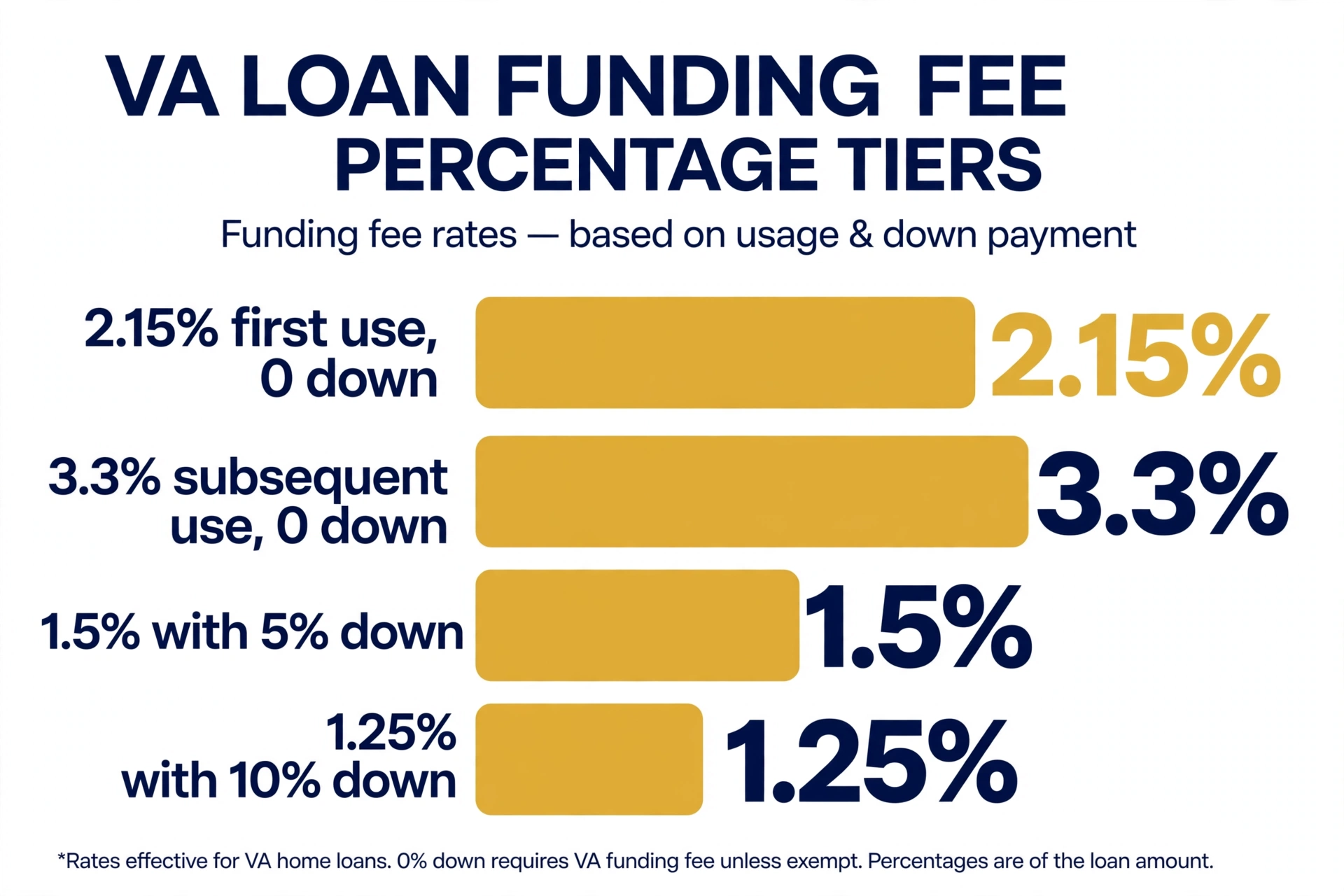
Notice the pattern: your down payment cuts the fee more than almost anything else you control. On a $300,000 purchase, putting 5% down means a $285,000 base loan and a 1.50% fee — $4,275 instead of $6,450. Ten percent down takes the base to $270,000 and the fee to 1.25% — $3,375. The difference between 2.15% and 1.50% alone is $3,250 on a $500,000 loan.
Why Does Your Second VA Loan Cost More?
It's the single most common surprise in this program. First use with zero down: 2.15%. Subsequent use with zero down: 3.30%. On a $300,000 loan, that's $6,450 versus $9,900 — a $3,450 penalty for being a repeat customer.
Here's what resets it: entitlement restoration. If you sell the home and pay off the VA loan in full, you can apply to restore your entitlement — and once restored, your next VA loan is treated as a first use again, back to the 2.15% tier. This is one of the reasons restoration matters beyond just freeing up buying power; it literally reprices your fee. (I wrote the full playbook on reusing your VA loan here — start there if you've used the benefit before.)
Who Pays $0? The Five Exemptions
The VA exempts five groups from the funding fee entirely. Your exemption status shows on your Certificate of Eligibility — and if your status can't be verified before closing, the fee gets charged as if you weren't exempt. Check early.
- Veterans receiving VA compensation for a service-connected disability. This is the big one — any level of disability compensation, even 10%, waives the fee.
- Veterans who would be entitled to that compensation but receive retirement or active-duty pay instead. The eligibility counts even if the paycheck comes from a different line.
- Service members with a proposed or memorandum rating before the closing date. If you filed a pre-discharge claim and the rating is proposed before you close, you're exempt.
- Surviving spouses entitled to Dependency and Indemnity Compensation (DIC). This covers spouses of veterans who died in service or from a service-connected disability — whether or not they're currently receiving the compensation.
- Active-duty service members who provide evidence of a Purple Heart on or before the closing date.

The pending-claim rule nobody tells you: if your disability claim is still in the VA's hands when you're shopping, tell your lender up front. A rating finalized before closing can waive the fee. And if the rating lands after closing with an effective date before your closing date, you didn't lose — you get the refund.
The Refund Most Veterans Never Claim
Here's the scenario: you closed with the fee because your claim was pending. Three months later, the VA awards your rating — and the effective date is before your closing. The VA now owes you that fee back. You call your VA regional loan center at (877) 827-3702 (weekdays, 8 AM to 6 PM ET) and request the refund.
How many veterans know this? Far fewer than have claims pending at closing. If you're rated after you close, check that effective date. Money is money.
Should You Pay the Fee at Closing or Roll It Into the Loan?
You have three real options:
- Pay it at closing. The cheapest option over the life of the loan — you never pay interest on the fee. But $6,450 in cash at closing isn't nothing.
- Finance it into the loan. This is what most buyers do. On that $300,000 first-use purchase, your loan becomes $306,450. Important mechanics: the fee is calculated on your base loan amount before the financed amount is added, and financing it raises your balance — not your rate.
- Have the seller cover it. VA allows sellers to contribute up to 4% in concessions (funding fee, prepaids, points, buydown subsidies). On $300,000, that's $12,000 of room — the fee fits easily, and it's negotiated into your purchase contract.
There's no universally right answer — it depends on your cash position and your plans for the house. What there isn't is a reason to avoid the conversation. This is one line of the Loan Estimate; it shouldn't drive the decision about whether the home is right for you.
Real Jacksonville Math
Let's put the whole thing on one $300,000 Jacksonville purchase — right at the area's median sold price:
- First VA loan, $0 down: 2.15% × $300,000 = $6,450. Financed, the loan becomes $306,450.
- Second VA loan, $0 down: 3.30% × $300,000 = $9,900. Restoration resets this to the 2.15% tier.
- First use, 5% down ($15,000): 1.50% × $285,000 = $4,275.
- First use, 10% down ($30,000): 1.25% × $270,000 = $3,375.
And remember what the fee replaces: a conventional buyer with less than 20% down pays monthly private mortgage insurance — often hundreds of dollars a month for years. The VA fee is paid once. On most holding periods, the VA borrower wins that comparison by a mile.
The Overlay Trap
Here's where a mortgage broker with 200 lenders earns his keep. The VA's guidelines on the funding fee are straightforward — the chart, the exemptions, the refund rule. But lenders layer their own overlays on top of the guidelines: one shop's underwriter "doesn't do" exemptions without a final rating letter, another one tells you the fee can't be financed past some internal cap. One lender's overlay is never the last word.
If a lender told you that you're stuck paying 3.3%, or that your pending claim doesn't count, or that the fee has to come out of your pocket at closing — the actual VA guideline may say otherwise, and another lender may run it differently. I have 200 lenders to choose from. The question is always the same: what are the actual guidelines, and which lender executes them cleanly for your file?
Related Reading
- VA Loans in a 7% World: The 2026 Playbook for Veterans
- Can You Use a VA Loan More Than Once? Entitlement, Restoration, and Second-Tier Entitlement
- The VA Loan Test That Has Nothing to Do With Your Credit Score: Residual Income
- VA Loan Assumption: How Any Buyer Can Take Over a Veteran's 3% Mortgage
Here's the discussion question: if you've used a VA loan, did your lender walk you through the fee chart, the exemptions, and the refund rule — or did the funding fee just show up as a line item you were expected to accept? Drop your story in the comments. The gap between what the guidelines say and what borrowers hear is exactly what this blog exists to close.
Start Here
Find out what your VA loan actually costs — fee, payment, and eligibility — in about 60 seconds:
Check Your VA Eligibility — 60-Second Quiz
Or go straight to the application: Apply Now
Douglas Wilkerson — Mortgage Broker, NMLS #1680719
Direct: (904) 517-4049 | Office: (904) 906-8869
[email protected] | [email protected]
1548 the Greens Way, Ste. 4, Jacksonville Beach, FL 32250
Freeman Douglas Corporation is a DBA of Edge Home Finance. This is not a promise to lend — all credit decisions are subject to approval. Douglas Wilkerson, NMLS #1680719 | Edge Home Finance, NMLS #891464. Verify licensing at nmlsconsumeraccess.org. Equal Housing Opportunity.
