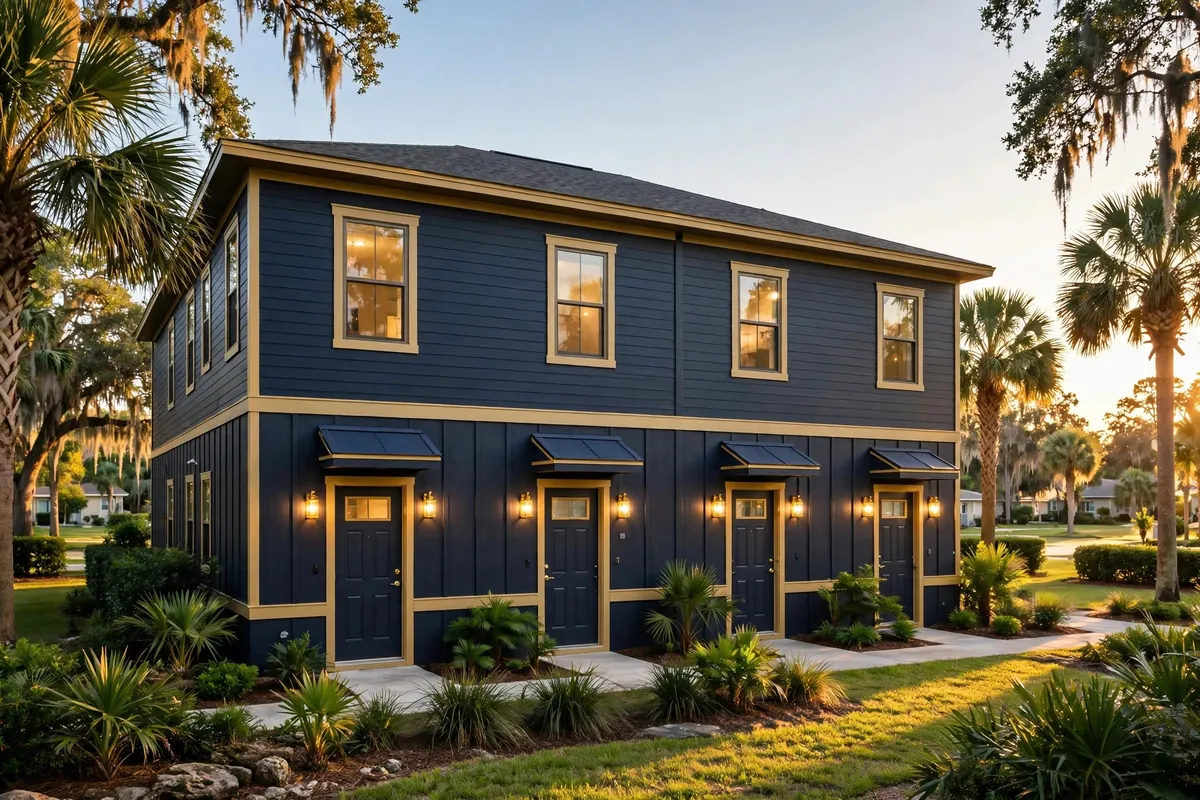
Buy a Fourplex With $0 Down: How VA House Hacking Works in 2026
Short answers: Yes — an eligible veteran can use a VA loan to buy a 2-to-4-unit property with $0 down, as long as they move into one unit within 60 days of closing. The VA charges no monthly mortgage insurance, and projected rental income from the other units can help you qualify (lenders typically count 75% of appraiser-supported market rent). The 2026 first-use funding fee is 2.15% of the loan at $0 down, usually financed into the mortgage. Below is the full playbook — rules, the Jacksonville math, and how VA stacks up against FHA and conventional.
House hacking with a VA loan: the short version
House hacking means buying a small multi-unit property, living in one unit, and renting out the rest. For an eligible veteran, the VA loan turns this into one of the most powerful entries into real estate that exists: up to four units with no down payment, no monthly mortgage insurance, and a rate advantage over conventional pricing.
Here is why it works. On a $450,000 Jacksonville triplex, you live in one unit and rent the other two. Your loan is a standard VA purchase loan — the same benefit you would use on a single-family home. The rents from the other units don't pay the whole mortgage on day one, but they offset most of it, and every month your equity grows while someone else's rent helps carry the payment.
What the VA actually allows
Let's start with the actual guidelines — not the bank overlays you'll hear from some lenders.
- Up to 4 units plus one business unit. VA guidelines allow financing of up to four residential units, plus one business unit. Two veterans buying together can go up to six residential units plus one business unit.
- You must live in one unit. This is a primary-residence loan, not an investment-property loan. Move into one unit within 60 days of closing, and intend to stay about 12 months. Life happens — PCS orders and legitimate changes don't violate the rule as long as the original intent was real.
- $0 down. With full entitlement, there is no VA loan cap in 2026 and no down payment on any of the units. (For context, the FHFA's 2026 conforming baseline is $832,750 for a 1-unit home, $1,066,250 for a 2-unit, $1,288,800 for a 3-unit, and $1,601,750 for a 4-unit — the multi-unit limits step up right along with the strategy.)
- No PMI — ever. VA loans have no monthly private mortgage insurance. There is a one-time VA funding fee instead: 2.15% of the loan amount at $0 down for first-time use, 3.3% for subsequent use. Put 5% down and the fee drops to 1.5%; 10% down takes it to 1.25%. A VA streamline refinance (IRRRL) carries just 0.5%. Veterans with a service-connected disability rating pay $0 — full exemption. Here's the full 2026 fee breakdown.
- The whole property must meet VA Minimum Property Requirements. Every unit — not just yours — has to pass the VA appraisal: safe, structurally sound, sanitary. Peeling paint, roof leaks, exposed wiring, bad plumbing — all of it applies across all four units.
Rental income: how lenders actually count it
Here's the part most articles get wrong. The VA itself does not publish a fixed "we count 75%" rule — that number comes from how lenders underwrite it. In practice, your lender will document expected rent one of two ways:
- An appraiser's small-income-property report (Form 1025) establishing fair market rents for the units, or
- Signed lease agreements on the non-owner units, when they exist.
Most lenders then count 75% of that gross rent as qualifying income — the 25% haircut covers vacancy and maintenance. Some lenders add overlays: six months of mortgage reserves, or documented landlord experience (a property manager can substitute). This is exactly where my "one lender's overlay is never the last word" rule earns its keep — I broker through 200+ lenders, and a rental-income overlay at one lender is a non-issue at another. If you've been told your rents "don't count," get a second opinion before you believe it.
Residual income and the 41% DTI: VA's two affordability tests
The VA runs two checks other loan programs don't. The 41% debt-to-income ratio is a guideline, not a hard ceiling — strong residual income can carry a file past it.
Residual income is what remains each month after the full housing payment, taxes, utilities, and debts. Florida sits in the VA's South region. For loans of $80,000 and up, the 2026 minimums are: family of 1, $441; family of 2, $738; family of 3, $889; family of 4, $1,003; family of 5, $1,039; add $80 for each additional member. If your DTI runs above 41%, lenders generally want residual income at least 20% above those figures. Here's the house-hacking angle: because the VA counts a chunk of your rental income, your residual income on a multi-unit file often looks better than it would on a single-family purchase at the same price.
The Jacksonville math: a real $450,000 triplex
Numbers time. These are illustrative — your rate and rents will differ — but the mechanics are real. Jacksonville's market as of mid-October 2026: median sale price around $312,000 (down about 1.4% year over year), homes taking roughly 43 days to go under contract, about 5.9 months of supply — a roughly balanced market with negotiating room. Small multi-units trade above the single-family median; $450,000 is a realistic Jacksonville triplex price.
The setup: VA loan, $0 down, first use. Purchase price $450,000. Funding fee 2.15% = $9,675, financed into the loan, so the loan amount is $459,675. VA 30-year purchase averages sat around 6.89% in early October 2026 (daily lender-marketplace averages; Freddie Mac's weekly survey had conventional 30-year at 7.40% for the week ending October 8).
- Principal & interest (6.89%): $3,024/month
- Property taxes (~1.05% of value): ~$394/month
- Homeowner's insurance (Florida, ~$3,000/yr): ~$250/month
- Total PITI: ~$3,668/month
You live in one unit and rent the other two. Jacksonville triplex rents around $1,550 per unit give you $3,100/month in gross rent.
- Net out of pocket: ~$568/month — for a property you own.
- For qualifying: ~$2,325/month (75% of $3,100) counts toward your income on the application.

Read that again: your housing cost drops to the price of a modest apartment — except you're building equity, capturing appreciation, and taking the tax treatment of an owner. And when the leases renew, you can move into a single-family home later (using remaining or restored entitlement — VA entitlement can be reused) and keep the triplex as a full rental.
VA vs. FHA vs. conventional: the house-hacking scorecard
| VA | FHA | Conventional (Fannie Mae) | |
|---|---|---|---|
| Minimum down (owner-occupied 2–4 unit) | $0 | 3.5% (~$15,750 on $450K) | 5% (~$22,500 on $450K) |
| Monthly mortgage insurance | None | Annual MIP ~0.55%/yr (~$203/mo on this example) | PMI required under 20% down |
| Self-sufficiency test (3–4 units) | No | Yes — PITIA ÷ net self-sufficiency rental income must not exceed 100% (rents from ALL units, including yours, minus at least 25% vacancy/maintenance) | No |
| Rental income counted | Yes — typically 75% of appraiser market rent or leases | Yes, subject to the self-sufficiency test on 3–4 units | Yes — 75% of market rent or leases; 6 months reserves required |
| Rate position | Usually the best of the three — VA pricing runs below conventional averages | Often slightly below conventional | PMMS 30-yr benchmark: 7.40% (week ended Oct 8, 2026) |
The comparison tells the story. FHA's 3.5% down looks attractive until the self-sufficiency test disqualifies the property — the test trips up most 3-4 unit deals in higher-priced markets. Conventional went from 15% down on 2-units and 25% on 3-4 units to 5% down (Fannie Mae, since late 2023) — a real improvement — but you still need $22,500 cash and you pay PMI. VA is the only lane with $0 down, zero monthly MI, and no self-sufficiency test.
Who this fits — and the honest caveats
This fits a veteran or active-duty buyer who is comfortable being a live-in landlord: screening tenants, handling repairs, collecting rent, keeping reserves. You're not buying a passive investment — you're buying your home with roommates who pay you. If you PCS in a few years, the property can convert to a full rental; just plan for that possibility up front.
The honest caveats: every unit must pass VA Minimum Property Requirements, so the charming-but-tired 1960s quadplex may need work before it can close. Florida insurance costs are real — shop them early. Lender overlays on rental income vary wildly, so if one lender counts your rents harshly, the next may not. And multi-unit inventory in Jacksonville moves in a balanced market — when a clean triplex lists at a fair number, have your pre-approval ready before you tour it.

Start Here
Ready to see if your numbers work? Check Your VA Eligibility — 60-Second Quiz. Ready to move? Apply Now — or call/text (904) 906-8869.
Let's talk about it
Here's my question for you: if you could buy a Jacksonville triplex with $0 down and have your tenants cover most of the payment, would you rather live in the triplex — or keep renting and let someone else build the equity? Drop your answer in the comments.
Contact
Douglas Wilkerson
Mortgage Broker, NMLS #1680719
Freeman Douglas Corporation (DBA of Edge Home Finance, NMLS #891464)
Jacksonville Beach, FL
Direct: (904) 517-4049 | Office: (904) 906-8869
[email protected] | [email protected]
Everything I know about mortgages lives on my website — freemandouglas.com. Go learn it all.
Freeman Douglas Corporation is a DBA of Edge Home Finance. This is not a promise to lend — all credit decisions are subject to approval. Douglas Wilkerson, NMLS #1680719 | Edge Home Finance, NMLS #891464. Verify licensing at nmlsconsumeraccess.org. Equal Housing Opportunity.
