The Mortgage Blog: Rates, VA Loans and Jacksonville Homebuying, Explained
Mortgage rate updates, VA loan guides and Jacksonville homebuyer playbooks from Douglas Wilkerson, Mortgage Broker at Edge Home Finance (NMLS #1680719) — current, researched and written in plain English. Call (904) 517-4049 with a question, and start with the guides below.
Home › Resources › Mortgage Blog
What this blog covers
The Freeman Douglas mortgage blog is where rate news meets real Jacksonville homebuying. Douglas Wilkerson, Mortgage Broker at Edge Home Finance (NMLS #1680719) and a Marine Corps veteran, writes it the way he talks to borrowers: current, researched, and with no bank-speak.
Here is what you will find, updated as the market moves:
- Mortgage rate updates — what changed, why it changed, and what it means for your payment. Check the current mortgage rates before you read the commentary.
- VA loan guides — the VA homeownership affordability angle in plain English: entitlement, the funding fee, and how to buy with $0 down. Start with VA home loans.
- Jacksonville homebuyer playbooks — step-by-step guides for first-time buyers, move-up buyers and relocating veterans, built around Northeast Florida neighborhoods. New buyers should also read the first-time homebuyer guide and the mortgage learning center.
Every post ends the same way: a clear next step. If a question is not answered here, the mortgage FAQs usually cover it — or call Douglas directly at (904) 517-4049. Below, the latest published posts appear first.
Latest posts
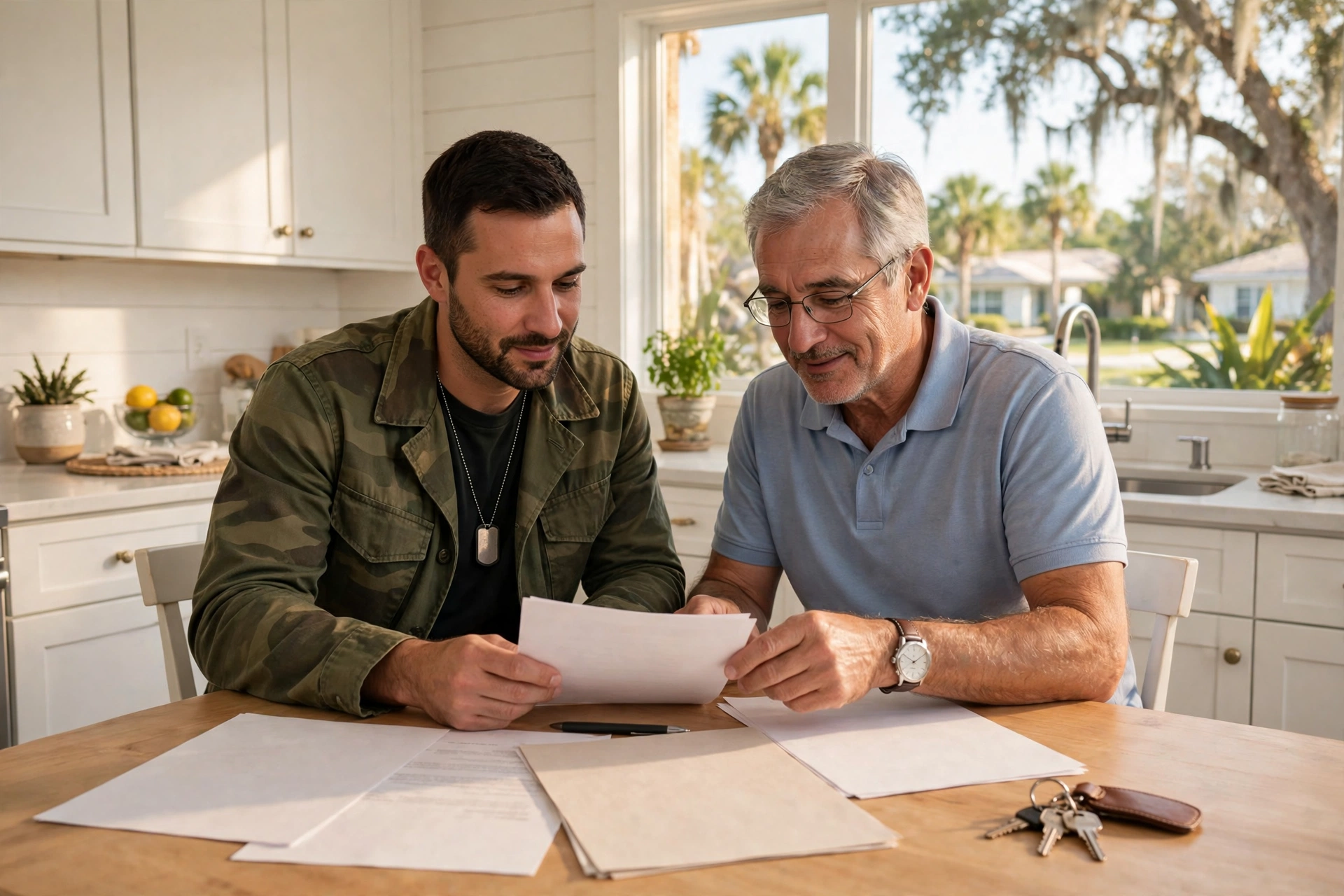
Can Someone Cosign Your VA Loan? Who Can Sign, What They're Really On the Hook For, and How to Get Them Off
The short answer
Yes — but probably not the way you mean it. The VA loan program has no standalone "cosigner" the way a car loan does. There is no box where a parent signs as a guarantor, stays off the title, and rides along just to strengthen your file. On a VA purchase, anyone who signs the note and owns the home with you is a co-borrower — and if that person is not your spouse, the loan becomes a joint loan under the VA Lenders Handbook (VA Pamphlet 26-7, Chapter 7, Topic 1): VA prior approval before closing, the guaranty covering only the veteran's share, and a funding fee charged only on the veteran's share. Your spouse is the exception — a veteran buying with a non-veteran spouse is not a joint loan, and gets the full guaranty on the whole loan. So the real question is never "can someone cosign?" It is "who is signing, what does that make them, and what are they on the hook for?"
A cosigner on a VA loan is a co-owner — on the note and on the title.
What "cosigning" actually means on a VA loan
On a conventional loan, cosigning usually means a second person guarantees the debt, often without owning the property. The VA program does not work that way: the handbook's joint-loan definition turns on two facts together — the person is liable on the note and holds title to the property. A pure guarantor who is not on title is generally not available on a VA purchase.
That single fact reframes every "can my dad cosign?" conversation. Your dad is not lending you his credit score for a signature. He is becoming a co-owner of your home, jointly liable for the full mortgage, with his name on the deed and the debt on his credit report. The rules change completely depending on who the second borrower is — which is what the table below lays out.
Who can cosign a VA loan?
Almost anyone can be the second borrower — the VA publishes no list of approved relationships. What matters is the category, because the category decides the rules:
| Who is signing with you | Joint loan? | VA prior approval? | Guaranty |
|---|---|---|---|
| Non-veteran spouse | No | No | Full guaranty on the whole loan |
| Fiancé(e) who marries before closing | No — treated as a spouse | No | Full guaranty on the whole loan |
| Parent, sibling, adult child, friend, unmarried partner | Yes | Yes | Veteran's share only |
| Another veteran not using entitlement | Yes | Yes | Using veteran's share only |
| Two veterans, both using entitlement | Yes — two-veteran joint loan | No, if the lender has automatic authority | Whole loan, up to combined entitlement |
Two details surprise people. First, the fiancé(e) rule: a loan to a veteran and a fiancé who intend to marry before closing and take title as veteran and spouse is treated as a loan to a veteran and spouse — conditioned on the marriage happening. Second, the two-veteran row: when two veterans both use their entitlement on the same purchase, the guaranty covers the whole loan and no prior approval is needed. That is why the joint VA loan we built for Daniel Del Valle and Freddy Perdomo, two veterans buying a multi-family property together, runs on a cleaner track than a veteran-plus-parent file.
One more thing the handbook is blunt about: some lenders simply do not offer veteran/non-veteran joint loans at all. The handbook notes this may look like marital-status discrimination, but a lender may refuse without violating the Equal Credit Opportunity Act, because VA is a special purpose credit program. That refusal is legal — a lender policy, not a VA denial. With 200 lenders to shop, a "no" from one lender's policy book is never the last word on your file.

Signing as a cosigner means signing the note. There is no lighter version of it.
What the cosigner is actually on the hook for
This is the part that usually gets skipped, and it matters most. A cosigner on a VA loan is jointly liable for the entire loan — not their half, the whole balance:
- The full payment is their legal obligation. If the veteran misses a payment, the lender comes to the cosigner for all of it. Joint liability does not split the bill.
- Missed payments hit both credit reports — same tradeline, same damage.
- The debt counts against the cosigner's borrowing power. When the cosigner applies for their own mortgage, car loan, or credit card, the full monthly payment counts in their debt-to-income ratio — a parent who cosigns a $350,000 VA loan may find their own next purchase harder to qualify for until this loan is gone.
- They own the home. The cosigner is on the title, with ownership rights — and they cannot be removed from the title by the veteran alone. Selling or refinancing needs their cooperation.
- Foreclosure follows both borrowers — and the VA's guaranty covers only the veteran's share.
None of that is a reason not to cosign — for a veteran buying a first home it can be the difference between closing and waiting another year. But cosign with your eyes open, and have the exit conversation before closing.
The income and credit rules are not symmetric
Here is the rule that kills more cosigned VA files than any other, straight from Chapter 7: on a veteran/non-veteran joint loan, the veteran's credit must be satisfactory, the veteran's income must be enough to repay the veteran's portion of the loan, and the non-veteran's credit must be satisfactory too. The income help only flows one direction — the veteran's income can compensate for the non-veteran's weakness, but the non-veteran's income cannot compensate for the veteran's weakness.
It is the opposite of how most people imagine cosigning works. The usual story is "my income is short, so my dad cosigns and his income fixes it." On a VA joint loan, that story fails: if the veteran's own income cannot carry the veteran's share, the cosigner's income does not rescue the file. On credit, nobody rescues anybody — both borrowers need satisfactory credit, full stop. On a two-veteran joint loan the rule is kinder: combined income and assets are evaluated together.
What it costs: the guaranty, the fee, and the down payment
The VA guaranty on a joint loan covers only the veteran's share: divide the loan by the number of borrowers, and the guaranty is 25% of the veteran's portion when the veteran has full entitlement and the loan is above $144,000. The non-veteran's share carries no VA backing at all.
Because the guaranty reaches only about half the loan on a two-borrower file, the secondary market expects the guaranty plus the down payment to reach 25% of the price before the loan can be pooled — which is why a down payment is usually part of a joint VA loan even though VA sets no down-payment percentage. We worked the exact math on a $400,000 purchase in Can You Buy a Home With a VA Loan and an Unmarried Partner? — and the answer is not the "12.5% down" shorthand you will see online.
The funding fee follows the same split: charged only on the portion tied to a veteran using entitlement who is not exempt — nothing on the non-veteran's portion, nothing on a veteran who did not use entitlement. The handbook allocates the loan amount equally between borrowers for the fee calculation, no matter who paid the down payment. Its own example: a non-veteran puts $5,000 down on a $100,000 purchase, the loan is $95,000, and the veteran pays the fee on a $47,500 portion — half the loan. At the first-use rate of 2.15% (VA.gov, rates effective April 7, 2023, still current), that fee is $1,021.25. The standard grid: 2.15% first use and 3.30% subsequent use under 5% down, 1.50% at 5% or more, 1.25% at 10% or more. Veterans receiving VA disability compensation are exempt — and if a rating comes through with an effective date before closing, the fee can be refunded (see You Paid the VA Funding Fee — but Did You Owe It?).

Run the numbers with everyone in the room before anyone signs.
How cosigning interacts with entitlement
Entitlement is where cosigning gets misunderstood in both directions. Three rules:
- The using veteran's entitlement is charged by the guaranty amount — for the guaranty on their share, not the whole loan. The rest stays available.
- A veteran who cosigns without using entitlement keeps their entitlement. If a veteran parent signs as the non-using co-borrower on their child's VA loan, their entitlement is not charged and no funding fee applies to their portion. But they are still fully liable on the debt, and it counts in their debt-to-income ratio when they later use their own benefit.
- Two veterans can stack entitlement. On a two-veteran joint loan with both entitlements in use, the guaranty is calculated on the total loan amount and the charge is divided between them — the structure behind our joint VA loan post.
One related case: a veteran cosigning a non-VA loan — say, a parent veteran cosigning a child's conventional or FHA loan — does not touch their VA entitlement at all, because the VA program is not involved. The liability and credit consequences are the same, but no VA rules apply.
How to get a cosigner off the loan later
There is no form that removes a cosigner from a VA loan. Both names stay on the note until the loan itself changes. Two real exits:
- Refinance in the veteran's name alone. Once the veteran's income, credit, and equity support the loan solo, a VA Interest Rate Reduction Refinance Loan (IRRRL) or a standard VA refinance in the veteran's name alone replaces the joint loan — and the cosigner walks away clean. Plan for this at the purchase: the goal is not to need the cosigner forever, only until the veteran's file can stand alone.
- Assumption by a qualifying veteran. A qualified veteran can assume the loan and substitute their own entitlement, releasing the original veteran's entitlement and the cosigner with it. A non-veteran assumption is possible with VA and lender approval, but it does not restore entitlement.
What does not work: asking the lender to take a name off, or signing a side agreement between family members. The liability ends when the loan ends or is replaced — not before. Put the exit in writing before closing. Especially in families that trust each other completely.
Source → Our Take → Next Step
Source: VA Lenders Handbook, VA Pamphlet 26-7, Chapter 7, Topic 1 (Joint Loans) — prior approval, the guaranty-on-the-veteran's-share math, the one-direction income rule, the funding-fee allocation, and the ECOA special-purpose exemption; governing regulation 38 CFR 36.4308, prior-approval procedures per VA Circular 26-19-13. Funding-fee rates from VA.gov (effective April 7, 2023, still current; page updated October 5, 2026): 2.15% first use / 3.30% subsequent use under 5% down, 1.50% at 5% or more, 1.25% at 10% or more.
Our Take: Cosigning a VA loan is not a favor signature — it is co-ownership with full joint liability, and the VA's rules are built to make sure the veteran can carry their own share. That is a protection, not a punishment. The families who do this well treat it as a bridge with a planned exit — a refinance in the veteran's name alone once the file can stand on its own — and they shop it with a broker who knows which of 200 lenders actually writes joint loans. One lender's policy refusal is never the VA's answer. The guideline is the guideline.
Next Step: If someone is offering to cosign your VA loan — or you are thinking of cosigning for a veteran in your family — get the file looked at before anyone signs anything.
The goal is not to need a cosigner forever — only until the veteran's file can stand on its own.
Here's the question I want to hear from you: if someone in your family offered to cosign your VA loan tomorrow, would you know exactly what you were asking them to sign — and what your exit plan is? Tell me in the comments — or tell me why you would never ask.
Your Next Step
Check Your Rate — Free — see what rate you actually qualify for across 200+ lenders. Free, no credit check, no pressure.
Running the cosigning numbers? Start with the VA loan overview: VA Home Loans — and if a non-spouse is signing with you, read the down-payment math in Can You Buy a Home With a VA Loan and an Unmarried Partner? before you budget.
Prefer to talk it through? Call Douglas direct: (904) 517-4049.
Douglas Wilkerson — NMLS #1680719
Direct: (904) 517-4049
[email protected] | [email protected]
1548 the Greens Way, Ste. 4, Jacksonville Beach, FL 32250
Freeman Douglas Corporation is a DBA of Edge Home Finance. This is not a promise to lend — all credit decisions are subject to approval. Douglas Wilkerson, NMLS #1680719 | Edge Home Finance, NMLS #891464. Verify licensing at nmlsconsumeraccess.org. Equal Housing Opportunity.

Start with these guides
Not sure where to begin? These are the guides readers come back to most. Each one is written in plain language, with real Jacksonville numbers and no bank-speak.
VA home loans — $0 down, no monthly mortgage insurance, and the eligibility rules veterans and active-duty buyers actually need, explained step by step.
First-time homebuyers — From pre-approval to closing day, what to expect when you buy your first home in Jacksonville, including down payment help worth asking about.
Mortgage Learning Center — The deeper library: loan types, credit, appraisals, closing costs and the moving parts of a mortgage, all in one place.
Mortgage FAQs — Short, direct answers to the questions borrowers ask most, from rate locks to how much cash you really need to close.
Mortgage rates — What rates are doing now, what moves them, and how to think about locking versus floating while you shop.
Frequently asked questions
How often are new posts published?
New posts go up regularly, and rate updates appear whenever the market moves enough to matter. Check back often, or call (904) 517-4049 and Douglas will point you to the latest post on your topic.
Are the VA loan guides only for veterans?
They are written for veterans, active-duty service members and eligible surviving spouses, but anyone shopping for a home can learn from them — especially the posts on $0-down options and VA affordability.
Where should a first-time Jacksonville buyer start reading?
Start with the first-time homebuyer guide, then browse the Mortgage Learning Center for the topics that apply to your purchase.
Can I ask Douglas a question or suggest a topic?
Yes. Call (904) 517-4049 with your question or topic idea — reader questions are a regular source of new posts, and you will get a straight answer either way.
Does the blog replace personalized mortgage advice?
No. The blog is general education, not advice about your loan. For numbers based on your credit, income and home price, call (904) 517-4049 for a personalized review.
Ready to talk about your loan?
Reading is a great start — a conversation is better. Call Douglas Wilkerson at (904) 517-4049 to talk through your options, or start with the programs below.
Check Your OptionsExplore Mortgage Programs
Equal Housing Opportunity
Mortgage services are provided by Douglas Wilkerson, Branch Manager and Mortgage Broker with Edge Home Finance Corporation. Loan programs, rates, eligibility, underwriting guidelines and availability are subject to change. All applications are subject to credit review, verification, property eligibility, applicable underwriting requirements and final approval. This website does not constitute a commitment to lend or a guarantee of financing.